Affirmative Action and the Myth of Colorblindness: Constitutional Tensions in Race and Law
Written by: Genesis Dacosta
Edited by: Aiyanna LeGrand and Sophia Stoute
Abstract:
This article discusses the ongoing debate over affirmative action and how it has been shaped by the U.S. legal system. Race-conscious policies were originally designed to address the lasting effects of slavery, segregation, and discrimination, but the legality of these policies has always been called into question. By analyzing key Supreme Court cases like Bakke and Students for Fair Admissions v. Harvard, this paper explores how the idea of a “colorblind” Constitution has gained influence in recent years. While opponents of affirmative action claim it creates unfair advantages, this paper argues that race-neutral approaches often ignore deeper structural inequalities. The future of American law depends on whether courts and policymakers can ensure that race-conscious and race-neutral policies work together to guarantee that marginalized groups aren’t left behind in the pursuit of justice for all.
For decades, affirmative action has been one of the most debated policies in American law and politics. Some argue that affirmative action is necessary to correct historical injustices and ensure equal opportunity, while others claim affirmative action violates the constitutional principle of equal protection by favoring some groups over others. The legal concept of colorblindness precedes this debate by positing that laws should not consider race in any way [1]. This principle, typically cited in opposition to affirmative action, claims to uphold equality but often ignores the structural inequalities that persist in American society. The Equal Protection Clause of the Fourteenth Amendment in the U.S. Constitution has been interpreted by courts and lawmakers in conflicting ways when deciding race-conscious policies [2]. While the Supreme Court has upheld affirmative action in some cases, recent decisions show a shift toward eliminating such measures in favor of race-neutral approaches. Despite claims of fairness, colorblind legal principles fail to address systemic racial disparities, making affirmative action a necessary tool for achieving true constitutional equality.
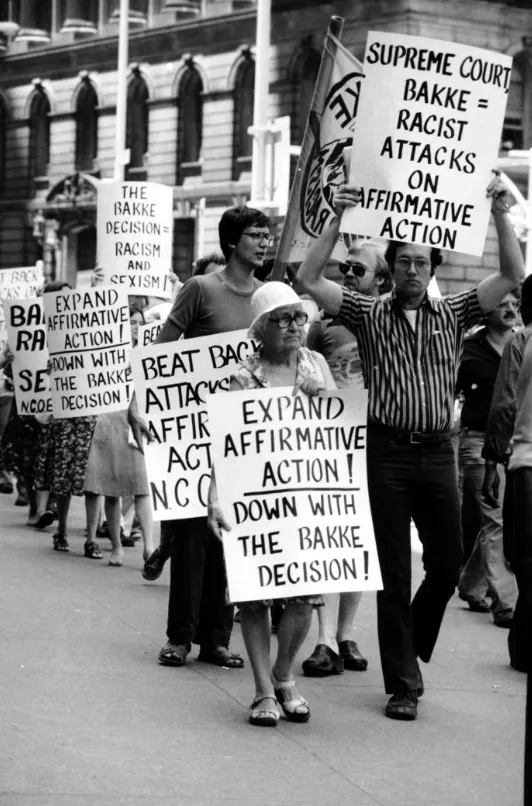
Affirmative action policies were developed as reparations for historical wrongdoings, such as the centuries of racial discrimination that denied marginalized groups access to education and employment opportunities. The Civil Rights Movement of the 1960s pushed for race-conscious policies to address these inequalities, leading to executive orders and legislation that encouraged diversity in schools and workplaces [3]. However, legal challenges soon emerged, with opponents arguing that these policies violated the Equal Protection Clause of the Fourteenth Amendment. The debate over affirmative action started more than 15 years before the 1978 Supreme Court case Regents of the University of California v. Bakke, with many people challenging affirmative action soon after it was introduced in the 1960s [4]. Affirmative action opponents fought these policies by filing lawsuits, claiming "reverse discrimination," and pushing for changes in government and workplace policies. Some liberals were not fully against it. Instead, they strove for a softer approach, like recruitment, financial aid, and extra support programs while opposing stricter methods, like setting numerical goals or quotas [5]. These ideas of colorblindness and meritocracy were increasingly promoted by affirmative action opponents after the rejection of medical school applicant Allan Bakke [6]. Allan Bakke, a white 35-year-old man, was denied admission to the University of California Medical School at Davis. The University of California at Davis reserved sixteen out of one hundred spots in each medical school class for minority students as part of its affirmative action program. This program was created to address past discrimination that had kept minorities out of the medical field. Allan Bakke argued in court that he was denied admission because of his race. The Supreme Court ruled that race could be considered in admissions to promote diversity but rejected strict quotas, a decision that set the foundation for future legal challenges against affirmative action [7]. More recent rulings, including Students for Fair Admissions v. Harvard (2023), have veered toward limiting race-conscious policies. In June 2023, the U.S. Supreme Court ruled against race-based affirmative action in college admissions [8]. The Supreme Court case focused on whether affirmative action in college admissions is legal. Students for Fair Admissions (SFFA), a group arguing against the use of affirmative action in college admissions, argued that Harvard discriminated against Asian American applicants by considering race in their admissions process. They claimed this violated the Equal Protection Clause of the Fourteenth Amendment and the Civil Rights Act of 1964. For 45 years, the Supreme Court had allowed colleges to consider race as one of many factors in admissions to promote diversity [9]. However, SFFA stated that although Asian American students had higher academic achievements than other groups, they were admitted at lower rates. They argued that Harvard’s policies were unfair. SFFA asked the Court to ban the use of race in admissions by requiring schools to make decisions without knowing an applicant’s race or ethnicity [10]. These legal developments reflect an ongoing struggle between efforts to correct historical injustices and the growing influence of colorblind legal principles that claim to promote equality by eliminating racial considerations altogether [11].
The legal argument for race-neutral policies is rooted in the idea that the government should not classify people based on race, as doing so could lead to unequal treatment under the law. Supporters of colorblind jurisprudence argue that the Fourteenth Amendment’s Equal Protection Clause requires laws and policies to be entirely race-neutral, rejecting any form of race-conscious decision-making [12]. This perspective is historically reinforced by cases such as Plessy v. Ferguson (1896), which upheld racial segregation under the doctrine of “separate but equal” [13]. However, the Supreme Court later rejected this reasoning in Brown v. Board of Education (1954), ruling that segregation was inherently unequal [14]. Modern legal debates have shifted toward viewing race-conscious policies like affirmative action as unconstitutional, with the Court increasingly favoring race-neutral approaches. This shift reflects a growing belief among some justices that the Constitution demands strict racial neutrality, even if race-neutral policies fail to address the long-term effects of discrimination. Colorblind ideology reinforces the idea that affirmative action is considered to be “as morally and legally repugnant as Jim Crow segregation [15]” by many of the program’s opponents. This view is rooted in the belief of colorblind constitutionalism and strict racial neutrality, meaning the government cannot consider race to address historical discrimination [16]. From this perspective, affirmative action is seen as no different from Jim Crow segregation because both involve racial classifications, despite the fact that affirmative action seeks to expand opportunities rather than restrict them [17].
The constitutional debate surrounding affirmative action centers on whether race-conscious policies serve as a necessary remedy for historical discrimination or constitute a form of “reverse discrimination.” Some scholars argue that opposition to affirmative action is, in part, driven by an unwillingness to acknowledge the historical exploitation that contributed to racial disparities [18]. In the past, African Americans were forcibly taken from their homes and enslaved to fuel economic prosperity for white Americans, creating deep systemic inequalities that persist today [19]. Yet, those who oppose affirmative action often refuse to recognize these systemic inequalities, instead insisting that racial minorities seek unfair advantages or government “handouts.” Furthermore, some conservatives argue that the end of legal segregation has dismantled any structural barriers preventing success, so any struggles faced by marginalized groups must be due to personal failings rather than historical oppression [20]. These arguments have influenced judicial decisions; the Supreme Court is moving away from race-conscious policies in favor of a strict colorblind approach. However, by ignoring the long-term consequences of racial oppression, such rulings raise the question of whether true equality can be achieved without addressing the deep-rooted disparities that continue to shape American society.
Affirmative action has its roots in slavery—its programs were developed as a policy response to the nation's complex history of racial injustice, aiming to address the lasting effects of slavery and promote greater racial equality [21]. Deeply rooted beliefs and subconscious biases shaped by years of racial segregation continue to influence social attitudes and institutions [22]. Although White Americans may dominate in various aspects of society, such as prestige, achievements, education, wealth, and power [23], the Constitution does not acknowledge or support any racial hierarchy. However, according to research conducted by Francis Kendall, white men make up 43% of the workforce, holding 95% of senior-level management positions [24]. Additionally, 40% of the middle management positions are held by white women, while very few of these positions are occupied by Black men and women [25]. According to proponents of the race-neutral view, the law should remain “colorblind,” treating all citizens equally, regardless of their race or social status. All citizens are equal before the law, and no individual or group is entitled to a superior or dominant status. However, racial segregation, as a constitutionally supported doctrine grounded in white supremacy, was formally abolished fewer than sixty years ago, a relatively brief period in the history of American law [26]. Although the Supreme Court struck down the legal basis for segregation in 1954, the end of segregation was not immediate. It took widespread civil rights protests from 1954 through the late 1960s to dismantle formal, legal segregation. The legal achievements of the civil rights movement culminated in the 1964 Civil Rights Act, which included Title VII. By prohibiting discrimination in private employment, this section played a key role in shaping the modern understanding of “affirmative action” [27].
Affirmative action is commonly misconceived as a program that unfairly prefers women and minorities at the expense of other identity groups. However, it does not mandate preferential treatment, nor do women and minorities expect to be favored. Instead, factors like race, gender, and national origin may be considered in hiring or college admissions processes, provided that the applicants meet the qualifications. This approach is comparable to many other preferences that can influence the selection of qualified candidates, like those given to veterans in employment or to children of alumni in college admissions. Similarly, when private colleges and universities seek to enhance geographic diversity on campus, they may admit out-of-state students over in-state applicants. Some institutions also factor in athletic abilities or leadership qualities alongside academic achievements when making admissions decisions [28].
Recent legal decisions have significantly altered the role of race in public policy, particularly in higher education and employment. The broader implications of these legal changes extend beyond admissions policies, potentially influencing future civil rights legislation and the interpretation of equal protection under the Constitution. If race-conscious policies continue to be dismantled, policymakers must consider new methods to ensure that historically marginalized communities are not left behind in the pursuit of equal opportunity. The future of American law will depend on whether policymakers and courts can reconcile race-conscious and race-neutral policies to create a system that upholds fairness and justice for all.
Works Cited
[1] Shams, “A Jurisprudential Reckoning.”
[2] Bomboy, “Supreme Court Rules Against Universities.”
[3] Pilar, “A Brief History of Affirmative Action.”
[4] Deslippe, “Protesting Affirmative Action.”
[5] Ibid.
[6] Ibid.
[7] Oyez, “Regents of the University of California v. Bakke.”
[8] Pham et al., “Students for Fair Admissions v. Harvard FAQ.”
[9] Oyez, “Students for Fair Admissions v. President and Fellows of Harvard College.”
[10] Ibid.
[11] Ibid.
[12] Id at [9].
[13] Oyez, “Plessy v. Ferguson.”
[14] Oyez, “Brown v. Board of Education of Topeka.”
[15] Id at [1].
[16] Ibid.
[17] Ibid.
[18] Huang, “Affirmative Action in Higher Education.”
[19] Solomon et al., “Systematic Inequality and Economic Opportunity.”
[20] Taslitz, “Racial Blindsight.”
[21] Sterling, “Through a Glass, Darkly.”
[22] Ibid.
[23] Kendall, “Understanding White Privilege.”
[24] Ibid.
[25] Colker, “The White Supremacist Constitution.”
[26] West, “The Historical Roots of Affirmative Action.”
[27] Upstate Diversity and Inclusion, “Myths and Realities of Affirmative Action.”
[28] Ibid.