From Affirmative Action to Colorblindness: The Legal and Moral Withdraw from Equity in Higher Education
Written by: Kazon Barbee
Edited by: Sophia Stoute and Teniola Adedire
Abstract:
This article examines the development of affirmative action, its legal challenges, and its eventual reversal in the United States. It begins with President Lyndon B. Johnson’s 1965 Howard University speech and Executive Order 11246. The article reviews key Supreme Court cases, including Regents of the University of California v Bakke (1978) and Grutter v. Bollinger (2003), which tried to balance equality and fairness by allowing race to be one factor in college admissions. In 2023, the Supreme Court’s decision in Students for Fair Admissions v. Harvard (2023) marked a shift toward a colorblind approach, overlooking the structural inequalities that affirmative action was designed to address. The article argues that race-neutral and merit-based policies do not fully address the lasting effects of systemic racism and can turn privilege into merit while blaming individuals for inequity. It also highlights the contradiction in a system that claims to value merit but still favors inherited advantages. This article concludes that genuine equity in higher education will necessitate reforms that extend beyond colorblindness and aim to dismantle historical barriers to opportunity.
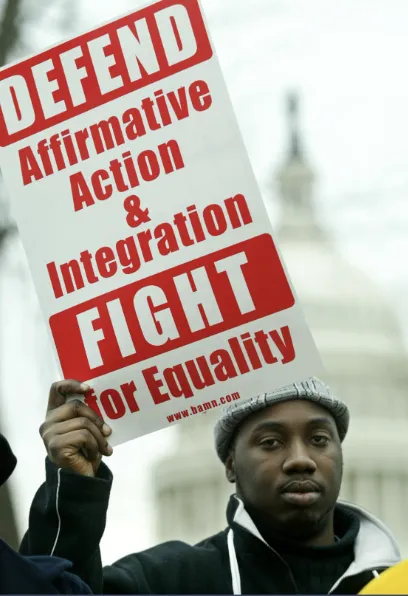
During the 1960s War on Poverty, President Lyndon. B. Johnson noticed the disparities Black Americans experienced in housing, employment, and access to resources. In June 1965, he gave a speech at the historically Black educational institution, Howard University, outlining the fundamental principles behind his push for expanding affirmative action. He likened racial inequality to setting free a man long bound by chains and then expecting him to compete on equal footing, calling out such claims of fairness as an illusion [1]. President Johnson, in his speech, underlined the importance of implementing actionable and equitable policies, emphasizing that legally desegregating schools was not sufficient in itself [2]. Following his word, Johnson signed Executive Order 11246 in 1965, significantly expanding the scope of affirmative action in the United States [3]. The primary purpose of affirmative action was to promote the hiring and employment of minorities [4]. Following Johnson’s order, many universities and professional schools began seeking minority students to integrate into their academic communities, adding race to the admissions process [5].
The first significant case in which the Supreme Court limited the scope of affirmative action was Regents of the University of California v. Bakke (1978). The prevailing argument for anti-affirmative action rhetoric was—and still is—that affirmative action allows unqualified Black students to take the spots of “well-deserving” white and Asian students. In this case, Bakke, a white man, applied to the University of California, Davis, medical school with above-average statistics, but he was rejected [6]. It was found that the medical school had put in place a racial quota that saved at least 16 out of the 100 spots for minority students [7]. On these grounds, Bakke sued the university, claiming it violated the Civil Rights Act of 1964 [8]. Ultimately, the Supreme Court ruled that racial quotas were unconstitutional, but simultaneously upheld the use of race as one factor among many in admissions decisions [9]. This dualistic outcome represented an emerging tension in both public and legal opinion: does equality require treating everyone identically, or must it account for the systemic inequalities that create an uneven playing field?
Those critical of affirmative action present colorblindness as equality, arguing that race-conscious admissions and policies create a “reverse manner of discrimination.” Likewise, supporters of race-neutral polices frequently claim that focusing on diversity can overshadow “real merit” and that the consideration of race should be removed entirely in a meritocratic system. As sociologists Monica McDermott and Annie Ferguson contend, colorblind ideology reconfigures privilege as neutrality, allowing white dominance to remain, while reducing the possibility for structural change [10]. Colorblindness, though, does nothing to combat racial injustice but only serves as a form of denying white privilege. In enacting colorblindness and ignoring the social reality of race, people pretend that the exclusion of African American, Latine, and Indigenous people is the result of their individual shortcomings rather than a societal injustice. In actuality, affirmative action did not guarantee the admission of underqualified applicants; it acknowledged that academic merit can not be measured apart from the social and historical conditions that still affect access to opportunities and resources.
This ongoing tension, first underscored in Regents of the University of California v. Bakke (1978), remained central to affirmative action debates for decades, setting the stage for the reversal of affirmative action in Students for Fair Admissions (“SFFA”) v. Harvard (2023). SFFA is an organization that combats the use of race in university admissions and advocates for a system based on merit. Before the SCOTUS ruling, Harvard had won their case against SFFA in the district court, but SFFA appealed that ruling to the First Circuit of the U.S. Court of Appeals [11]. In the SCOTUS case, SFFA sued Harvard College over its admissions process, claiming that Harvard’s use of race-based admissions discriminated against Asian American applicants and violated Title VI of the Civil Rights Act of 1964 in favor of applicants from underrepresented minority backgrounds [12]. Harvard acknowledged that they used race as a factor in many cases, but that it adhered to constitutional standards [13]. It is also important to note that SCOTUS initially heard this case alongside SFFA v. University of North Carolina (2023), but the two cases were subsequently separated [14].
Harvard’s use of race as a factor among many had legal precedent to support it. In 2003, SCOTUS heard the case Grutter v. Bollinger (2003). In this case, a white Michigan resident had applied to the University of Michigan Law School and was denied admission, despite having a 3.8 undergraduate GPA and a 161 LSAT score [15]. Like Harvard, the law school admitted using race as one factor among many in the admissions process, citing the benefits of diversity to the educational environment [16]. SCOTUS ruled 5–4 that the equal protection clause does not forbid the “narrowly tailored” use of racial background in making decisions for admission [17]. SCOTUS’s reasoning behind this decision was that, since the law school conducts highly individualized evaluations of its applicants, no rejection or acceptance could be based on a single variable, such as race [18]. In the majority opinion, Justice O’Connor documented that, “the Law School’s race-conscious admissions program does not unduly harm nonminority applicants” [19].
Harvard College cited Grutter v. Bollinger (2003) to argue that its race-conscious admission process complies with the regulations governing race-based admissions [20]. The current Supreme Court ruled 6–2 that Harvard’s implementation of race in its admissions violated the Equal Protection Clause of the Fourteenth Amendment, with Justice Jackson recusing herself because she is an alumna of Harvard [21]. The majority opinion held that Harvard failed to circumvent racial stereotypes and “did not offer a logical endpoint for when race-based admissions would cease” [22]. They did note, though, that applicants mentioning how their race influenced their lives is permissible as long as it is “concretely tied to a quality of character or unique ability that the particular applicant can contribute to the university” [23].
The inclusion of race in admission was in place to help mitigate the persisting effects of racial exclusion and systemic racism. SCOTUS’s decision to overrule the precedent of these cases with SFFA v. Harvard (2023) ignored a fundamental truth: ignoring race does not solve inequality. Instead, it shifts focus to socioeconomic factors, furthering the barriers to elite universities. The “race-neutral” approach that SCOTUS ardently supports fails to acknowledge that to use a neutral framework in a system that has been forged on inequity does not result in justice. Race-neutral strategies cannot offset the accumulation of centuries of exclusion, resource deprivation, and segregation. In doing this, they mark out race from the dialogue and leave its impact unacknowledged. SCOTUS’s focus on a colorblind approach rests on the fallacious belief that everyone starts from the same place. Realistically, it rebrands privilege as “merit” and oppression as “unworthiness.”
The reversal of affirmative action indicates a regression from the progress made to overcome these historical injustices. Now, colleges and universities must navigate ways to cultivate a diverse learning environment through implicit methods, such as essays on overcoming hardship and community impact, which often benefit students with access to mentorship, editing support, and preparatory courses, all of which are shaped by privilege. The consequence is a more discreet, yet still powerful, form of exclusion.
Some may argue that this is a class issue, not a racial issue, but in the United States, the two are inseparable. In 2022, a year before the SFFA v. Harvard case, both the Black and Native American communities had the highest number of people living below 100 percent of the poverty level [24]. In the United States from 1980 to 2022, compared to white populations, people of color have experienced poverty at higher rates [25]. When examining these metrics, it is evident that race has a significant impact on economic opportunity and mobility, reaffirming how socioeconomic class is structured on racial inequality.
Interestingly, what persists after the fall of affirmative action is legacy admissions, which continues the privileging of whiteness and wealth under the guise of custom. Legacy admissions offer preferential treatment to those with familial connections to the institution, often justified by the need to secure alumni donations and funding. Ironically, this practice operates as an affirmative action for the wealthy, white, elite applicants. The contradiction between the emphasis on merit and the lack of focus on ending legacy admissions is apparent. SCOTUS has based its argument on claims of unequal treatment but has not addressed legacy admissions that benefit applicants from wealthy backgrounds. The endurance of legacy admission reveals that the college admissions process in the United States has never been authentically meritocratic. If legacy admissions are allowed to continue shaping the makeup of elite universities, racial and economic inequality will persist in the scaffolding of American higher education.
Getting rid of legacy admissions alone would not fix ingrained racial inequalities in the higher education system. Yet ending this practice would indicate a commitment to the ideal President Johnson expressed: that justice must be backed by active engagement, not passivity. American Universities cannot claim to value diversity while upholding policies that perpetuate inherited socio-economic advantages. The university is meant to be a place that is equitable and a realm of social mobility. If that is truly the case, then we must address the frameworks that discreetly uphold privilege, such as legacy admission and an overemphasis on standardized tests.
Following the outcome of SFFA v. Harvard, America must ask itself whether it will continue to let equality be defined by a thin, colorblind ideal or by a holistic comprehension of how history continues to affect disenfranchised communities. If intentional, thoughtful action is not taken to work against the haunting legacy of oppression, then equity will never be achieved. The end of affirmative action may have been a step back in history, but that does not mean that progress cannot still be made to ensure a better future.
[1] Garrison-Wade, Dorothy F., and Chance W. Lewis, “Affirmative Action: History and Analysis”, The Journal of College Admission (Summer 2004), 23–26.
[2] Ibid.
[3] Ibid.
[4] Ibid.
[5] Ibid.
[6] Cornell Law School, “Regents of the University of California v. Bakke (1978) | Wex | US Law | LII / Legal Information Institute.”, n.d.
[7] Ibid.
[8] Ibid.
[9] Ibid.
[10] McDermott, Monica, and Annie Ferguson, “Sociology of Whiteness.” Annual Review of Sociology, April 2022, 258–269.
[11] Students for Fair Admissions, Inc. v. President and Fellows of Harvard College, 600 U.S. (2023)
[12] Ibid.
[13] Ibid.
[14] Ibid.
[15] Grutter v. Bollinger, 539 U.S. 306 (2003)
[16] Ibid.
[17] Ibid.
[18] Ibid.
[19] Ibid.
[20] Students for Fair Admissions, Inc. v. President and Fellows of Harvard College, 600 U.S. (2023)
[21] Ibid.
[22] Ibid.
[23] Ibid.
[24] “Poverty: No one should experience poverty or economic insecurity.” National Equity Atlas, n.d. Accessed November 10, 2025.
[25] Ibid.
Works Cited
Cornell Law School. n.d. “Regents of the University of California v. Bakke (1978) | Wex | US Law | LII / Legal Information Institute.” Law.Cornell.Edu. Accessed November 6, 2025. https://www.law.cornell.edu/wex/regents_of_the_university_of_california_v_bakke_%281978%29.
Garrison-Wade, Dorothy F., and Chance W. Lewis. 2004. “Affirmative Action: History and Analysis.” The Journal Of College Admission, (Summer), 23-26. https://files.eric.ed.gov/fulltext/EJ682488.pdf.
“Grutter v. Bollinger.” 2003. Oyez. https://www.oyez.org/cases/2002/02-241.
McDermott, Monica, and Annie Ferguson. 2022. “Sociology of Whiteness.” Annual Review of Sociology, (April), 258-269. https://doi.org/10.1146/annurev-soc-083121-054338.
“Poverty: No one should experience poverty or economic insecurity.” n.d. National Equity Atlas. Accessed November 10, 2025. https://nationalequityatlas.org/indicators/poverty.
“Students for Fair Admissions v. President and Fellows of Harvard College.” n.d. Oyez. Accessed November 6, 2025. https://www.oyez.org/cases/2022/20-1199.