Congestion Pricing in New York City: A Long History and an Uncertain Future
Written by: Helen Yibrah
Edited by: Christopher Brown
Abstract:
This piece examines the history of the congestion pricing plan in New York City (NYC) including the various legal battles it underwent as it attempted to gain state approval. Congestion pricing was first proposed in the mid-20th century and it has been implemented in cities such as Stockholm and London, but never in the United States. As New York’s population has increased since 1950, traffic and congestion problems have become more significant. To address this and improve public transit, Mayor Michael Bloomberg proposed a congestion pricing plan in 2007, but it did not pass through the state legislature. In 2019, Governor Andrew Cuomo included congestion pricing in the state budget and it gained state approval. After being delayed several years due to the COVID-19 pandemic and federal opposition, it was set to be implemented in 2024. However, it was paused suddenly and indefinitely by Governor Kathy Hochul, triggering a series of environmental lawsuits. The re-election of Trump on November 5, 2024, has further complicated the implementation of the plan, as he has pledged to block it permanently. Following Trump’s election, state and local government officials have been looking to fast-track the plan and implement it before Trump takes office. This article seeks to provide more context to the uncertain future of congestion pricing.
Introduction:
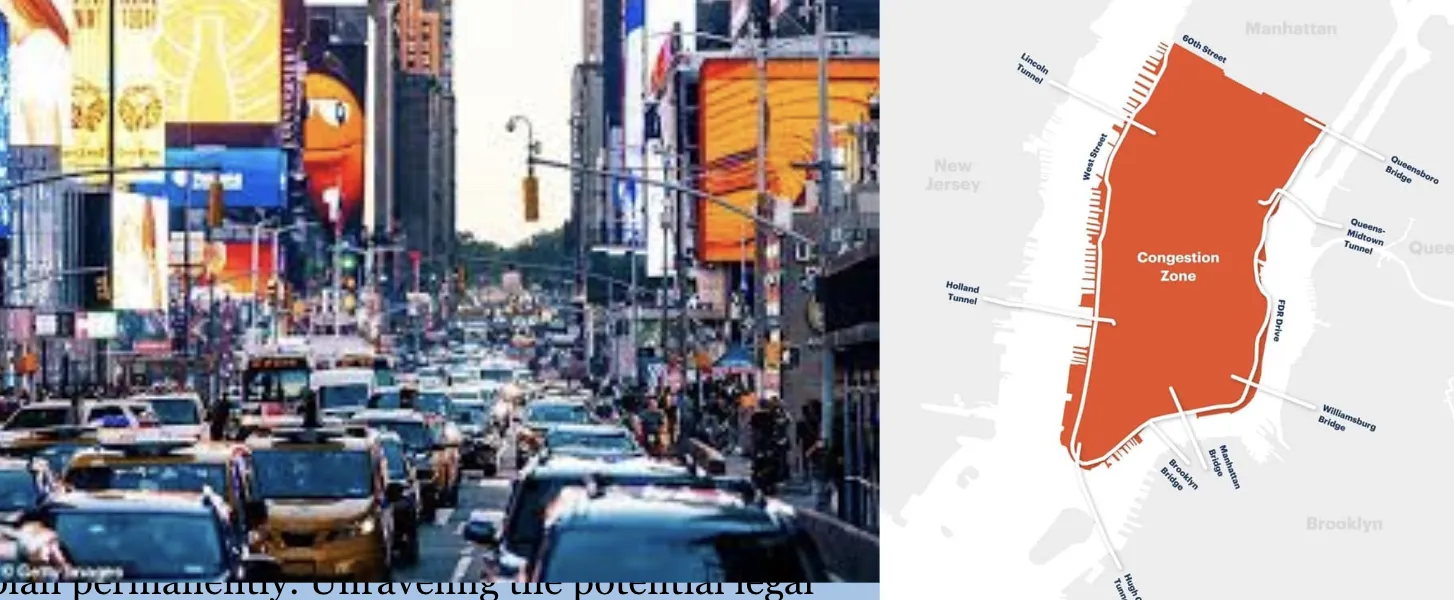
Congestion pricing is a tolling plan that has been reintroduced to New York City (NYC) by Mayor Bloomerg in 2007 after being proposed more than half a century ago. The program would charge vehicles a fee for entering Manhattan’s Central Business District (CBD), defined as all roadways south of 60th Street during peak traffic hours. Passenger vehicles would incur a fee of $15 for entering the congestion zone and trucks would be charged $24 or $36 depending on their size. [1] This plan has undergone a tumultuous review process and its future is more uncertain following the re-election of President Trump on November 5, 2024. There has been significant political division on this issue since it was first seriously considered in 2007. Mayor Michael Bloomberg proposed a congestion plan in 2007 but it failed to garner enough support to move forward in local and state law. After serious efficiency concerns with NYC’s public transit system reached a critical point in the summer of 2017, state officials sought to allocate more funding to the city’s transportation system. It was included in the 2019 New York government budget plan before being further delayed due to the impacts of the COVID-19 pandemic. After taking office in 2021, Governor Kathy Hochul pushed the plan forward as it underwent review. It was finally approved and ready for implementation by 2024 with an implementation date of June 30, 2024. However, weeks before it was planned to take effect, Governor Hochul paused the plan indefinitely. The sudden postponement of the plan has triggered several lawsuits by many environmental groups and proponents of public transportation. The future of the plan has become even more uncertain as President-elect Trump has expressed significant opposition and intention to block the plan as soon as he takes office. [2]
Congestion Pricing History:
Columbia University economist and Nobel Prize winner William Vickery first proposed the idea of congestion pricing in 1952. Vickery’s proposal was first recommended for subway systems, where fares would be increased during peak hours to reduce congestion. He proposed a similar concept for road pricing and received pushback from various elected officials. In response to this backlash, he responded, “People see it as a tax increase, which I think is a gut reaction. When motorists' time is considered, it's really a savings.” [3] He saw congestion pricing as a potential solution to inefficient, overcrowded transportation by incentivizing a more evenly spread flow of traffic. However, the idea was not seriously considered by policymakers until the start of the 21st century. Early implementations of congestion charges took hold abroad in London in 2003 and Stockholm in 2006. When London implemented the congestion plan, “total traffic fell 18 percent, increasing road speeds and cutting air pollutants.” [4] The early results of these programs abroad led many activists and organizations to advocate for parallel programs in New York.
Failure of PlanNYC:
Following years of advocacy, in 2007 Mayor Michael Bloomberg revealed a series of initiatives under PlanNYC that set out to address the city’s quality of life and climate change concerns. PlanNYC included a congestion pricing plan to charge cars $8 and trucks $21 when they entered Manhattan streets south of 86th Street. The United States Department of Transportation introduced an Urban Partnership Agreement (UPA) for cities to compete for federal funding to address congestion and improve public transportation. To receive funding, the city plan needed approval from state officials. After its announcement, Mayor Bloomberg had a few months to garner statewide support for the plan before the vote for state assembly approval. The successful implementation of a congestion pricing scheme in London was often referenced to lobby support for Bloomberg’s plan, but it was unable to garner the state assembly approval necessary to secure the UPA funding. [5] The plan was supported within the city, but the inability to build sufficient support in the state legislature blocked its implementation.
Shift from Local to State:
The plan was shelved for almost a decade as it failed to gain enough bipartisan support to win a vote. However, NYC’s subway system became extremely overwhelmed leading to a series of failures in the summer of 2017. During this summer, “A rush-hour Q train careened off the rails in southern Brooklyn. A track fire on the A line in Upper Manhattan sent nine riders to the hospital. A crowded F train stalled in a downtown tunnel, leaving hundreds in the dark without air-conditioning for nearly an hour.”[6] These are a few of the incidents that led the State governor to deem the transit system in a state of emergency and system failure. It was deemed “the summer of hell” by city Governor Cuomo. The local and state governments failed to adequately fund the subway systems as the budget had not been updated in nearly 3 decades. It became abundantly clear to elected officials that the Metropolitan Transportation Authority’s (MTA) subway budget needed significant boosts for repairs.
To generate the revenue to fund these repairs, Governor Cuomo circled back to congestion pricing, even though he was not initially in favor of the policy. He explained, “Congestion pricing is an idea whose time has come.”[7] He and other state officials began working on a plan based on Mayor Bloomberg's failed attempt to implement this system about a decade prior. Given the mounting pressure to repair the subway system without a clear mechanism for funding, state legislators were now more inclined to support congestion pricing.
Traffic Mobility Act:
In 2019, Governor Cuomo included congestion pricing in the 2019 New York State budget which created the law that authorized the plan. It was listed under Article 44-C as the Central Business District Tolling Program (CBDTP), otherwise known as the Traffic Mobility Act. The legislative findings and declaration cite, “In order to ensure a safe and efficient mass transit system within the city of New York and to protect the public health and safety of New York's residents, a program to establish tolls for vehicles entering or remaining in the most congested area of the state is found to be necessary and to be a matter of substantial state concern.”[8] The act authorized the Triborough Bridge and Tunnel Authority (TBTA), an affiliate agency of the MTA to establish the tolling program. The TBTA would be responsible for coordinating with New York City Department of Transportation on the planning, designing, constructing, and implementing the plan.
The state law included the creation of a Traffic Mobility Review Board (TMRB) that would submit recommendations to the TBTA. The TMRB was intended to be a 6-person review board with a chairman and 5 members. The board includes one member appointed by the mayor, one from the Metro North region, and one who resides in the Long Island Rail Road Region [9]. The TMRB followed guidelines outlined in the legislation with comments from public hearings to construct an efficient tolling plan that would generate at least $15 million for capital improvements in the public transit system. Following delays, the official toll plan was submitted and published in November 2023, nearly 4 years later.
Legal Challenges and Delays:
Proponents of the program faced pushback from several constituencies. Suburban and New Jersey drivers were not satisfied with the plan as car ownership is more common outside the city and the toll would affect car commuters more. Other groups that were opposed included truck companies and small businesses. For transportation companies, “With a toll program meant to disincentivize passenger vehicles in favor of public transit, commercial vehicles have no recourse but to eat the added costs of business.”[10] Local businesses located within the congestion zone anticipated less business and higher delivery costs due to the transportation surcharge on truck companies. Federal opposition to the project under President Donald Trump’s administration and the various lawsuits raised by these groups prolonged the timeline for this proposed project.
Because some federal roads were included in the plan, the Federal Highway Administration (FHWA) needed to approve the project. Under President Trump’s administration, approval was denied, stalling the implementation of the plan until the inauguration of President Joe Biden in 2021. The outbreak of the COVID-19 pandemic also delayed plans to implement the project and planning did not resume until people began returning to office. [11] Furthermore, as required of any major project with federal property, the proposed project triggered an environmental review by the National Environmental Policy Act (NEPA). The NEPA process can take one of three levels of review for projects: categorical exclusion (CATEX), environmental assessment (EA), and environmental impact statement (EIS). The FWHA chose an EA, the second most rigorous form of environmental review to evaluate if the project would have significant adverse environmental impact. In June of 2023, the FHWA determined a finding of no significant impact (FONSI) meaning that a full EIS would not be necessary for the project. However, “Lawsuits challenging New York’s congestion pricing scheme began as soon as the FHWA released the Final EA. In July 2023, New Jersey filed a suit alleging that the FHWA did not adequately consider New Jersey in its environmental analysis.”[12] This was one of several NEPA-based lawsuits from New York and New Jersey residents claiming that the FHWA did not do an adequate NEPA review. Many of these lawsuits, attempting to delay the project, advocated for a costly, full EIS report. Many of these lawsuits were dismissed by 2024 but a few remain pending in New Jersey District Court. While these court decisions could potentially halt the programs, the plan to implement the project proceeded with a set date of June 30, 2024.
A Sudden Halt and Legal Backlash:
After almost 5 years, various lawsuits, and several environmental reviews, the congestion pricing program was finally set to take effect in the summer of 2024. But, less than one month before the plan was set to commence, Governor Hochul put the project on an indefinite hold. The decision came as a shock to many local elected officials and staff members at the MTA. Governor Hochul’s vague reason for halting the program was “to avoid added burdens to working- and middle-class families,” as cited on the Governor’s website. [13] However, many speculate that part of this decision to delay stems from suburban New Yorker’s opposition to the plan and “concern that the implementation would hurt Democrats in competitive House of Representatives races this year.”[14]
Governor Hochul was met with lawsuits from various environmental lawyers and organizations regarding the legality of this decision. Michael Gerrard, a Columbia University law professor, is part of several lawsuits to challenge this decision, explaining that there are several possible legal routes. One of these lawsuits could “trigger what’s called an Article 78 hearing, questioning the state's failure to implement the law…There could also be lawsuits for potentially violating the Americans with Disabilities Act and compromising air pollution.”[15] The combination of these lawsuits against Governor Hochul’s temporary halt of the program and other lawsuits regarding the program itself has left the state in a complex legal battle, with congestion pricing hanging in the balance.
Uncertain Future of Congestion Pricing:
Governor Hochul and other state officials petitioned to dismiss the lawsuits against their decision to halt the congestion pricing program. The New York Supreme Court has denied this petition by the state in the ongoing case Riders Alliance v. Hochul on September 30, 2024 [16]. This authorized the lawsuits to proceed and they continued as normal until the 2024 presidential election. President-elect Trump had been exceedingly vocal in his opposition to the project with “[threats] to kill congestion pricing as one of his first acts in office.”[17] The ability of President Trump to terminate congestion pricing when it is already in effect is significantly more difficult than attempting to implement it after he has taken office. For these reasons, Governor Hochul, who initially supported the project, has begun efforts to fast-track implementation. She consulted with the MTA to reduce the toll price from its original value to address some of the plan’s initial criticism. The revised plan features “a reduced base fare of $9 -- down from the original plan of $15 -- and the state is ‘looking at Jan. 5’ as the start date…She added that additional discounts are being introduced for low-income drivers making less than $50,000 annually, who will receive a 50% discount after their tenth toll each month.”[18] The revenue from the initial plan was expected to be at about $15 million but the reduced rate will diminish a lot of that value. With this sudden shift to resume congestion pricing, the previous lawsuits against the implementation of the project have also resumed while the lawsuits to implement it are likely to be put on the back burner.
The ability for this plan to get implemented and remain throughout President Trump's next term remains highly uncertain. President Trump is adamant about removing this policy and there are potential mechanisms for him to do so. According to a report from the New York Times, “He could try to revoke federal approval or threaten to withhold federal funding. But he would not have unilateral power to quash the program, and his administration would most likely have to go to federal court to undo it.”[19] With such strong opposition to the project, it is not unlikely that President Trump’s administration will attempt to invoke some of these strategies to halt the program. However, if the project is implemented before President Trump takes office, proponents of the program are hopeful that it will not be significantly impacted by these federal actions. During this brief period between the election and second inauguration of President Trump, state officials and advocacy groups in favor of the plan are working quickly to safeguard the project. If implemented, it would be the first congestion pricing program in the country.
[1] “Congestion Pricing in New York,” Metropolitan Transportation Authority, 2023
[2] “As Trump’s New Term Looms, Hochul Considers Reviving Congestion Pricing,” New York Times, 2024
[3] “Principles of Efficient Congestion Pricing,” Columbia University, 1992
[4] “New York’s Long Road to Congestion Pricing,” Works in Progress, 2024
[5] “A Comprehensive Transportation Policy for the 21st Century: A Case Study of Congestion Pricing in New York City,” NYU Environmental Law Journal, 2008
[6] “How Politics and Bad Decisions Starved New York’s Subways,” New York Times, 2017
[7] “Cuomo Calls Manhattan Traffic Plan an Idea ‘Whose Time Has Come’” New York Times, 2017
[8] Central Business District Tolling Program, NY State Law, § 1701, 2019
[9] Traffic Mobility Review Board, NY Pub Auth L § 553-K, 2023
[10] “NYC’s Congestion Pricing: What Happened?” Fleet Owner, 2024
[11] “Congestion pricing in NYC timeline: How we got here,” ABC7, 2024
[12] “Congestion Pricing: A Case Study on Interstate Air Pollution Disputes,” NYSBA, 2024
[13] “What They Are Saying: Governor Hochul Announces Pause on Congestion Pricing to Address the Rising Cost of Living in New York,” New York State Governor, 2024
[14] “New York Governor Shocks Manhattan With Halt to Congestion Pricing,” Bloomberg, 2024
[15] “Feds give final congestion pricing approval, week after Hochul put plan on pause,” NBC4, 2024
[16] Riders Alliance v. Kathy Hochul, NYSCEF Doc No. 57, 2024
[17] “Hochul Brings Back Congestion Pricing Plan After Months of Suspense,” New York Times, 2024
[18] “New York to launch congestion pricing with lower toll for driving in Manhattan,” ABC7, 2024
[19] id at 2
Works Cited
Andrew Siff, “Feds give final congestion pricing approval, week after Hochul put plan on
pause,” NBC4, June 14, 2024, https://www.nbcnewyork.com/news/local/feds-final-congestion-pricing-approval-after-hochul-pause/5509162/ (accessed November 18, 2024)
Anna Ley and Winnie Hu, “Hochul Brings Back Congestion Pricing Plan After Months of
Suspense,” New York Times, November 12, 2024, https://www.nytimes.com/2024/11/14/nyregion/congestion-pricing-nyc-hochul.html (accessed November 19, 2024)
Ben Adler, “New York’s Long Road to Congestion Pricing,” Works in Progress, Issue 15, May
17, 2024, https://worksinprogress.co/issue/new-yorks-long-road-to-congestion-pricing/ (accessed November 16, 2024)
Ben Ritter, “Congestion pricing in NYC timeline: How we got here,” ABC7, May 31, 2024,
https://abc7ny.com/post/congestion-pricing-nyc-timeline-toll-starts-stop/14895566/ (accessed November 18, 2024)
Brian Rosenthal, Emma Fitzsimmons, and Michael LaForgia, “How Politics and Bad Decisions
Starved New York’s Subways,” New York Times, November 18, 2017, https://www.nytimes.com/2017/11/18/nyregion/new-york-subway-system-failure-delays.html (accessed November 16, 2024)
Central Business District Tolling Program, NY State Law, § 1701, Vehicle & Traffic (VAT)
Chapter 71, Title 8, Article 44-C (2019) https://www.nysenate.gov/legislation/laws/VAT/1701
Christine Billy, “Congestion Pricing: A Case Study on Interstate Air Pollution Disputes,”
NYSBA, September 23, 2024, https://nysba.org/update-congestion-pricing-a-case-study-on-interstate-air-pollution-disputes/?srsltid=AfmBOopFb9Xtzv1csC3Azrty_qXO-ljwL4bDRtdoR3wAYtTzKd97V79L (accessed November 18, 2024)
Emma Fitzsimmons, Winnie Hu, and Grace Ashford, “As Trump’s New Term Looms, Hochul
Considers Reviving Congestion Pricing,” New York Times, November 8, 2024, https://www.nytimes.com/2024/11/08/nyregion/trump-congestion-pricing-nyc.html (accessed November 16, 2024)
Environmental Law Journal, Volume 17, November 21, 2008,
https://nyuelj.org/wp-content/uploads/2013/03/Soffian.pdf (accessed November 16, 2024)
Jeremy Wolfe, “NYC’s Congestion Pricing: What Happened?” Fleet Owner, June 21, 2024,
https://www.fleetowner.com/news/article/55090192/what-made-new-york-city-pause-its-congestion-toll-program-indefinitely (accessed November 18, 2024)
Marc Santora, “Cuomo Calls Manhattan Traffic Plan an Idea ‘Whose Time Has Come,’” New
York times, August 13, 2017, https://www.nytimes.com/2017/08/13/nyregion/cuomo-rethinks-opposition-to-tolls-to-ease-manhattan-traffic.html (accessed November 18, 2024)
Michelle Kaske, Laura Nahmias and Zach Williams, “New York Governor Shocks Manhattan
With Halt to Congestion Pricing,” Bloomberg, June 5, 2024, https://www.bloomberg.com/news/articles/2024-06-05/nyc-congestion-pricing-risks-delay-after-hochul-weighs-pause (accessed November 18, 2024)
Riders Alliance v. Kathy Hochul, NYSCEF Doc No. 57, September 30, 2024,
https://climatecasechart.com/wp-content/uploads/case-documents/2024/20240930_docket-1567112024_order.pdf
Sam Shwartz, Gerrard Soffian, Jee Kim, Annie Weinstock, “A Comprehensive Transportation
Policy for the 21st Century: A Case Study of Congestion Pricing in New York City,” NYU
Sonia Rincons, “New York to launch congestion pricing with lower toll for driving in
Manhattan,” ABC7, November 14, 2024, https://abc7ny.com/post/congestion-pricing-nyc-new-york-governor-kathy-hochul-expected-unpause/15544827/ (accessed November 19, 2024)
Traffic Mobility Review Board, “Congestion Pricing in New York,” Metropolitan Transportation
Authority, November 2023, https://new.mta.info/document/127761 (accessed November 16, 2024)
Traffic Mobility Review Board, NY Pub Auth L § 553-K (2023)
https://law.justia.com/codes/new-york/pba/article-3/title-3/553-k/
William Vickery, “Principles of Efficient Congestion Pricing,” Columbia University, June 1992,
https://www.vtpi.org/vickrey.htm#:~:text=Introduction,and%20be%20lowered%20in%20others (accessed November 16, 2024)
“What They Are Saying: Governor Hochul Announces Pause on Congestion Pricing to Address
the Rising Cost of Living in New York,” New York State Governor, June 5, 2024, https://www.governor.ny.gov/news/what-they-are-saying-governor-hochul-announces-pause-congestion-pricing-address-rising-cost (accessed November 18, 2024)