Corporate Complicity in Authoritarianism: A Legal Examination Through Kiobel v. Royal Dutch Petroleum Co. (2013)
Written by: Jessica Nwosu
Edited by: Kianna Victor and Emma Farley
Abstract
This article examines the legal and ethical implications of corporate complicity in authoritarian regimes, focusing on the landmark case Kiobel v. Royal Dutch Petroleum Co. (2013). It explores how Shell’s collaboration with Nigeria’s military dictatorship in the 1990s—marked by systemic repression and environmental degradation in the Ogoni region—prompted a legal challenge under the Alien Tort Statute (ATS). Tracing the evolution of Kiobel from lower courts to the U.S. Supreme Court, this article analyzes the Court’s decision to limit the extraterritorial application of the ATS and its impact on corporate accountability. By comparing international legal responses in Canada and France, this article underscores the inadequacy of current U.S. legal frameworks in addressing cross-border human rights violations and calls for legal reforms and transnational strategies to bridge the justice gap.
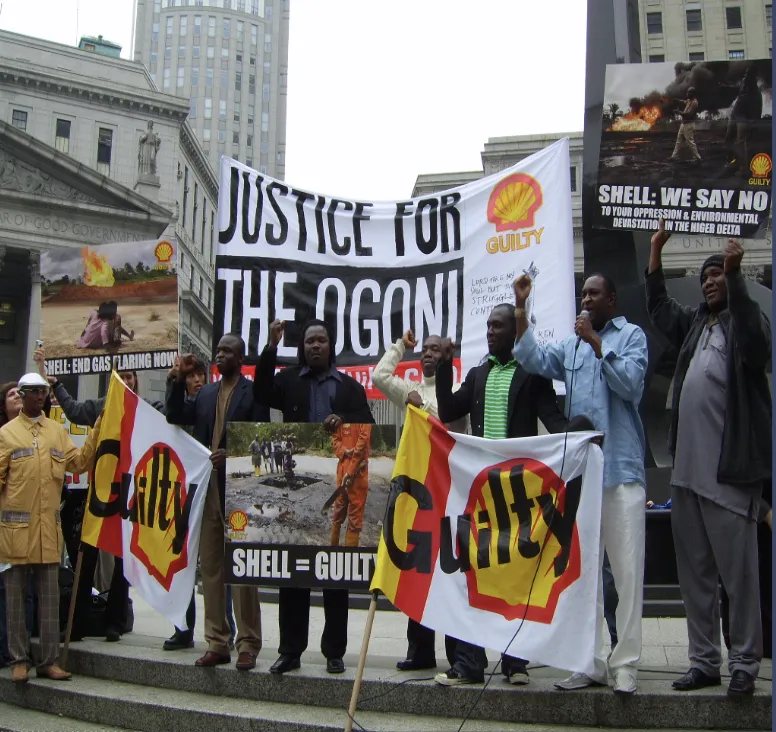
In an era of globalization, multinational corporations operate across multiple legal jurisdictions, often navigating complex relationships with authoritarian regimes. Corporate complicity in human rights abuses has become a pressing issue, particularly when domestic legal frameworks fail to provide accountability. The Kiobel v. Royal Dutch Petroleum Co. (2013) case exemplifies the legal challenges in addressing such complicity, revealing how jurisdictional constraints and corporate legal defenses undermine efforts to hold multinational corporations accountable for human rights violations abroad.
Corporations often engage in legally sanctioned practices that indirectly or directly support authoritarian regimes. These practices include labor exploitation, censorship compliance, and collaboration with state surveillance programs. Many governments, particularly those with authoritarian tendencies, rely on multinational corporations to sustain economic and technological development while suppressing dissent.
For example, Sierra Leone, a West African country, has rich diamond reserves, and companies like De Beers have historically controlled much of the trade. Not only did this exploitation of natural resources impact the country's economy and result in human rights abuses due to a lack of regulation in mining and coerced labor, but De Beers' interactions with Sierra Leone also played a key part in the Sierra Leone Civil War (1991-2002). During the civil war, the Revolutionary United Front (RUF) used De Beers diamonds to fund their operations, buy weapons, and sustain their brutal campaign [1]. The extensive diamond trade in Sierra Leone contributed to prolific violence, and as a result, the war caused about 50,000 deaths and countless atrocities, including child soldiers and mass amputations. [1] Across the African continent, the rise of transnational corporate power and globalization has been closely linked to the exploitation of natural resources and a corresponding increase in violent conflict. In the context of Nigeria’s ongoing conflict, Shell has repeatedly exploited the Ogoni people and their land in pursuit of the country’s oil reserves.
Shell’s operations in the oil-rich Niger Delta offer a stark example of how corporate interests can deepen social and environmental harm in regions with weak legal protections. In Ogoniland, a territory home to the Ogoni people, Shell has extracted billions of dollars’ worth of oil while leaving behind a legacy of pollution, economic disenfranchisement, and repression [2]. The company’s infrastructure has contaminated farmlands and drinking water, decimating local livelihoods and exposing communities to serious health risks. Rather than receiving benefits from the vast oil wealth beneath their land, the Ogoni people have endured decades of marginalization, state-backed violence, and environmental devastation—conditions that laid the groundwork for the landmark Kiobel v. Royal Dutch Petroleum case.
Legal frameworks, such as the UN Guiding Principles on Business and Human Rights, aim to regulate corporate involvement in human rights abuses [3]. However, enforcement remains weak due to jurisdictional limitations and the ability of corporations to shield themselves through complex legal structures and defenses, including the use of foreign subsidiaries and plausible deniability. This is seen when the Royal Dutch Petroleum group (Shell) allegedly collaborated with the Nigerian military regime in the 1990s, in order to suppress environmental and human rights activism in the oil-rich Ogoni region. Shell’s alleged complicity extended beyond passive economic benefit; the company was accused of actively collaborating with the Nigerian military by providing financial and logistical support—including transportation, housing, and payments—to security forces that carried out torture, extrajudicial killings, and other severe abuses against Ogoni activists. Internal communications revealed in later investigations suggested that Shell personnel exchanged information with military officials and requested government intervention to suppress protests that disrupted oil operations. This coordination blurred the line between corporate protection and state-sponsored violence, embedding Shell in the machinery of repression. These allegations culminated in the landmark case Kiobel v. Royal Dutch Petroleum Co. (2013), where plaintiffs sought to hold Shell accountable under the Alien Tort Statute in U.S. courts [4].
At the time Shell was expanding its oil operations in Ogoniland, Nigeria was under the military dictatorship of General Sani Abacha (1993–1998), a regime notorious for systemic repression and human rights abuses. Though not formally labeled an authoritarian state, Nigeria during this era bore all the hallmarks of one: censorship, the silencing of political opposition, extrajudicial killings, and the violent suppression of grassroots movements. The government’s brutal crackdown on the Ogoni people—particularly the peaceful resistance led by Ken Saro-Wiwa and the Movement for the Survival of the Ogoni People (MOSOP)—was not incidental, but part of a broader campaign to protect corporate interests and suppress environmental and human rights activism. The Kiobel case exemplifies the legal barriers that victims of corporate-backed state violence face when seeking justice across borders, highlighting how jurisdictional limitations can ultimately shield multinational corporations from accountability.
The Kiobel case arose from allegations that Royal Dutch Petroleum (Shell) was complicit in human rights abuses, including torture and extrajudicial killings, carried out by the Nigerian government against activists opposing oil exploitation in the Ogoni region. Activists, led by Ken Saro-Wiwa and the Movement for the Survival of the Ogoni People (MOSOP), began protesting oil exploitation and environmental degradation in the Ogoni region in the early 1990s, with mass demonstrations peaking in 1993[5]. This surge in activism brought international attention to the human rights violations occurring in Ogoniland and intensified tensions between the Ogoni people, Shell, and the Nigerian military regime. In the wake of these crackdowns, Nigerian citizens—many of whom were victims or survivors of state violence—sought to hold Shell accountable in U.S. courts under the Alien Tort Statute (ATS), a law historically used to seek redress for egregious human rights violations committed abroad [6].
(The Alien Tort Statute (ATS), enacted in 1789, grants U.S. federal courts jurisdiction to hear lawsuits filed by non-U.S. citizens for violations of international law. Although originally obscure, it has been revived in recent decades as a tool for addressing egregious human rights abuses involving foreign plaintiffs and defendants[7].)
These differences raised significant legal uncertainties and led to Kiobel being filed in a U.S. district court in 2002 [8]. After progressing through the lower courts, the case reached the U.S. Court of Appeals for the Second Circuit, which ruled that corporations could not be held liable under the ATS for violations of international law—a decision that contradicted precedents from other circuits. This split prompted the U.S. Supreme Court to grant certiorari in 2011. Initially, the Court was set to decide whether corporations could be sued under the ATS at all. However, during oral arguments, the justices expanded the scope of the case by ordering supplemental briefing on a broader question: whether the ATS could be invoked for conduct that occurred entirely outside the United States. This shift reframed Kiobel as a pivotal case on the extraterritorial application of the statute, ultimately reshaping its legal and policy implications.
The central legal question in Kiobel was whether the ATS allowed U.S. courts to hear cases involving human rights abuses committed by foreign corporations in foreign countries. The plaintiffs argued that Shell’s complicity in human rights abuses constituted a violation of customary international law, making the case admissible under the ATS.
The U.S. Supreme Court ruled against the plaintiffs, holding that the ATS does not apply extraterritorially—that is, it cannot be used to litigate human rights abuses that occur entirely outside the United States. The Court emphasized that for the ATS to be invoked, there must be a “strong connection” to the United States. This typically means the defendant must be a U.S.-based entity, the conduct in question must have occurred at least in part on U.S. soil, or the case must “touch and concern” U.S. territory with sufficient force. For example, in Filártiga v. Peña-Irala (1980), the Court allowed the case because the defendant, though a former Paraguayan official, was physically residing in the U.S., providing jurisdictional grounding. While Kiobel barred the plaintiffs due to a lack of U.S. ties—Shell being a foreign company and the abuses occurring in Nigeria—the decision does not completely close the door for all foreign plaintiffs. The Court's language left room for exceptions where sufficient U.S. connections can be demonstrated, meaning that foreign plaintiffs may still invoke the ATS if they can prove that the conduct was closely tied to U.S. interests or operations.
The Kiobel decision significantly weakened the Alien Tort Statute (ATS) as a legal mechanism for addressing corporate complicity in human rights abuses. By ruling that the ATS does not apply extraterritorially unless a claim sufficiently “touches and concerns” the United States, the Supreme Court established a precedent that narrowed the scope of corporate liability under U.S. law for actions conducted abroad. This has had far-reaching implications in the areas of jurisdiction, corporate accountability, and international human rights enforcement [9].
One of the most immediate consequences of the Kiobel ruling has been the reinforcement of strict jurisdictional limits in U.S. courts. Plaintiffs must now demonstrate a clear and substantial connection to the United States to proceed with litigation under the ATS. In Nestlé USA, Inc. v. Doe (2021), for example, former child laborers from Mali brought a case against Nestlé and Cargill, alleging that the companies aided and abetted child slavery on cocoa plantations in Côte d’Ivoire. Despite the corporations’ operations and decision-making occurring partly in the United States, the U.S Supreme Court found the connection insufficient under the precedent set by Kiobel and dismissed the case [10]. This outcome illustrates how the decision continues to block foreign plaintiffs from pursuing justice in U.S. courts, even when the companies they accuse are American.
This limitation has broader consequences for corporate accountability. With diminished legal risk in the United States, corporations are increasingly able to operate in authoritarian regimes with impunity [11]. A notable example is the lawsuit filed against Cisco Systems by survivors of persecution in China. The plaintiffs accused Cisco of providing surveillance technology that enabled the Chinese government to track, detain, and torture members of the Falun Gong religious movement. However, U.S. courts dismissed the case in part due to the jurisdictional barriers reinforced by Kiobel. Without meaningful avenues for redress, corporations may continue profiting from repressive partnerships without facing consequences in the countries where their victims reside [12].
The weakening of the ATS has also revealed critical gaps in international human rights enforcement [13]. As U.S. courts become less accessible to victims of cross-border corporate abuses, there is growing recognition that current legal structures are inadequate. Advocates have called for stronger international frameworks, including binding treaties on business and human rights or the establishment of a global tribunal capable of holding corporations accountable for violations of international law [14]. Without such mechanisms, the global legal system remains fragmented, leaving victims without justice and corporations without deterrence.
In contrast to the restrictive approach of the United States, several other jurisdictions have adopted laws and legal interpretations that expand corporate accountability. France, for instance, enacted the Duty of Vigilance Law in 2017, requiring large French companies to implement and publish due diligence plans to prevent human rights and environmental violations throughout their global supply chains [15]. Under this law, corporations like TotalEnergies and BNP Paribas have faced scrutiny for their international operations, particularly in regions with histories of conflict and repression. Similarly, in Canada, the Supreme Court’s decision in Nevsun Resources Ltd. v. Araya (2020) allowed Eritrean workers to pursue a civil lawsuit against a Canadian mining company for alleged complicity in forced labor and other abuses at a mine in Eritrea. Unlike in Kiobel, the Canadian court held that customary international law could apply in civil litigation, opening the door to corporate accountability for grave human rights violations abroad [16].
These international developments demonstrate that alternative models for justice are not only possible but already in motion [17]. While the Kiobel decision has significantly constrained human rights litigation in the United States, other countries are stepping in to fill the void, signaling a potential shift in where and how global corporate accountability is pursued.
The Kiobel decision marked a significant setback in efforts to hold multinational corporations accountable for their role in human rights abuses committed abroad. By limiting the extraterritorial reach of the Alien Tort Statute, the Supreme Court insulated foreign corporate conduct from scrutiny in U.S. courts, even when companies benefit from or enable state-sponsored violence. In contrast, frameworks like France’s Duty of Vigilance Law and Canada’s ruling in Nevsun illustrate how domestic courts can engage with transnational harms by grounding corporate liability in international norms. Moving forward, potential avenues for challenging or circumventing the Kiobel precedent include legislative reform, such as amending the ATS to explicitly permit extraterritorial application in cases involving grave human rights violations, or invoking alternative statutes like the Torture Victim Protection Act (TVPA) or state-level human rights laws where applicable. Plaintiffs may also frame future cases to establish a stronger nexus to the U.S., such as demonstrating that corporate decisions were made at U.S. headquarters or that abuses were part of a broader U.S.-linked business strategy. Beyond litigation, increased shareholder activism, mandatory corporate reporting requirements, and international treaty development could pressure companies to uphold human rights standards regardless of legal jurisdiction. In my view, the Court’s decision in Kiobel prioritizes formal jurisdictional constraints over substantive justice, shielding corporate actors from accountability through legal technicalities. If the U.S. wishes to remain a credible voice in the global human rights movement, it must embrace evolving legal strategies and international models that reflect the realities of twenty-first-century corporate power.
The Kiobel case underscores the legal barriers to holding multinational corporations accountable for their complicity in human rights abuses [18]. By limiting the extraterritorial reach of the ATS, the decision leaves victims with few legal avenues for redress in the United States. While international efforts to regulate corporate behavior continue, the lack of robust enforcement mechanisms allows corporations to evade liability. As authoritarian regimes increasingly rely on corporate partnerships to maintain control, the legal community must seek alternative avenues to ensure accountability and justice for victims of corporate complicity in human rights abuses.
[1] “Corporate Exploitation and Global Conflicts: How Big Companies Destabilize Nations and Fuel Civil Wars,” Vocal Media
[2] The Guardian, “Shell and Human Rights Abuses in Nigeria”
[3] UN Guiding Principles on Business and Human Rights, United Nations OHCHR
[4] Kiobel v. Royal Dutch Petroleum Co. (2013), Supreme Court Opinion
[5] “Nothing About Us Without Us: The Ogoni Demand Environmental Justice,” Corp Accountability Lab
[6] Beth Stephens, “Corporate Liability for Human Rights Violations under the Alien Tort Statute,” SSRN
[7] Alien Tort Statute (28 U.S.C. § 1350), Cornell Law
[8] Craig Scott, Torture as Tort, Hart Publishing
[9] Karen E. Bravo, “Corporate Responsibility and Accountability for Human Rights Violations Post-Kiobel,” Georgetown Law Journal
[10] Nestlé USA, Inc. v. Doe (2021), Oyez
[11] Rome Statute of the International Criminal Court (1998), ICC Website
[12] Amnesty International, “Corporate Crimes: Holding Multinationals Accountable”
[13] The New York Times, “How U.S. Courts Shut the Door on Human Rights Cases Against Corporations”
[14] Human Rights Watch, “The Case for Corporate Accountability”
[15] OECD Guidelines for Multinational Enterprises
[16] Nevsun Resources Ltd. v. Araya (2020), Supreme Court of Canada
[17] Brookings Institution, “Corporate Accountability in a Globalized World”
[18] International Covenant on Civil and Political Rights, United Nations Treaty Collection