Deportation by Proxy: The Optics and Implications of the Supreme Court’s Third-Party Deportation Ruling
Written by: Rihann Howell
Edited by: Jameeiah Domercant and Emma Farley
Abstract:
This article examines the Supreme Court’s 2025 shadow-docket ruling in DHS v. D.V.D., which upheld third-party deportations without requiring notice or time for migrants to appeal, even when they risk torture in the receiving countries. By outlining the legal basis of third-party deportation and its recent expansion, this piece situates the decision within broader patterns of U.S. immigration enforcement that disproportionately endanger Black and African migrants. Through cases involving detainees diverted to countries with documented human rights abuses, the article illustrates how the ruling enables the U.S. to outsource responsibility for inhumane treatment while reinforcing racialized narratives that frame African nations as acceptable sites for migrant suffering. Ultimately, this piece argues that D.V.D. marks a troubling escalation of executive power that undermines due process and obscures accountability under the guise of administrative efficiency.
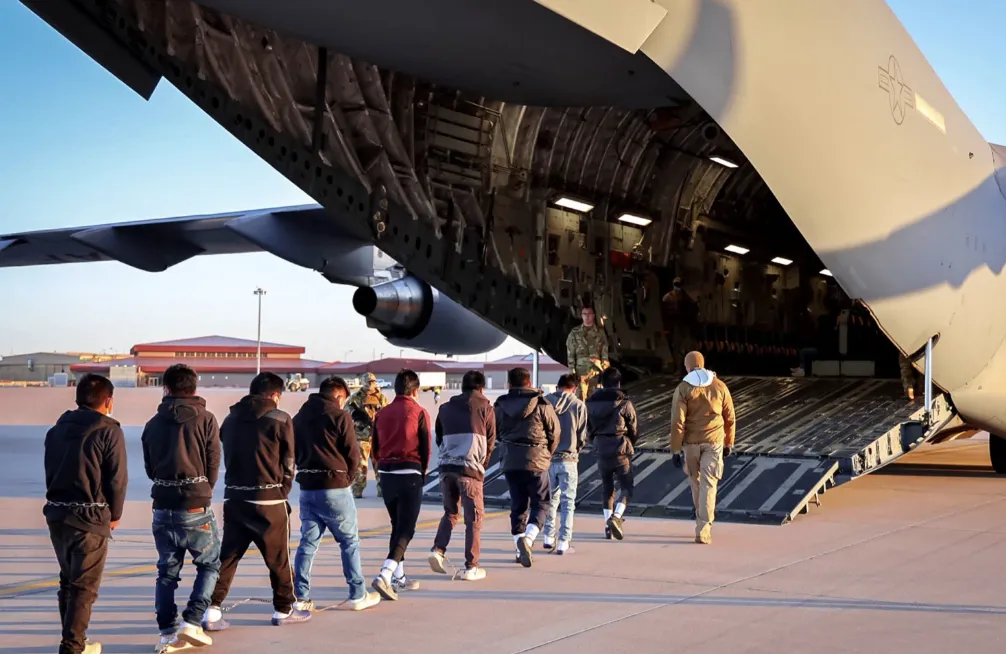
On June 23, 2025, in the Department of Homeland Security v. D. V. D. case, the Supreme Court ruled that the Department of Homeland Security was justified in making “third-party deportations” without providing migrants with appropriate notice or time to appeal, even if they may face torture in the third-party countries. The ruling was made rather quickly and placed on the Court’s “shadow docket,” which the Court typically reserves for decisions they believe will set significant legal precedents. Understanding why this case was prioritized by the Supreme Court requires a detailed view of the facts and relevant prior legal rulings.
A third-party deportation is when a nation other than the U.S. or the immigrant’s country of origin “will accept the alien into the country’s territory if removal ... is impracticable, inadvisable, or impossible” [1]. This clause has been used fairly rarely up to this point because the US had no real reason to utilize it .But now the US has a reason to outsource detainees as the US simply does not have the space to process all the detainees overcrowding and the fact that the home nations don’t want to house them. In response to this problem, countries including Uganda, South Sudan, Eswatini, and Rwanda have recently agreed to participate due to economic and geopolitical pressures from the U.S. According to Reuters, the Rwandan government will be paid an undisclosed amount by the U.S. for housing immigrant detainees. Additionally, the detainees and the third-party countries may benefit, as the Prime Minister of Rwanda explained that “those approved will be provided with workforce training, healthcare, and accommodation support to jumpstart their lives in Rwanda, giving them the opportunity to contribute to one of the fastest-growing economies in the world over the last decade.”
Migrants facing third-party deportation are fighting back, claiming that being placed in these countries puts them at risk for torture. In one case, eight migrants who were accused of crimes were being deported to South Sudan. The plane had to divert to Djibouti, where the detainees were held in an overheated shipping container located near burn pits, and endured frequent malaria outbreaks. The men sued the U.S., alleging that the conditions they were kept in amounted to torture under the UN Convention Against Torture (CAT). Under CAT, torture is defined as “any act by which severe pain or suffering, whether physical or mental, is intentionally inflicted on a person for such purposes as ... punishing him for an act he or a third person has committed or is suspected of having committed, or intimidating or coercing him or a third person” [2]. They argued that the U.S. violated multiple articles of CAT, as the U.S. was supposed to notify them of their deportation destination and give them time to sue if they had reason to suspect torturous conditions. In response to this case and a handful of others like it, on March 28, 2025, the U.S. District Judge of Massachusetts issued a Temporary Restraining Order to prevent third-party deportation without notice. The case was then appealed to the Supreme Court, and they struck down the Restraining Order, ultimately upholding third-party deportations. Because this ruling was placed on the expedited shadow docket, the justices that ruled in majority were not obligated to write a piece defending their ruling, and they chose not to. It was very convenient to place this case on the shadow docket, as it expedites this case thus COLUMBIA BLACK PRE-LAW JOURNAL streamlining the deportation process and allows the majority to have no comments on their legal rationale so they can't face scrutiny.
While Trump’s administration has prioritized efficiency, it has failed to consider the optics and ethics of the situation. The U.S. is disproportionately deporting migrants to African nations with a history of human rights violations. According to the U.S. Department of State’s yearly report of human rights, in Uganda “there were credible reports government agents tortured and physically abused detainees, according to media, opposition political parties, and human rights activists”[3]. There are reports for South Sudan, Eswatini , and Rwanda that have much the same concerns over human rights violations. In accepting these four countries as places that will accept third party deportees, the administration has chosen to disregard human rights concerns. In four separate opportunities to examine how citizens have been abused in these countries, the administration determined these conditions hospitable for detainees.
The actions of this administration and the ruling of this cause suggest the U.S. does not want to accept responsibility for the inhumane treatment and outsource the blame to these nations. The US has been under public scrutiny for the conditions ICE detainees have had to endure. One situation that bears similarities to the DVD case, involved ICE detainees being kept in their cells during a fire until they passed out due to smoke inhalation [4]. While the United States received major backlash because the inhumane treatment happened on American soil, third party deportations allow for plausible deniability. Consider if any of the defendants in the DVD case, fell sick with cancer or heart issues as a direct result of inhaling the air from the burn pits. The backlash would be targeted towards the country housing the detainees. In this way the US benefits as the blame can be passed onto the African third party deportation countries by leveraging untrue stereotypes that African nations are inherently violent and wartorn. In 2018 President Trump asked “Why are we having all these people from shithole countries come here?” in reference to increased immigration from Africa and the Middle East [5]. Following this logic shithole countries are the perfect place to house immigrant detainees convicted of crimes because they will not be treated well. That maltreatment within itself is the punishment and fear mongering that Trump’s deportation agenda is keen on. The defendants in this case are being made into examples by being shipped off to places that they could very well be tortured in to keep other immigrants in line. This logic is that while unethical it deepens negative sentiment about African nations adding another layer of concern and criticism.
In this way, we can see how the DVD v. DHS decision reflects not only a legal shift in U.S. immigration policy, but also a broader geopolitical and racialized narrative: that African nations are viewed as disposable dumping grounds for people deemed undesirable by the U.S. government. By fast-tracking deportations to countries with known instability and human rights concerns without due process protections the ruling reinforces harmful stereotypes that devalue both migrant lives and undermine the dignity of African states. The optics suggest a disturbing hierarchy of human worth, where the U.S. avoids the responsibility of humane treatment by outsourcing suffering, cloaked under the guise of security and international cooperation.
[1] 8 U.S. Code § 1231 - Detention and Removal of Aliens Ordered Removed” 2011
[2] United Nations 1984
[3] “Uganda - United States Department of State” 2025
[4] “ICE’s Inadequate Recordkeeping on Treatment of Detained Asylum Seekers Threatens Their Lives - American Immigration Council” 2025
[5] Hill 2019
Works Cited
ABC News. “Plane Carrying Deportees from U.S. Arrives in African Nation of Eswatini.” ABC News, 2025, https://abcnews.go.com/International/wireStory/plane-carrying-deportees-us-arrives-african-nation-eswatini-126243569.
American Immigration Council. ICE’s Inadequate Recordkeeping on Treatment of Detained Asylum Seekers Threatens Their Lives. Anne Peterson, 24 Jan. 2025, americanimmigrationcouncil.org/blog/ice-recordkeeping-treatment-detained-asylum-seekers.
American Immigration Council Associated Press. “Supreme Court Allows U.S. to Resume Third-Country Deportations under Trump Administration.” AP News, 2025, https://apnews.com/article/supreme-court-immigration-trump-south-sudan-c7ffbbcede3158a3352b2dbf4439780a.
Associated Press. “Migrants Challenge U.S. Third-Country Deportation Agreements amid Rights Concerns.” AP News, 2025, https://apnews.com/article/third-country-agreements-abrego-garcia-deportation-76911317384dd329731246e607048f98.
Cable News Network (CNN). “Uganda Confirms Migrant Transfer Deal with U.S. under Trump Administration.” CNN, 28 Aug. 2025, https://www.cnn.com/2025/08/28/africa/uganda-trump-us-migrant-deal-intl.
Cornell Law School, Legal Information Institute. “8 U.S. Code § 1231 – Detention and Removal of Aliens Ordered Removed.” U.S. Code, law.cornell.edu/uscode/text/8/1231. Legal Information Institute
Council on Foreign Relations. “What Are Third-Country Deportations, and Why Is Trump Using Them?” CFR, 2025, https://www.cfr.org/article/what-are-third-country-deportations-and-why-trump-using-them.
Office of the High Commissioner for Human Rights (OHCHR). “UN Experts Alarmed by Resumption of U.S. Deportations to Third Countries.” OHCHR Press Release, July 2025, https://www.ohchr.org/en/press-releases/2025/07/un-experts-alarmed-resumption-us-deportations-third-countries-warn.
Office of the United Nations High Commissioner for Human Rights (OHCHR). Convention Against Torture and Other Cruel, Inhuman or Degrading Treatment or Punishment. OHCHR, www.ohchr.org/en/instruments-mechanisms/instruments/convention-against-torture-and-other-cruel-inhuman-or-degrading. UN Human Rights Office
PBS NewsHour. “More African Nations Are Receiving Third-Country Immigrants Deported by the U.S. Here Are 5 Things to Know.” PBS, 2025, https://www.pbs.org/newshour/world/more-african-nations-are-receiving-third-country-immigrants-deported-by-the-u-s-here-are-5-things-to-know
Politico. “Trump Revives Third-Country Deportations in New Agreement with Uganda.” Politico, 21 Aug. 2025,
https://www.politico.com/news/2025/08/21/trump-deportations-third-country-uganda-00518163.
Supreme Court of the United States. Department of Homeland Security v. D.V.D., No. 24A1153, 23 June 2025, https://www.supremecourt.gov/opinions/24pdf/24a1153_l5gm.pdf.
U.S. Department of State. 2024 Country Reports on Human Rights Practices: Uganda. 2024, state.gov/reports/2024-country-reports-on-human-rights-practices/uganda. ecoi.net
Wheaton, Sarah. “Trump’s Message to Troubled Developing Countries? Figure it Out On Your Own. Here’s Why That’s Not a Smart Move.” Newsweek, 18 Oct. 2019, newsweek.com/2019/10/18/trump-countries-africa-sierra-leone-singapore-aid-development-1462722.html.