The Environmental Costs of Cop City
Written by: Helen Yibrah
Edited by: Christopher Brown
Abstract:
This article unravels the environmental litigation that has been used in various attempts to halt the construction of Atlanta’s police training facility known as “Cop City.” Since its inception, this project has proven to be highly controversial for civil rights activists but over the course of its development, environmentalists have also taken issue with the project for a variety of reasons. Beyond the fact that significant clearcutting of forestry is required to make space for the facility, the project has raised water pollution, air pollution, and environmental racism concerns. These concerns have resulted in several lawsuits against the Atlanta Police Department that seek to disrupt the establishment of the facility. Throughout these legal battles, protesters and non-profit organizations have engaged in various demonstrations against the facility under a decentralized movement called “Stop Cop City.” Despite these various efforts, the construction of the facility has continued to move at a standard pace leaving many community members concerned about the environmental implications of such a project.
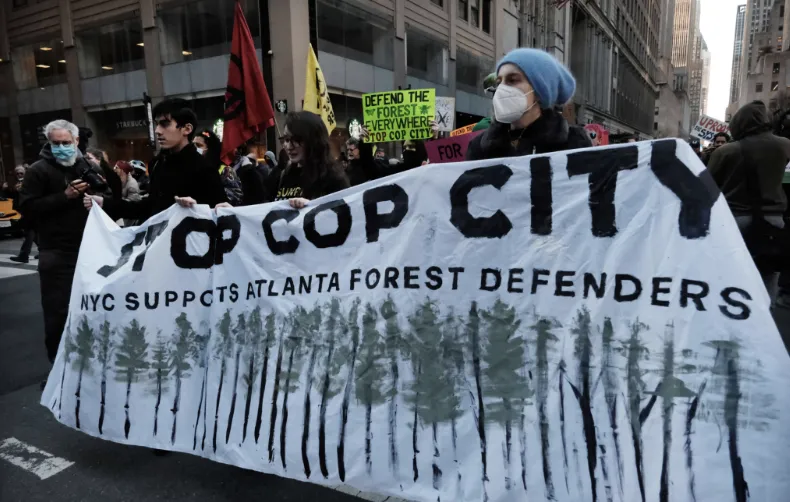
Since it was first proposed in 2017, the construction of Cop City in Atlanta, Georgia has proved to be a highly controversial project. The Atlanta Public Safety Training Center, commonly referred to as “Cop City”, is a substantial law enforcement training facility under construction in the South River Forest area of Dekalb County. Once it is fully constructed, it will be one of the largest militarized police training facilities in the nation. Opposition to the project significantly ramped up following the reignition of the Black Lives Matter movement in 2020 when calls to defund the police gained prominence. In addition to controversy stirred by the increased anti-police sentiments, environmentalists and Atlanta residents alike have taken issue with Cop City. Many are familiar with opposition to Cop City from the civil rights standpoint but there are significant environmental issues at stake in the project as well. Environmental activists and organizations have expressed dissent from various angles citing deforestation, water pollution, and environmental discrimination among other concerns in their pleas against the facility. Some environmental organizers have even utilized legal frameworks in their efforts to halt construction.
On August 1, 2023, the South River Watershed Alliance (SRWA), filed a lawsuit against the city of Atlanta and the police foundation spearheading plans for the facility [1]. The SRWA is the only advocacy organization centered on protecting the South River, one of the most endangered rivers in the U.S. [2]. The organization filed the lawsuit on the premise that the facility was in violation of the Clean Water Act claiming that “sediment discharged from the construction site into the South River watershed violates the project's Clean Water Act permit and the law's water quality standards” [3]. Sediment runoff is a significant issue in matters of water pollution as it is the most substantial polluter of rivers and streams in the United States [4]. This is especially topical in this case as the South River is already considered endangered and any significant pollution could have devastating consequences on the condition of the river.
Amidst several unsuccessful demonstrations to slow the development of the facility resulting in arrests and domestic terrorism charges, this lawsuit seemed like a potentially promising strategy to decelerating construction of the training center. However, the Supreme Court decision Sackett v. The Environmental Protection Agency in May 2023 [5], significantly undercut the scope of the Clean Water Act. It ruled that the jurisdiction of the act “does not cover wetlands that lack a continuous surface connection to a larger body of water” [6]. While this ruling did not necessarily exclude the South River in the scope of the Clean Water Act, it significantly weakened federal protection of wetlands and lowered the threshold for obtaining a permit. This ruling precedent, along with the robust legal defense that the city employed, resulted in the federal court ruling against the SRWA on January 16, 2024. In his ruling, District Judge J.P, Boulee wrote, “The city and APF provided evidence to show they comply with best management practices that prevent the discharge of enough sediment to cause a water quality problem” [7]. The court further explained that the Plaintiff had not, at that point, presented enough evidence to “warrant the ‘extraordinary and drastic remedy' of halting construction” [8]. Based on the rationale provided in this decision, it seems that at this stage in the training facility’s construction, the court would need a highly substantial or extraordinary cause to legally halt the project.
Environmental activists have recognized the swift development of the training facility as a deliberate strategy to strengthen their case in legal proceedings. The SRWA board president explains, “‘We are trying to stop construction at the site because [the contractors] are going at it seven days a week…They are really trying to get it to a point where they can make a claim that they have gone too far to stop now’” [9]. Legal battles against the Cop City project have proven to be extremely difficult as this lawsuit is just one of four attempts made by the SRWA to stop the construction of the facility. The January 2024 decision comes after a February 2023 joint injunction attempt by a Dekalb resident, Dekalb County Commissioner, and the SRWA. They fought to get a stop-work order based citing land use and environmental concerns but ultimately a county judge ruled against it. The several legal attempts to prosecute Cop City made by the SRWA alone demonstrates the highly controversial nature of this facility for environmental activists, lawyers, and organizations.
These environmental concerns have intersected with various other aspects of the opposition movement referred to as Stop Cop City. In fact, “The EPA confirmed…it is reviewing the complaint filed Oct. 30 [2023] by a coalition of DeKalb County residents, three environmental advocacy nonprofits, and Community Movement Builders, a nonprofit working to achieve Black liberation” [10]. This complaint highlights a legal strategy to focus on federal regulations that pertain to the intersection between marginalized communities and the environment. The construction site for the facility is located in a predominantly Black and Hispanic community which has sparked claims of environmental racism. The issues in the complaint include “that clearing 85 acres of trees has likely already increased water and air pollution in an area where 74% of the residents are Black and Hispanic; that a smaller tree canopy is already making the area hotter; that increased waterway sediment will kill off area wildlife; that the reduction of greenspace will hurt nearby property values; and that the South River and its Intrenchment Creek tributary, which runs through a predominantly Black and low-income neighborhood near the center, are already a notorious dumping ground for raw sewage and for other pollutants” [11]. Through this approach, activists hope that the combined efforts of civil and environmental litigation will produce a more serious cause for pumping the brakes on the Cop City project, which has been moving at a swift speed. Furthermore, Atlanta has been nicknamed “The City in a Forest” because of its dense urban tree coverage and abundance of forestry [12]. For many protestors, clearcutting this forestry to make space for Cop City is a removal of a symbolic and integral component of the city itself. It led to massive, widespread protesting where one environmental protester was fatally shot and killed in the clash between law enforcement and protesters [13]. Such events have created a tense legal and political environment surrounding the implementation of Cop City. The tumultuous legal battle that opponents of Cop City have faced in the past year has activists, residents, and organizations concerned about the complex implications of this project. What will happen to Atlanta’s South River? How will the clear-cutting of South Forest impact nearby communities and the landscape of urban environmental law?
Bibliography
[1] South River Watershed Alliance v. City of Atlanta, U.S. District Court for the Northern District of Georgia, 2023
[2] “South River Named Among America’s Most Endangered Rivers”, American Rivers, 2021
[3] Clark Mindock, “Atlanta sued over water pollution from 'Cop City' construction”, Reuters, 2023
[4] “What is Sediment Pollution?”, EPA
[5] Sackett v. Environmental Protection Agency, Supreme Court of the United States, 2022
[6] Alex Brown, “After Clean Water Act ruling, states that want to protect affected wetlands need millions”, Stateline, 2023
[7] Dyana Bagby, “Judge rules against environmental group’s attempt to stop construction of ‘Cop City’”, Rough Draft, 2024
[8] Id.
[9] Jocelyn James, “Environmental pollution lawsuit may pump the breaks on Cop City construction”, Prism, 2023
[10] Chauncey Alcorn, “Environmental impact targeted in new push against ‘Cop City’”, The Center for Public Integrity, 2023
[11] Id.
[12] Johanna Baidya, “A City in the Forest: Atlanta’s Effort to Preserve Nature in the City”, Trees Atlanta
[13] Nick Valencia, Devon Sayers, Pamela Kirkland, “Climate activist killed in ‘Cop City’ protest sustained 57 gunshot wounds”, 2023
Works Cited
Alcorn, Chauncey. “Environmental Impact Targeted in New Push against ‘Cop City.’” Center for Public Integrity, 15 Nov. 2023, publicintegrity.org/environment/pollution/environmental-justice-denied/environmental-impact-targeted-in-new-push-against-cop-city/.
Bagby, Dyana. “Judge Rules against Environmental Group’s Attempt to Stop Construction of ‘Cop City.’” Rough Draft Atlanta, 19 Jan. 2024, roughdraftatlanta.com/2024/01/18/judge-rules-against-environmental-groups-attempt-to-stop-construction-of-cop-city/.
Baidya, Johanna. “A City in the Forest: Atlanta’s Effort to Preserve Nature in the City.” Trees Atlanta, www.treesatlanta.org/news/a-city-in-the-forest-atlantas-effort-to-preserve-nature-in-the-city/. Accessed 19 Apr. 2024.
Brown, Alex. “After Clean Water Act Ruling, States That Want to Protect Affected Wetlands Need Millions.” Stateline, 5 Dec. 2023, stateline.org/2023/12/05/after-clean-water-act-ruling-states-that-want-to-protect-affected-wetlands-need-millions/#:~:text=Staffing%20shortfalls,many%20waters%20that%20connect%20underground.
James, Jocelyn. “Environmental Lawsuit May Pump the Breaks on Cop City.” Prism, 20 Nov. 2023, prismreports.org/2023/11/20/environmental-racism-lawsuit-cop-city/.
Mindock, Clark. “Atlanta Sued over Water Pollution from ‘cop City’ Construction | Reuters.” Reuters, 4 Aug. 2023, www.reuters.com/legal/litigation/atlanta-sued-over-water-pollution-cop-city-construction-2023-08-04/.
“South River Named among America’s Most Endangered Rivers.” Life Depends on Rivers, 13 Apr. 2021, www.americanrivers.org/media-item/south-river-named-among-americas-most-endangered-rivers/#:~:text=Washington%2C%20D.C.%20–%20American%20Rivers%20today,clean%20water%20and%20public%20health.
Supreme Court of the United States. Sackett v. Environmental Protection Agency. 25 May 2023, https://www.supremecourt.gov/opinions/22pdf/21-454_4g15.pdf. Accessed 19 Apr. 2024.
U.S. District Court for the Northern District of Georgia. South River Watershed Alliance v. City of Atlanta and Atlanta Police Foundation. 1 Aug. 2023, https://fingfx.thomsonreuters.com/gfx/legaldocs/mopajkmxdva/cop%20city%20lawsuit.pdf. Accessed 19 Apr. 2024.
Valencia, Nick, et al. “Climate Activist Killed in ‘cop City’ Protest Sustained 57 Gunshot Wounds, Official Autopsy Says, but Questions about Gunpowder Residue Remain.” CNN, Cable News Network, 20 Apr. 2023, www.cnn.com/2023/04/20/us/cop-city-activist-killed-dekalb-county-medical-examiner/index.html.
“What Is Sediment Pollution?”, cfpub.epa.gov/npstbx/files/ksmo_sediment.pdf. Accessed 19 Apr. 2024.