The Impact of Coal Plants on Climate Change in South Africa
Written by: Emma Farley
Edited By: Keana Simon and Lawrence Langen
Abstract:
This article explores a South African court case where three civil society organizations launched a youth-led constitutional challenge against the government regarding its plans to build new coal plants. By examining the historical context of the Paris Agreement and other South African cases that challenged government inaction toward climate change, this article delineates a timeline that contextualizes the coal vs. renewable energy debate in South Africa. This piece aims to explain why people in South Africa support or oppose using coal or renewable energy and make inferences about how continuing to use fossil fuels will affect the South African environment and economy in the future.
On April 22, 2016, South Africa signed the Paris Agreement, a diplomatic agreement on climate change. It was adopted by 196 parties at the UN Climate Change Conference (COP21) in Paris, France on December 12, 2015, and entered into effect on November 4, 2016 [1]. This treaty's overarching goal was to hold "the increase in the global average temperature to well below 2°C above pre-industrial levels" and pursue efforts "to limit the temperature increase to 1.5°C above pre-industrial levels" [2]. The Paris Agreement is a landmark treaty since it was the first binding agreement that brought nations together to combat climate change and limit its effects [2]. All the members annually meet, share progress, renew their climate action pledges, and encourage each other to step up their commitments. However, there are no legal consequences for failing to meet the agreement [3].
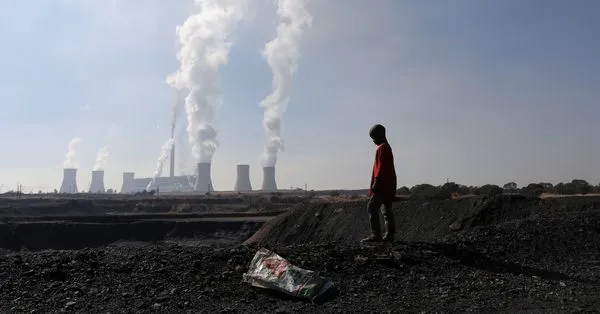
In November 2023, three South African senior government officials announced that their country would miss its 2030 carbon emissions targets under the Paris Agreement as it plans to run eight coal-fired power plants longer than planned. South Africa has one of the world’s highest per capita emissions of greenhouse gasses (GHGs) [4]. The country committed under the Paris Agreement to cut emissions between 350 and 420 million tonnes by 2030 [4]. To achieve this goal, South Africa originally planned to decommission eight coal-fired power plants, six by 2030 and the remaining by 2034. However, the process of switching from coal to renewable energy has been slowed down by disagreements within the government on energy policies [4].
One prominent official representing many South Africans who disagree with switching from coal to renewable energy is Gwede Mantashe, South Africa’s Minister of Mineral Resources and Energy. Mantashe was a former coal miner and has positioned himself as a champion of the coal industry, claiming that a hasty transition will cost jobs and cripple the country [5]. He believes public investments in coal, gas, and nuclear power are necessary for energy security and economic development [6]. In 2023, Mantashe attended the Africa Energy Indaba in Cape Town, Africa’s premier energy conference [7]. He urged delegates not to neglect the use of fossil fuels in the continent. Mantashe stated that addressing South Africa’s energy crisis will require increasing the amount of energy that power stations produce and finding ways to continue to have energy during emergencies. He believes the country should focus on these issues, not turning away from coal. Mantahse also claimed that many wealthy countries used coal and other fossil fuels to fortify their electricity supply but did not want African countries to do the same [7].
The debate over whether coal or renewable energy is the best option for South Africa is central to a new court case. On November 10, 2021, in a case titled Africa Climate Alliance et al. v. Minister of Mineral Resources & Energy et al. (also known as Cancel Coal), three civil society organizations - the African Climate Alliance (ACA), Vukani Environmental Justice Movement in Action (VEM), and groundWork (gW) - launched a youth-led constitutional challenge against Mantashe and the National Energy Regulator of South Africa (NERSA) concerning the government's plans to procure 1500 MW of new coal-fired power electricity capacity [8]. Specifically, the plaintiffs claimed that NERSA violated Section 24 of South Africa's Constitution, which states, "Everyone has the right…to an environment that is not harmful to their health or well-being…" [9]. According to plaintiffs, acquiring 1500 MW of new coal-fired power presents a severe threat to the constitutional rights of the people of South Africa. The plaintiffs state the new coal plants violate their environmental rights, children's best interests, and the rights to life, dignity, and equality [8].
On December 8, 2021, Mantashe said he would oppose the challenge. The plaintiffs agreed to grant Mantashe an extension to January 20, 2022, so he has more time to file the record of his decision and reasons. After that, the plaintiffs will have an opportunity to supplement their papers, which means they can modify or add to their initial claims. The President of South Africa has given notice that he will not oppose the case and will abide by the court's decision. Since the case is still pending, the plaintiffs are likely gathering more documents supporting their claim [8].
The plaintiffs in Africa Climate Alliance note that South Africa is one of the world's 15 most significant contributors to GHG emissions due to its overreliance on coal for energy generation. They argue that renewable energy as an alternative to coal is essential for protecting the environment and human health and is a practical economic solution to the need to increase the available energy in South Africa [8]. However, Mantashe and his supporters believe using coal is in South Africa’s best interest. Mantashe supported this belief at The Africa Energy Indaba in 2023 by saying, “Coal will be with us for many years to come, those who see it as a road to corruption will be disappointed for many years. Coal is going to outlive many of us” [7]. Mantashe said that since coal is a precious mineral in South Africa, the country should continue using it. He also said South Africa can use coal to increase and strengthen its energy supply [7]. Mantashe’s statements represent many South Africans' reluctance to abandon coal since it has been their main energy source for a long time.
The plaintiffs launched the Africa Climate Alliance case after the South African government failed to respond to a letter of demand sent to Mantashe on September 17, 2021, by The Center for Environmental Rights on behalf of ACA and VEM, which demanded that “...the IRP 2019 be revisited and the allocation of new coal and gas capacity…be abandoned” [10]. The IRP (Integrated Resource Plan) is a plan aimed at estimating South Africa’s electricity demand. The IRP 2019 aims to alleviate severe electricity supply shortages, which have led to frequent load-shedding (planned power outages) in South Africa. The IRP 2019 also involves installing over 25GW of renewable energy capacity and 3GW of energy storage by 2030 [11].
The Africa Climate Alliance case also comes in the wake of COP26 and the global consensus that countries must immediately phase out using coal if the world is to avoid catastrophic global warming [12]. At COP26, 190 countries agreed to phase down coal power [13]. Since the Paris Agreement was adopted, there has been a 76 percent drop in the number of new coal plants planned globally over the last six years [14].
To follow the Paris Agreement and decommission its old coal plants, South Africa signed onto the Just Energy Transition Partnership (JETP) in 2021 [15]. This financing cooperation mechanism helps heavily coal-dependent countries transition away from coal and towards new economic opportunities and jobs. The first JETP emerged from COP26 when South Africa was promised 8.5 billion USD in financing by the United States, France, Germany, the United Kingdom, and the European Union to help the country make this energy change [15]. According to the International Trade Administration, JETP plans to decommission and repurpose outdated coal-fired power plants to lower South Africa’s high emissions. By 2032, the South African government plans to shut down seven coal-fired power facilities. However, the International Trade Administration reports that despite environmental concerns, coal will continue to provide most of South Africa’s power for the next decade [14].
South Africa has struggled to move away from coal because coal has traditionally dominated the country's energy supply sector [16]. South Africa has a plentiful supply of cheap coal, making it a low-cost fuel source for electricity generation. About 80 percent of South Africa's primary energy needs are provided by coal [16]. A crucial advantage of using coal is that it's easy to store. Once mined, people can safely store it without risking fire or explosion hazards, which can happen with gas or oil [17]. However, South Africa may not be able to afford to use coal in the future if private banks stop funding it. For example, according to the Washington Post, “South African financial conglomerate FirstRand announced in September 2021 that it would end funding for new coal-fired power plants and coal mines by 2026 and that it would reduce its exposure to coal to reach net-zero carbon emissions by 2050” [18]. Many private companies in different countries are pulling funding from coal countries, and the trend could force coal-dependent countries, like South Africa, to move toward renewable energy.
More cases surrounding the coal vs. renewable energy debate may arise if the South African government refuses to shut down new coal plants and high GHG emissions and extreme weather events caused by climate change continue [19]. One example of a South African case that challenged government inaction towards climate change is Trustees for the Time Being of the Groundwork Trust and Vukani Environmental Justice Alliance Movement in Action v Minister of Environmental Affairs (the Deadly Air case). Here, the applicants' claims were similar to the ones in the Africa Climate Alliance case. The applicants challenged the failure of the South African government to protect people's constitutional rights to health and wellbeing from toxic levels of ambient air pollution caused predominantly by coal-fired power generation projects in the Highveld Priority Area (HPA), which is located in South Africa's Mpumalanga province [19].
The Deadly Air case was heard in the North Gauteng High Court in May 2021, and the final judgment came out on March 18, 2022. The court ruled in favor of the applicants in a landmark decision, which, for the first time, declared that the South African government was in breach of a constitutional right due to the health impacts of air pollution. The High Court concluded that the levels of air pollution in the HPA violated Section 24(a) of South Africa’s constitution, which states that citizens have a right to an environment that is not harmful to health or wellbeing [19].
Another case about coal plants in South Africa is The Deadly Air case. This case was heard in the North Gauteng High Court in May 2021, and the final judgment came out on March 18, 2022. The court ruled in favor of the applicants in a landmark decision, which, for the first time, declared that the South African government was in breach of a constitutional right due to the health impacts of air pollution. The High Court concluded that the levels of air pollution caused predominantly by coal-fired power generation in the HPA violated Section 24(a) of South Africa’s constitution. Section 24 is the same clause that the Deadly Air and Africa Climate Alliance plaintiffs used to support their claims [19].
Although many South Africans, like Mantashe, are worried about the impact of decommissioning coal-fired plants on the economy, opponents argue that climate change could seriously disrupt South Africa's economy in the long run. Warmer temperatures, rising sea levels, and extreme weather will damage property and critical infrastructure, impact human health and productivity, and negatively affect sectors such as agriculture, forestry, fisheries, and tourism [20]. The Africa Climate Alliance case plaintiffs may use these facts to support further their argument on why the government should shut down the new coal plants. However, South Africa has used coal as its primary energy resource for so long that the government might have to continue to promote it. Climate change affects not just South Africa but the entire planet, and the Africa Climate Alliance case is just one of many cases we will see in the future regarding how people will combat the effects of climate change.
[1] “South Africa.”
[2] “The Paris Agreement.”
[3] “How Are Countries Held Accountable Under the Paris Agreement? | MIT Climate Portal.”
[4] “Exclusive: South Africa to Miss 2030 Emissions Goal as It Keeps Coal Plants Burning.”
[5] Andreoni, “The Coal Challenge.”
[6] Hedley, “South African Ministry Uses Opaque Modeling to Argue for Weakening Climate Ambition.”
[7] Matwadia, “Mantashe Defends the Continued Use of Coal at Africa Energy Indaba.”
[8] “Africa Climate Alliance Et. Al., V. Minister of Mineral Resources &Amp; Energy Et. Al. (#CancelCoal Case) - Climate Change Litigation.”
[9] “Constitution of the Republic of South Africa, 1996 - Chapter 2: Bill of Rights | South African Government.”
[10] Antwi et al., “LETTER OF DEMAND - INTEGRATED RESOURCE PLAN FOR ELECTRICITY 2019 AND THE MINISTERIAL DETERMINATION ON THE PROCUREMENT OF 1 500 MW OF NEW GENERATION CAPACITY FROM COAL.”
[11] “Bloomberg - Are You a Robot?”
[12] Nozuko, “Youth-Led #CancelCoal Climate Case Launched Against Government’s Plans for New Coal-Fired Power.”
[13] Admin, “What Does COP Stand for in COP21? – Shabupc.Com.”
[14] “South Africa - Energy.”
[15] Kramer, “Just Energy Transition Partnerships: An Opportunity to Leapfrog From Coal to Clean Energy.”
[16] “South Africa - Energy,” January 26, 2024.
[17] Energy Explorer, “Power From Coal.”
[18] Mufson, “South Africa Has One of the Most Coal-Intensive Economies in the World. Can It Change?”
[19] Loser, “Litigation Against Coal-Fired Power in South Africa: Lessons From and for Global Climate Litigation to Reduce Greenhouse Gas Emissions.”
[20] Greenpeace Africa, “Climate Change in South Africa: 21 Stunning Facts About South Africa’s Climate Breakdown - Greenpeace Africa.”
[21] Merven, Burton, and Lehmann-Grube, “Assessment of New Coal Generation Capacity Targets in South Africa’s 2019 Integrated Resource Plan for Electricity.”
[22] Bouwer, “The Influence of Human Rights on Climate Litigation in Africa.”
[23] Sahu and Centre for Environmental Rights, “COMMENTS ON POTENTIAL IMPACTS OF PROPOSED NEW COAL GENERATION UNDER THE SOUTH AFRICA 2019 INTEGRATED RESOURCE PLAN.”
[24] UNITED NATIONS, “PARIS AGREEMENT.”
[25] Bega, “Court Orders Mantashe to Release Key Planning Records About New Coal Power.”
[26] Earthjustice, “South Africa’s Youth Take on Coal and the Climate Crisis - Earthjustice.”
[27] “Climate Change Litigation in Africa: Current Status and Future Developments.”
[28] Boundless Immigration, U.S. Immigration News - the Boundless Blog.
[29] “Anudo V. United Republic of Tanzania.”
[30] “EarthLife Africa Johannesburg V. Minister of Environmental Affairs and Others - Climate Change Litigation.”
Works Cited
Admin. n.d. “What Does COP Stand for in COP21? – Shabupc.com.” https://www.shabupc.com/what-does-cop-stand-for-in-cop21/.
“Africa Climate Alliance Et. Al., V. Minister of Mineral Resources &Amp; Energy Et. Al. (#CancelCoal Case) - Climate Change Litigation.” 2021. Climate Change Litigation. December 17, 2021. https://climatecasechart.com/non-us-case/africa-climate-alliance-et-al-v-minister-of-mineral-resources-energy-et-al-cancelcoal-case/.
Andreoni, Manuela. 2023. “The Coal Challenge.” Climate Forward, March 3, 2023. Accessed March 28, 2024. https://www.nytimes.com/2023/03/03/climate/the-coal-challenge.html.
“Anudo V. United Republic of Tanzania.” n.d. Open Society Justice Initiative. https://www.justiceinitiative.org/litigation/anudo-v-united-republic-tanzania.
Bega, Sheree. 2022. “Court Orders Mantashe to Release Key Planning Records About New Coal Power.” The Mail & Guardian. December 15, 2022. https://mg.co.za/the-green-guardian/2022-12-15-court-orders-mantashe-to-release-key-planning-records-about-new-coal-power/.
“Bloomberg - Are You a Robot?” n.d. https://www.bloomberg.com/netzeropathfinders/best-practices/integrated-resource-plan-south-africa/#:~:text=The%20plan%20aims%20to%20alleviate,2030%2C%20procured%20through%20regular%20auctions.
Boundless Immigration. n.d. U.S. Immigration News - the Boundless Blog. Boundless. https://www.boundless.com/blog/category/immigration-news/.
Bouwer, Kim. 2022. “The Influence of Human Rights on Climate Litigation in Africa.” Journal of Human Rights and the Environment 13 (1). https://doi.org/10.4337/jhre.2022.01.07.
“Climate Change Litigation in Africa: Current Status and Future Developments.” 2021. White & Case LLP International Law Firm, Global Law Practice. November 9, 2021. https://www.whitecase.com/insight-our-thinking/climate-change-litigation-africa-current-status-and-future-developments.
“Constitution of the Republic of South Africa, 1996 - Chapter 2: Bill of Rights | South African Government.” n.d. https://www.gov.za/documents/constitution/chapter-2-bill-rights#24.
Earthjustice. 2022. “South Africa’s Youth Take on Coal and the Climate Crisis - Earthjustice.” October 4, 2022. https://earthjustice.org/experts/ramin-pejan/south-africas-youth-take-on-coal-and-the-climate-crisis.
“EarthLife Africa Johannesburg V. Minister of Environmental Affairs and Others - Climate Change Litigation.” 2021. Climate Change Litigation. January 6, 2021. https://climatecasechart.com/non-us-case/4463/.
Energy Explorer. n.d. “Power From Coal.” The Clay Center. https://www.theclaycenter.org/wp-content/uploads/2016/10/Energy-Curriculum-Coal.pdf.
Greenpeace Africa. 2023. “Climate Change in South Africa: 21 Stunning Facts About South Africa’s Climate Breakdown - Greenpeace Africa.” August 30, 2023. https://www.greenpeace.org/africa/en/blogs/54171/climate-change-in-south-africa-21-stunning-facts-about-south-africas-climate-breakdown/#:~:text=Warmer%20temperatures%2C%20sea%20level%20rise,biggest%20threats%20to%20economic%20stability.
Hedley, Nick. 2024. “South African Ministry Uses Opaque Modelling to Argue for Weakening Climate Ambition.” Climate Home News. January 8, 2024. https://www.climatechangenews.com/2024/01/08/south-african-ministry-uses-opaque-modelling-to-argue-for-weakening-climate-ambition/.
“How Are Countries Held Accountable Under the Paris Agreement? | MIT Climate Portal.” n.d. MIT Climate Portal. https://climate.mit.edu/ask-mit/how-are-countries-held-accountable-under-paris-agreement.
Kramer, Katherine. n.d. “Just Energy Transition Partnerships: An Opportunity to Leapfrog From Coal to Clean Energy.” International Institute for Sustainable Development. https://www.iisd.org/articles/insight/just-energy-transition-partnerships.
Loser, Nicole. 2021. “LETTER OF DEMAND - INTEGRATED RESOURCE PLAN FOR ELECTRICITY 2019 AND THE MINISTERIAL DETERMINATION ON THE PROCUREMENT OF 1 500 MW OF NEW GENERATION CAPACITY FROM COAL.” CER61/NL/MS. Centre for Environmental Rights. Centre for Environmental Rights. https://cer.org.za/wp-content/uploads/2021/09/CER-Letter-of-Demand-to-Minister-Mantashe-and-NERSA-2021.09.17.docx.pdf.
———. 2024. “Litigation Against Coal-fired Power in South Africa: Lessons From and for Global Climate Litigation to Reduce Greenhouse Gas Emissions.” In Bristol University Press eBooks, 68–101. https://doi.org/10.51952/9781529228977.ch004.
Matwadia, Eyaaz. 2023. “Mantashe Defends the Continued Use of Coal at Africa Energy Indaba.” The Mail & Guardian. March 8, 2023. https://mg.co.za/the-green-guardian/2023-03-07-mantashe-defends-the-continued-use-of-coal-at-africa-energy-indaba/.
Merven, Bruno, Jesse Burton, and Patrick Lehmann-Grube. 2021. “Assessment of New Coal Generation Capacity Targets in South Africa’s 2019 Integrated Resource Plan for Electricity.” https://cer.org.za/wp-content/uploads/2021/11/ESRG_New-coal-plants-South-Africa_021121.pdf.
Mufson, Steven. 2021. “South Africa Has One of the Most Coal-intensive Economies in the World. Can It Change?” Washington Post, November 1, 2021. https://www.washingtonpost.com/climate-environment/2021/10/31/south-africa-has-one-most-coal-intensive-economies-world-can-it-change/.
Mukherjee, Promit. 2023. “Exclusive: South Africa to Miss 2030 Emissions Goal as It Keeps Coal Plants Burning.” Reuters. November 9, 2023. https://www.reuters.com/sustainability/south-africa-miss-2030-emissions-goal-it-keeps-coal-plants-burning-2023-11-09/.
Nozuko. 2021. “Youth-led #CancelCoal Climate Case Launched Against Government’s Plans for New Coal-fired Power.” Centre for Environmental Rights. November 17, 2021. https://cer.org.za/news/youth-led-cancelcoal-climate-case-launched-against-governments-plans-for-new-coal-fired-power.
Sahu, Ranajit, Ph.D, QEP, CEM and Centre for Environmental Rights. 2021. “COMMENTS ON POTENTIAL IMPACTS OF PROPOSED NEW COAL GENERATION UNDER THE SOUTH AFRICA 2019 INTEGRATED RESOURCE PLAN.” https://cer.org.za/wp-content/uploads/2021/08/SAHU-SA-2019-IRP-2021-07-6jl-clean-final.docx.pdf.
“South Africa - Energy.” 2024a. International Trade Administration | Trade.Gov. January 26, 2024. https://www.trade.gov/country-commercial-guides/south-africa-energy.
“———.” 2024b. International Trade Administration | Trade.Gov. January 26, 2024. https://www.trade.gov/country-commercial-guides/south-africa-energy#:~:text=The%20projections%20are%20supported%20by,2023%20according%20to%20BMI%20projections.
UNITED NATIONS. 2015. “PARIS AGREEMENT.” https://unfccc.int/files/essential_background/convention/application/pdf/english_paris_agreement.pdf.
“United Nations Climate Change.” 2002. United Nations Climate Change. 2002. Accessed March 28, 2024. https://unfccc.int/node/61201.
Ware, Jessica. 2021. “End of Coal in Sight at COP26.” Press release. November 4, 2021. https://unfccc.int/news/end-of-coal-in-sight-at-cop26.
“What Is the Paris Agreement?” n.d. Uploaded by the United Nations. United Nations Climate Change. Accessed March 28, 2024. https://unfccc.int/process-and-meetings/the-paris-agreement.