The Impact of Ramos V. Nielsen on Temporary Protection for Migrants
Written by: Emma Farley
Edited By: Keana Simon and Lawrence Langen
Abstract:
In my article, I discuss the history of Temporary Protected Status (TPS) and how the program has changed under several presidential administrations. I analyze the importance of TPS designations among migrants who need this status in order to legally work and reside in the U.S. I explain how the Trump Administration's decision to terminate TPS designations for certain countries violated the U.S. Constitution and the Administrative Procedure Act. I also address how TPS holders from countries whose status is in jeopardy, including Haitian migrants, are fairing today. I am passionate about this piece because I am interested in how U.S. immigration and asylum policy has evolved over time.
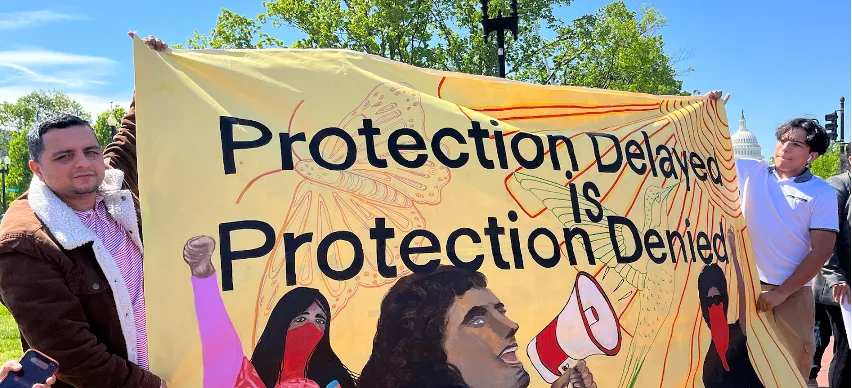
Temporary Protected Status (TPS) is a program established in 1990 that allows migrants the right to live and work in the U.S. TPS enables migrants to work in the U.S. for up to eighteen months. The U.S. government can renew TPS status for countries unlimited times. The U.S. government gives countries TPS status if it believes those countries are unsafe places to live. Former President Donald Trump adopted a narrower interpretation of the federal law governing TPS after taking office. Between late 2017 and early 2018, his administration used that interpretation to terminate TPS status for Sudan, Nicaragua, Haiti, and El Salvador. On October 3, 2018, TPS holders from those countries and their U.S. citizen children filed a lawsuit against the federal government in a case titled Ramos v. Nielsen. They argued that the TPS termination for their countries was illegal and explained that the government did not follow the Administrative Procedure Act (APA), which governs the process by which federal agencies develop and issue regulations, and acted out of racism, claiming the federal government was violating the Equal Protection Clause in the Fifth Amendment of the Constitution .
Congress established TPS as part of the Immigration Act of 1990 to provide humanitarian relief to citizens whose countries were suffering from natural disasters, protracted unrest, or conflict. That same year, Congress offered this program to people fleeing the Salvadoran Civil War. This war in El Salvador between the government of El Salvador and the Farabundo Martí National Liberation Front lasted from 1979 to 1992. Democrats and Republicans have broadly supported TPS for over three decades. The United States has another program similar to TPS called Deferred Enrollment Departure (DED). This program offers a temporary stay to migrants fleeing from war or other conflict. One of the main differences between TPS and DED is that the Secretary of the Department of Homeland Security designates TPS-eligible countries, and the president grants people DED through executive order.
Today, about six hundred and ten thousand foreign nationals from sixteen countries hold TPS. As of 2022, over three hundred thousand people were at risk of deportation and family separation from the Trump TPS terminations. Before the plaintiffs for Ramos v. Nielsen filed their case in 2018, the Trump administration moved to end TPS designations in 2017. Immigration restriction was central to Trump's presidential campaign platform, and he took numerous steps to boost immigration enforcement and change asylum policy, laws that allow individuals to remain in the U.S. instead of being deported to a country where those people fear persecution or harm.
The Refugee Act of 1980 established permanent procedures for vetting, admitting, and resettling refugees into the U.S. Since Congress passed this law, the U.S. has admitted more than three million refugees. The president proposes annual numerical ceilings on refugee admissions and requires congressional approval. In 2016, former President Barack Obama increased an earlier approved ceiling of eighty thousand to allow in an additional five thousand refugees as part of an effort to address a growing migration crisis caused by a worsening conflict in Syria. In 2017, Trump reversed Obama’s proposed ceiling to fifty thousand. Trump lowered the ceiling again to forty-five thousand in 2018, thirty thousand in 2019, eighteen thousand in 2020, and fifteen thousand in 2021, the lowest refugee ceiling since the start of the Refugee Act.
Trump's platform also included planning to end TPS protections for hundreds of thousands of migrants. In late 2017, Trump’s administration terminated the TPS designations for Haiti, Nicaragua, and Sudan. The following January, it terminated the protections for Salvadorans, who account for more than half of all TPS holders. In April, it terminated TPS for Nepal and Honduras. The Department of Homeland Security (DHS) explained Trump's decision to end the TPS designations for these migrants by stating that the countries these migrants were from had recovered enough for those people to return safely. DHS gave these migrants between twelve and eighteen months to remain in the United States and plan for their return to their country. However, various legal challenges halted the Trump Administration's efforts to end TPS designations. Many lawsuits argued that the administration's decision to terminate TPS infringed on individuals' constitutional rights and was racially discriminatory.
The Ramos v. Nielsen case highlights how the Trump Administration's decision to end TPS violated the Constitution and other legislation. In this civil case, TPS holders and their U.S. citizen children challenged the termination of TPS for Sudan, Nicaragua, Haiti, and El Salvador. The Ninth Circuit Court of Appeals found substantial evidence that the terminations were motivated by racism in violation of the Constitution. The court also found that the Trump Administration violated the Administrative Procedure Act by not explaining why they set new standards for TPS designations. The plaintiffs used the Equal Protection Clause in the Fifth Amendment, which prohibits racial discrimination, to support their argument that the Trump Administration violated the Constitution. They claimed that Trump “expressed animus against non-white, non-European immigrants.” However, the court determined that the plaintiffs were entitled to a preliminary injunction based on their APA claim alone and that a decision on the plaintiffs’ Equal protection claim would not provide them any additional relief..
The Trump Administration violated the Administrative Procedure Act (APA) by not following protocol for terminating TPS. According to the United States Environmental Protection Agency, "The Administrative Procedure Act (APA) governs how federal agencies develop and issue regulations. It includes requirements for publishing notices of proposed and final rulemaking in the Federal Register and provides opportunities for the public to comment on notices of proposed rulemaking". In the immigration context, the APA is an essential tool for challenging immigration laws and policies and can be used to remedy unlawful immigration actions. APA claims are brought in federal district court by filing a civil complaint, which initiates a lawsuit. Through APA claims, one can seek injunctive relief, which restrains a party from doing certain acts or requires a party to act in a certain way. Some types of injunction relief include temporary restraining orders or preliminary injunctions .
On October 3, 2018, the U.S. District Court of the Northern District of California issued a preliminary injunction blocking the Trump administration's termination of legal status for beneficiaries of Temporary Protected Status (TPS) from El Salvador, Nicaragua, Haiti, and Sudan. Currently, the Ramos v. Nielsen preliminary injunction is still in effect. As a result of the injunction, the TPS designations of El Salvador, Haiti, Nicaragua, and Sudan remain standing. Haiti’s TPS status will go into 2024, while the rest of these countries will maintain their TPS status until 2025.
The Ramos v. Nielsen lawsuit resulted in TPS holders from Nicaragua, Haiti, and Sudan receiving an automatic nine-month extension of their TPS and work authorization every nine months while the lawsuit is ongoing. However, the Supreme Court may only protect TPS holders for a little longer. In June 2021, the Supreme Court ruled that being granted TPS does not override a previous unlawful entry into the country. This ruling disqualifies many migrants seeking to transition from TPS to permanent residency. People who come to the U.S. illegally cannot become permanent residents, so for many migrants, having TPS status is the only way they can stay in the U.S.
Many TPS holders also risk being deported to countries where they could suffer extreme violence. Emmanuella is a Haitian migrant waiting to receive TPS status since she arrived in the U.S. in 2020. She currently lives in an apartment building in Auguam, Massachusetts. She describes the dangers she grew up around in Haiti when she states, “There was a lot of rape, violence, and kidnapping around me”. Andre, another Haitian migrant who lives a few units down from Emmanuella, worries for his mom and siblings living in Port-au-Prince, Haiti. He describes the violence in the capital when he states, “People's lives are worth nothing…They kidnap people. Even if you’re a patriot and you love your country, you would not want to live in this moment”. Andre is currently waiting for TPS status. He has a wife and a three-year-old son and feels that not having a work permit makes it difficult for him to provide for his family. TPS gives migrants security and stability in their lives, and not knowing when their TPS status will come is stressful.
The U.S. has supported its decisions to terminate TPS designation in the past with evidence that those countries no longer require aid from the U.S. In the case of Haiti, DHS stated in 2017 that Haitians no longer needed TPS status because, since the 2010 earthquake, the number of displaced people in Haiti had decreased by 97 percent. Nearly thirty thousand children have been born in the U.S. to Haitians with protected status. Those children are citizens and entitled to stay. If Haitian parents lose their TPS status, many of them will have to decide between taking their children back to Haiti, leaving them with relatives or guardians in the U.S., or remaining in the country illegally, risking deportation.
President Joe Biden is planning to reverse Trump's restrictive approach to immigration, renew TPS designations for specific countries, and expand the program. In March 2021, his administration granted TPS designations to Myanmar and Venezuela due to ongoing humanitarian crises. In May, it announced a new eighteen-month designation for Haiti following weeks of political unrest there. DHS also extended TPS benefits for nine other countries, including El Salvador, Nepal, and Somalia, all of which were hit hard by COVID-19. Extending TPS status for these countries will help limit the risk that migrants from these countries will be deported.
On January 20, 2021, Biden announced the US Citizenship Act of 2021, his plan for reforming immigration policy. This bill aims to create an eight-year path to citizenship for nearly eleven million undocumented immigrants. This group of immigrants includes those who have lived in the U.S. since 2017. The American Dream and Promise Act of 2021, a subset of this bill, would create a conditional permanent resident status for migrants, including DED and TPS holders, lasting up to ten years. This act passed in the House of Representatives in 2021. Biden’s Build Back Better infrastructure plan includes a provision to provide TPS holders with a path to citizenship.
Biden also plans to reduce visa backlogs and deploy new technologies to increase security at the southern U.S. border. As of May 19, 2023, over 20 Democratic senators are reviewing efforts to pass legislation allowing qualified TPS recipients to apply for legal permanent residency. Immigration reform is expected to be a significant issue for the 2024 presidential election next fall, and the future of TPS will likely be a large part of this debate.
Works Cited
ACLU of Southern California. “Ramos v. Nielsen,” June 21, 2023. https://www.aclusocal.org/en/cases/ramos-v-nielsen.
Capital Area Immigrants’ Rights Coalition. “Bringing Administrative Procedure Act (APA) Claims to Challenge Immigration Actions.” Capital Area Immigrants’ Rights Coalition. Accessed November 27, 2023. https://www.caircoalition.org/sites/default/files/APA%20Practice%20Advisory%20FINAL.pdf.
“Challenges to TPS and DED Terminations and Other TPS-Related Litigation | Catholic Legal Immigration Network, Inc. (CLINIC),” October 6, 2023. https://www.cliniclegal.org/resources/humanitarian-relief/temporary-protected-status-and-deferred-enforced-departure/challenges.
Council of the EU. “Ukrainian Refugees: EU Member States Agree to Extend Temporary Protection.” European Council: Council of European Union, September 28, 2023. Accessed November 27, 2023. https://www.consilium.europa.eu/en/press/press-releases/2023/09/28/ukrainian-refugees-eu-member-states-agree-to-extend-temporary-protection/.
Hoeppner, Katie, and Emi MacLean. “The US Government Gave Them Protection. Now It May Take It Away. | ACLU.” American Civil Liberties Union, February 24, 2023. https://www.aclu.org/news/immigrants-rights/the-us-government-gave-them-protection-now-it-may-take-it-away.
Jordan, Miriam. “Trump Administration Ends Temporary Protection for Haitians.” The New
Klobucista, Claire. “How Does the U.S. Refugee System Work?” Council on Foreign Relations, February 16, 2023. https://www.cfr.org/backgrounder/how-does-us-refugee-system-work-trump-biden-afghanistan.
Montes, Gabrielle Thomas Clayton Oates, Megan Williams and Denisse Córdova. “Deporting Haitian Migrants Tears Black Families Apart. It’s the Afterlife of Slavery | Opinion.” Miami Herald, March 14, 2023. https://www.miamiherald.com/opinion/op-ed/article273135895.html.
National Immigrant Justice Center. “A Timeline of the Trump Administration’s Efforts to End Asylum,” n.d. https://immigrantjustice.org/timeline-trump-administrations-efforts-end-asylum#:~:text=In%20July%202019%2C%20the%20administration,U.S.%20through%20the%20southern%20border.
Panama, U.S. Mission. “Fact Sheet: The Biden-Harris Administration Takes New Actions to Increase Border Enforcement and Accelerate Processing for Work Authorizations - U.S. Embassy in Panama.” U.S. Embassy in Panama, September 25, 2023. https://pa.usembassy.gov/fact-sheet-the-biden-harris-administration-takes-new-actions-to-increase-border-enforcement-and-accelerate-processing-for-work-authorizations/.
Pew Research Center. “How TPS Has Expanded under the Biden Administration | Pew Research Center,” April 21, 2023. https://www.pewresearch.org/short-reads/2023/04/21/biden-administration-further-expands-temporary-protected-status-to-cover-afghanistan-cameroon-ukraine/.
POLITICO. “Biden Administration Expands Legal Status and Work Permits to Thousands of Venezuelan Migrants,” September 20, 2023. https://www.politico.com/news/2023/09/20/biden-expands-tps-migrants-00117278.
“Ramos FAQs – National TPS Alliance,” n.d. https://www.nationaltpsalliance.org/tps-lawsuit/ramos-faqs/#:~:text=In%20March%202018%2C%20TPS%20holders,Nielsen%E2%80%9D.
“Ramos v. Nielsen 3:18-Cv-01554 (N.D. Cal.) | Civil Rights Litigation Clearinghouse,” n.d. https://clearinghouse.net/case/16815/.
Roy, Diana. “What Is Temporary Protected Status?” Council on Foreign Relations, September 21, 2023. https://www.cfr.org/backgrounder/what-temporary-protected-status#:~:text=Established%20by%20the%20U.S.%20Congress,but%20extendable%2C%20period%20of%20time.
Spagat, Elliot, and Nbc. “US Court Allows Trump to End TPS for 4 Countries.” NBC 6 South Florida, September 15, 2020. https://www.nbcmiami.com/news/local/us-court-allows-trump-to-end-tps-for-4-countries/2292659/.
The Texas Tribune. “Broken Border,” April 9, 2020. https://www.texastribune.org/series/broken-border-texas-mexico-crisis-immigration-migr/
“TPS Lawsuit – National TPS Alliance,” n.d. https://www.nationaltpsalliance.org/tps-lawsuit/.
United States Citizenship and Immigration Services. “Temporary Protected Status | USCIS,” October 10, 2023. https://www.uscis.gov/humanitarian/temporary-protected-status#:~:text=Existing%20TPS%20beneficiaries%20who%20wish,period%20for%20your%20country%20begins.
United States Citizenship and Immigration Services. “Update on Bhattarai v. Nielsen | USCIS,” June 21, 2023. https://www.uscis.gov/humanitarian/temporary-protected-status/update-on-bhattarai-v-nielsen.
United States Citizenship and Immigration Services. “Update on Ramos v. Nielsen | USCIS,” June 21, 2023. https://www.uscis.gov/humanitarian/update-on-ramos-v-nielsen.
US Environmental Protection Agency. “Summary of the Administrative Procedure Act | US EPA,” n.d. https://www.epa.gov/laws-regulations/summary-administrative-procedure-act#:~:text=(1946),on%20notices%20of%20proposed%20rulemaking.
WBUR. “‘Anybody’s Guess How Long It Will Take’: Haitians Resettling in Agawam Wait for Federal Protections | WBUR News.” WBUR.Org, June 2, 2023. https://www.wbur.org/news/2023/06/02/temporary-protected-status-haitian-immigration-massachusetts.
World Bank Group. “Supporting Colombian Host Communities and Venezuelan Migrants during the COVID-19 Pandemic.” World Bank, October 31, 2021. https://www.worldbank.org/en/results/2021/10/31/supporting-colombian-host-communities-and-venezuelan-migrants-during-the-covid-19-pandemic.
New York Times, November 20, 2017. https://www.nytimes.com/2017/11/20/us/haitians-temporary-status.html.