International Law or the Lack Thereof: A Tale of Two Countries, Starring the Federal Republic of Nigeria and the United States of America
Written by: Temitope O. Taiwo | Georgia State University
Edited by: Natasha Kalombo
Abstract:
This article examines the legal and geopolitical contradictions underlying the United States government’s military intervention in Nigeria in late 2025, using the case as a lens through which to interrogate the structural weakness of international law. When President Donald J. Trump designated Nigeria a “Country of Particular Concern” under the International Religious Freedom Act and subsequently authorized missile strikes against ISIS-affiliated encampments in Sokoto State, he did so without congressional authorization, without a United Nations Security Council resolution, and without the deliberative process the relevant statute requires. This piece argues that the Nigerian case is not an anomaly but a demonstration: international law is consistently insufficient to constrain powerful nations, which selectively invoke or discard its frameworks based on strategic interests rather than principled obligations. This article further interrogates the factual premise of the intervention, the racial and geopolitical contradictions embedded in the administration's simultaneous travel ban on Nigerian nationals, and the broader implications for Black sovereignty and the future of the international legal order.
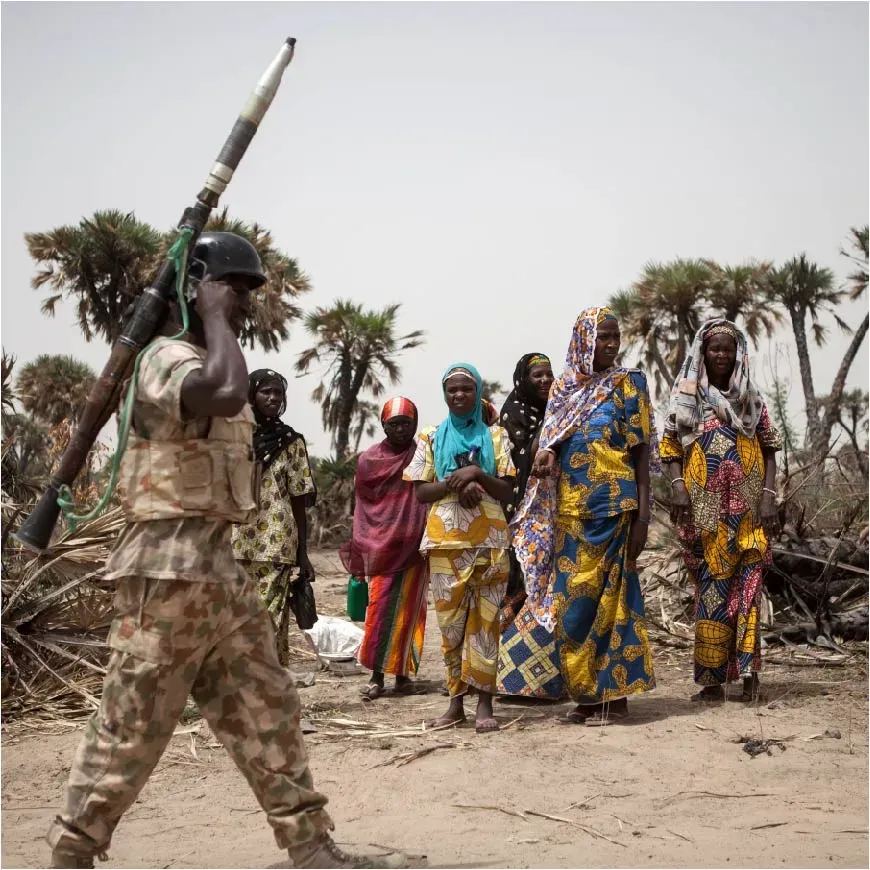
When the United States government turned its attention to Nigeria in the fall of 2025, many people took it at face value. The imagery was potent enough. Christians are being slaughtered. Radical Islam. Mass graves. The kind of language that has historically mobilized Western governments into action, or at least the performance of it. But, there is something deeply puzzling about watching a president who has banned the citizens of the most populous Black nation on Earth from entering the United States suddenly declare himself their savior. The tension at the center of this conversation is one that Black and African communities have encountered before, in Congo, in Libya, and in Sudan. When the United States intervenes in Africa, one must always ask who is truly being served. This piece argues that, in the case of Nigeria, the answer is not Nigerians. It is an argument not merely about one administration’s conduct, but about the architecture of international law itself, a system that presents as a universal framework of accountability while in practice, too weak to constrain nations powerful enough to ignore it.
On October 31, 2025, President Donald J. Trump designated Nigeria a “Country of Particular Concern” (CPC) under the International Religious Freedom Act of 1998, accusing the Nigerian government of permitting the massacre of Christians by radical Islamist groups. [1] Within days, he threatened military action, and on Christmas Day 2025, U.S. Africa Command fired Tomahawk missiles at ISIS-affiliated encampments in Sokoto State, Nigeria, deliberately timed, in Trump’s words, to arrive as a “Christmas present.” [2] These are not benign actions. They represent an American president authorizing military force in a sovereign African country, on explicitly religious grounds, without a congressional declaration of war or a United Nations Security Council resolution. The action being made on religious grounds alone should be enough to demand rigorous legal scrutiny, beginning with the statute the administration claimed as its authority.
The International Religious Freedom Act provides a mechanism for designating foreign governments as Countries of Particular Concern when “particularly severe violations of religious freedom” are found to occur. [3] But the statute calls for a deliberate, structured process, with the U.S. Commission on International Religious Freedom tasked with evaluating conditions worldwide and recommending designations to the Secretary of State. [4] As legal scholars at Lawfare have noted, the IRFA mechanism “has been more effective at condemning violations of religious freedom than at encouraging foreign governments to change policy,” and even at its best, the CPC designation is meant to trigger diplomatic tools, not military ones. [5] However, what happened in the final months of 2025 was different. The designation of Nigeria as a CPC country was announced on social media, credited to two congressional allies whom Trump personally directed to “look into” the matter, and followed within weeks by missile strikes. [6] This is not how the statute was designed to work, and scholars of executive power have long warned about exactly this kind of precedent.
The question of whether the American president has the legal authority to engage militarily in another country’s affairs is one of the oldest and most contested debates in constitutional and international law. Domestically, Article I of the U.S. Constitution gives Congress, not the president, the power to declare war. The War Powers Resolution of 1973 requires the president to notify Congress within 48 hours of introducing armed forces into hostilities and limiting deployments to 60 days without authorization. [7] But as Yale Law professor Oona Hathaway has argued, “presidents of both parties have expansively interpreted presidential authority to make decisions to use force, and Congress has proven unable or unwilling to insist on playing its formal constitutional role in response.” [8] Courts have almost always refused to intervene, leaving the executive branch with what Hathaway describes as “unprecedented free reign to decide when, where, and how to deploy armed force on behalf of the United States.” [9] Under international law, similar issues are present. The United Nations Charter’s Article 2(4) prohibits the use of force against the territorial integrity of another state, with exceptions reserved for Security Council authorization or genuine self-defense under Article 51. [10] As Hathaway’s research shows, the American habit of “ever-expanding reliance on the principle of self-defense” has “begun to erode the international law prohibition on the use of force not only for the United States, but for the world at large.” [11] To put it plainly, when the most powerful nation on earth repeatedly redefines when it is permissible to bomb another country, it rewrites the rules for everyone.
Nigeria’s case illustrates exactly how that rewriting manifests. Nigeria neither launched nor threatened an attack on the United States. The militant groups in question have targeted communities in Nigeria’s northwest, not American soil. The U.S. position was that the strikes were conducted in collective self-defense at Nigeria’s invitation, and the Nigerian government provided intelligence cooperation. [12] But the framing of the strikes as retaliation for Christian killings, not as a joint security operation with a sovereign partner, weakens that consent-based justification considerably. It raises a troubling question: was Nigeria consulted because the U.S. needed legal cover, or because the U.S. genuinely respected Nigerian sovereignty? One of AFRICOM’s posts on X initially stated the strikes were conducted “at the request of Nigerian authorities,” and was then deleted. [13] That deletion in itself tells its own story.
What the administration could not delete, however, was the data. The Trump administration framed its actions as a response to the genocide of Christians in Nigeria, but the data complicates that narrative significantly. An article from the New Internationalist found that of the nearly 53,000 civilians killed in targeted political violence since 2009, the overwhelming majority were of all faiths, concentrated in regions where jihadist insurgency, banditry, land disputes, and ethnic competition overlap. [14] A study published in the International Journal of Research and Innovation in Social Science found that between 2020 and 2024, ACLED recorded approximately 23,931 conflict events in Nigeria, resulting in 48,820 fatalities, with only about 1,033 events flagged as explicitly religion-targeted and yielding 779 fatalities, while ethnic and communal targeting caused many more deaths. [15] A peer-reviewed analysis in Terrorism and Political Violence similarly described Nigeria’s crisis as driven by two overlapping dynamics: the Boko Haram insurgency and the violence between Fulani herders and farming communities, with the Institute of Economics and Peace noting that together, “Fulani extremists and Boko Haram account for 78 percent of terror-related incidents and 86 percent of deaths from terrorism” across all victims, not only Christians. [16] Taken together, the data reveal not a religious war but a political and territorial one, and an administration that framed it otherwise was not confused about the facts. It was counting on its audience to be.
However, this does not mean that Christians have not suffered. Christian Nigerians have, disproportionately in certain areas like Benue State in the Middle Belt, been subject to religious terrorism, and that suffering is real and documented. [17] What the data does not support, however, is the narrative of a coordinated campaign to exterminate Christianity in Nigeria, which is a very specific legal and political claim. The 1948 Convention on the Prevention and Punishment of the Crime of Genocide defines genocide as acts “committed with intent to destroy, in whole or in part, a national, ethnic, racial or religious group.” [18] Intent is essential to that definition, and it is precisely what is missing when the overwhelming evidence shows that those responsible for violence in Nigeria, including Boko Haram and ISWAP, have attacked mosques, markets, and Muslim communities as readily as they have churches. [19] As HumAngle’s analysis of ACLED data concluded, “a systematic, nationwide genocide targeting Christians or any single religious group is not evident.” [20]
Which returns us to the strangeness of the situation. A president who has described Somalians as "garbage" and called for bans on immigration from “third world countries” is now presenting himself as the defender of Black African Christians. On December 16, 2025, just nine days before Christmas Day, Trump signed a proclamation expanding travel restrictions to include Nigeria, blocking virtually all immigrant and non-immigrant visas for Nigerian nationals. [21] The American Immigration Council noted that Nigeria was “the country most heavily impacted by the new restrictions,” with approximately 128,000 Nigerians having received visas annually in recent years. [22] The proclamation itself cited “radical Islamic terrorist groups such as Boko Haram and the Islamic State” operating in Nigeria as grounds for restricting Nigerians from entering the US. [23] So within the space of two weeks, the same administration told the world that Nigeria is a country so dangerous it cannot send visitors to America, and also fired missiles into it to protect Christians. One would have to find some reconciling logic between those two positions, and the obvious candidate is that neither position has much to do with the welfare of Nigerians, Christian or otherwise.
The more coherent explanation, which political scholars, including Adekeye Adebajo, have raised in The Gleaner, is that Trump's fixation on Nigeria, like his fixation on Ukraine, Greenland, and the Democratic Republic of Congo, is better understood through the lens of the Trump administration’s broader strategic obsession with critical minerals. The White House’s December 2025 National Security Strategy emphasized "securing access to critical supply chains and materials," and the Council on Foreign Relations has documented how access to critical minerals has been “at the core” of the administration's foreign policy posture across multiple continents. [24] The Foreign Policy Research Institute noted that the Trump administration views Africa as “a battleground for resource competition with China” and “a source of raw materials and a market for U.S. goods and services.” [25] Nigeria's north, the heart of the insurgency, sits atop significant mineral resources. A U.S. military foothold there means leverage over both those resources and China's competition for them. That is the straightforward logic of resource imperialism that African nations have been navigating since the colonial era.
It is also worth pausing to consider the spectacle of an American president, acting as the head of a constitutionally secular government, claiming to defend religious minorities beyond that country’s borders. The First Amendment to the U.S. Constitution prohibits the government from making laws “respecting an establishment of religion,” a principle that has been interpreted broadly to mean that the federal government should not favor one religion over others. [26] When a president deploys military force explicitly because Christians are being killed, and does not deploy military force when Muslims are being killed in the same conflict, they have made a religious distinction at the level of national security policy. The retaliatory attacks on February 3, 2026, which killed at least 162 people in the Muslim-majority villages of Woro and Nuku in Kwara State, received virtually no American commentary, and the U.S. State Department's condolences statement made no mention of the victims’ faith. [27] That asymmetry should disturb anyone who takes the secular character of the American state seriously.
That selective silence is international law without its costume, not the version written into charters and resolutions, but the version that actually governs the world, where powerful nations decide when the rules apply and to whom. The United States has been chipping away at that order for decades, and it just happens to be Nigeria’s turn now. Each time, the justification seems different. Each time, the underlying logic is the same: we are powerful enough to act, so we will frame our interests as out of moral necessity, and the rules will bend to accommodate us. For Black and African communities, the concern is not abstract. It is the recognition that the same legal architecture being eroded to bomb Nigeria today could be invoked by anyone tomorrow.
What Nigeria needs, as Nigerian civil society has said repeatedly, is not a foreign military presence announced on Truth Social and timed to coincide with a holiday. It needs the kind of sustained, multilateral engagement that addresses the root causes of its security crisis: the legacy of colonial boundaries that placed competing ethnic and religious groups within a single state, the competition over land and resources that fuels communal violence, and the jihadist ideology that has metastasized in the vacuum of poverty and government neglect. [28] What the United States has offered instead is a spectacular military gesture wrapped in the language of Christian solidarity, accompanied by a travel ban that tells Nigerian Christians and Muslims alike that they are not welcome on American soil. That is not protection. It is performance, dressed up in the language of international law long enough to satisfy the media. But yet, reform is still possible. Ideas are not what is missing; rather, it is the willpower to execute them. The War Powers Resolution must be given genuine enforcement mechanisms so that a president cannot unilaterally fire missiles into a sovereign nation and describe it in a social media post before notifying Congress. The United Nations Security Council’s veto structure must be reformed so that permanent membership does not amount to permanent impunity. African regional institutions, particularly the African Union, must be resourced and empowered to the point where African nations can resolve African crises without waiting for a Western government to decide their suffering is strategically useful. None of these changes is easy, and none of them is fast. But the alternative is a world where international law remains exactly what the Nigeria case reveals it to be: a set of rules that powerful nations wave at each other and quietly ignore when inconvenient. That is not a legal order. It is the performance of it, and the people of Nigeria deserve better than an audience.
References:
[1] Armed Conflict Location and Event Data Project (ACLED), “Fact Sheet: Attacks on Christians Spike in Nigeria Alongside Overall Rise in Violence Targeting Civilians,” ACLED,
[2] CNN Politics, “Trump says US military struck ISIS terrorists in Nigeria,” December 25, 2025.
[3] International Religious Freedom Act of 1998, 22 U.S.C. § 6442 (2000).
[4] U.S. Commission on International Religious Freedom, "IRFA Factsheet," USCIRF, March 2021,
[5] Rachel Dresser and Stephen Schneck, “Revisiting the CPC Designation,” U.S. Commission on International Religious Freedom; Noam Levey, “The International Religious Freedom Act: A Primer,” Lawfare, January 18, 2023
[6] Foreign Policy Research Institute, “A Conundrum: Strategic Minerals and a Peripheral Africa,” February 2026,
[7] War Powers Resolution of 1973, 50 U.S.C. §§ 1541-1548, Avalon Project, Yale Law School
[8] Oona A. Hathaway, “How the Erosion of U.S. War Powers Constraints Has Undermined International Law Constraints on the Use of Force,” Harvard National Security Journal, 2023,
[9] Hathaway, “How the Erosion of U.S. War Powers Constraints.”
[10] United Nations Charter, art. 2, para. 4 (1945); art. 51.
[11] id at 9.
[12] Foreign Policy Research Institute, “A Conundrum.”
[13] Zachary Basu, “US Strikes ISIS in Nigeria after Trump Warnings on Christian Killings,” Axios, December 25, 2025,
[14] New Internationalist, “Nigeria's Deadly Violence is Complex, but it’s Not a 'Christian Genocide,” December 9, 2025,
https://newint.org/violence/2025/nigerias-deadly-violence-complex-its-not-christian-genocide.
[15] Chibuike Okafor et al., “Bridging Nigeria's Intercultural and Interreligious Divides,” International Journal of Research and Innovation in Social Science 9, no. 11 (November 2025): 7529–7539,
https://rsisinternational.org/journals/ijriss/uploads/vol9-iss11-pg7529-7539-202512_pdf.pdf.
[16] Bello C. Chioma, “Violent Conflict and Hostility Towards Ethnoreligious Outgroups in Nigeria,” Terrorism and Political Violence 36, no. 3 (2024): 1–19,
https://www.tandfonline.com/doi/full/10.1080/09546553.2023.2285939.
[17] Ismail Olawale, “Is There a Christian Genocide in Nigeria? Evidence Shows All Faiths Are Under Attack by Terrorists,” The Conversation, November 5, 2025,
https://theconversation.com/is-there-a-christian-genocide-in-nigeria-evidence-shows-all-faiths-ar e-under-attack-by-terrorists-268929.
[18] Convention on the Prevention and Punishment of the Crime of Genocide, art. 2, December 9, 1948, 78 U.N.T.S. 277.
[19] HumAngle Media, “Nigeria's Conflicts Defy Simple Religious Labels,” October 20, 2025, https://humanglemedia.com/nigerias-conflicts-defy-simple-religious-labels/.
[20] HumAngle Media, “Nigeria's Conflicts Defy Simple Religious Labels.”
[21] Donald J. Trump, Proclamation 10998, “Restricting and Limiting the Entry of Foreign Nationals to Protect the Security of the United States,” December 16, 2025, https://www.whitehouse.gov/presidential-actions/2025/12/restricting-and-limiting-the-entry-of-fo reign-nationals-to-protect-the-security-of-the-united-states/.
[22] American Immigration Council, “President Trump Expands His Travel Ban: What You Need to Know,” December 19, 2025,
https://www.americanimmigrationcouncil.org/blog/president-trump-expands-his-travel-ban-what -you-need-to-know.
[23] Trump, Proclamation 10998.
[24] Council on Foreign Relations, “Behind Trump's Peace Efforts: A Strategic Focus on Critical Minerals,” December 15, 2025,
https://www.cfr.org/articles/behind-trumps-peace-efforts-strategic-focus-critical-minerals. [25] ID at 12.
[26] U.S. Const. amend. I.
[27] ID at 12.
[28] Chibuike Okafor et al., “Bridging Nigeria's Intercultural and Interreligious Divides,” International Journal of Research and Innovation in Social Science 9, no. 11 (November 2025): 7529–7539.
Works Cited:
Armed Conflict Location and Event Data Project (ACLED). "Fact Sheet: Attacks on Christians Spike in Nigeria Alongside Overall Rise in Violence Targeting Civilians." ACLED. https://acleddata.com/brief/fact-sheet-attacks-christians-spike-nigeria-alongside-overall-ri se-violence-targeting.
American Immigration Council. "President Trump Expands His Travel Ban: What You Need to Know." December 19, 2025.
https://www.americanimmigrationcouncil.org/blog/president-trump-expands-his-travel-ba n-what-you-need-to-know.
Basu, Zachary. "US Strikes ISIS in Nigeria after Trump Warnings on Christian Killings." Axios, December 25, 2025.
https://www.axios.com/2025/12/25/trump-us-forces-isis-targets-nigeria.
Chioma, Bello C. "Violent Conflict and Hostility Towards Ethnoreligious Outgroups in Nigeria." Terrorism and Political Violence 36, no. 3 (2024): 1–19.
https://www.tandfonline.com/doi/full/10.1080/09546553.2023.2285939.
CNN Politics. "Trump says US military struck ISIS terrorists in Nigeria." December 25, 2025.
Convention on the Prevention and Punishment of the Crime of Genocide. December 9, 1948. 78 U.N.T.S. 277.
Council on Foreign Relations. "Behind Trump's Peace Efforts: A Strategic Focus on Critical Minerals." December 15, 2025.
https://www.cfr.org/articles/behind-trumps-peace-efforts-strategic-focus-critical-minerals.
Dresser, Rachel, and Stephen Schneck. "Revisiting the CPC Designation." U.S. Commission on International Religious Freedom.
https://www.uscirf.gov/publications/revisiting-cpc-designation.
Foreign Policy Research Institute. "A Conundrum: Strategic Minerals and a Peripheral Africa." February 2026.
https://www.fpri.org/article/2026/02/a-conundrum-strategic-minerals-and-a-peripheral-afr ica/.
Hathaway, Oona A. "How the Erosion of U.S. War Powers Constraints Has Undermined International Law Constraints on the Use of Force." Harvard National Security Journal, 2023.
https://journals.law.harvard.edu/nsj/2023/05/how-the-erosion-of-u-s-war-powers-constrai nts-has-undermined-international-law-constraints-on-the-use-of-force/.
HumAngle Media. "Nigeria's Conflicts Defy Simple Religious Labels." October 20, 2025. https://humanglemedia.com/nigerias-conflicts-defy-simple-religious-labels/.
International Religious Freedom Act of 1998. 22 U.S.C. § 6442 (2000).
Levey, Noam. "The International Religious Freedom Act: A Primer." Lawfare, January 18, 2023. https://www.lawfaremedia.org/article/international-religious-freedom-act-primer.
New Internationalist. "Nigeria's Deadly Violence is Complex, but it's Not a 'Christian Genocide.'" December 9, 2025.
https://newint.org/violence/2025/nigerias-deadly-violence-complex-its-not-christian-geno cide.
Okafor, Chibuike, et al. "Bridging Nigeria's Intercultural and Interreligious Divides." International Journal of Research and Innovation in Social Science 9, no. 11 (November 2025): 7529–7539.
https://rsisinternational.org/journals/ijriss/uploads/vol9-iss11-pg7529-7539-202512_pdf.p df.
Olawale, Ismail. "Is There a Christian Genocide in Nigeria? Evidence Shows All Faiths Are Under Attack by Terrorists." The Conversation, November 5, 2025.
https://theconversation.com/is-there-a-christian-genocide-in-nigeria-evidence-shows-all-f aiths-are-under-attack-by-terrorists-268929.
Trump, Donald J. Proclamation 10998. "Restricting and Limiting the Entry of Foreign Nationals to Protect the Security of the United States." December 16, 2025.
https://www.whitehouse.gov/presidential-actions/2025/12/restricting-and-limiting-the-ent ry-of-foreign-nationals-to-protect-the-security-of-the-united-states/.
U.S. Commission on International Religious Freedom. "IRFA Factsheet." USCIRF, March 2021. https://www.uscirf.gov/sites/default/files/2021-03/2021%20Legislation%20Factsheet%20 -%20IRFA.pdf.
U.S. Const. amend. I.
United Nations Charter. Art. 2, para. 4 (1945); art. 51.
War Powers Resolution of 1973. 50 U.S.C. §§ 1541–1548. Avalon Project, Yale Law School. https://avalon.law.yale.edu/20th_century/warpower.asp.