Jurisprudence of Contemporary Insurrection
Written by: Ellison Richardson | Howard University
Edited by: Jameeiah Domercant, Steycie Louis, and Seth Williams
Abstract:
As the 2024 Presidential primary approached, various federal courts heard cases from appellants and objectors arguing for President Trump to remain on the ballot, with some states then going on to remove the candidate from their respective ballots. One particular case, Trump v. Anderson, was quickly appealed to the Supreme Court of the United States, predominantly focusing on the issue of jurisdiction by posing the question: Can states and Congress, also enforce Section Three? In this article, I argue vehemently that due to the uniqueness of the situation, states undoubtedly have the authority to bar an oath breaking insurrectionist from the presidency.
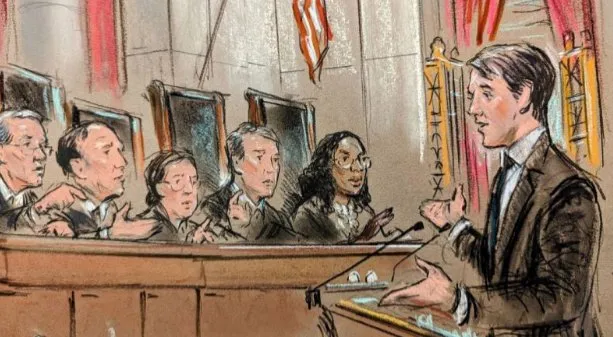
On January 6, 2021 Congress, pursuant to the Twelfth Amendment [1] and the Electoral Count Act [2], convened in the national capitol to certify the Electoral Votes, cementing Joseph R. Biden as the President-Elect. Simultaneously, then President Donald Trump rallied with his unwavering supporters and urged them to "confront this egregious assault on our democracy" [3]; "walk down to the Capitol…show strength" [4]; and that if they did not "fight like hell, [they would] not…have a country anymore." [5] Heeding these words, the supporters soon began approaching the capital, transitioning from rally participants to perilous insurrectionists. Now, more than three years later, it is clear that this event will be cemented in political and legal history. It has triggered a revolutionary understanding of constitutional and election law, along with jurisprudence and the overall political process.
Following the January 6 hearings, as the 2024 Presidential primary approached, various federal courts heard cases from appellants and objecters arguing for President Trump to remain on the ballot, with some states then going on to remove the candidate from their respective ballot. The most noticeable of such cases took place in Colorado, where the majority ruled that the District Court for the City and Council of Denver erred in ruling that Section Three of the Fourteenth Amendment, also referred to as the Insurrection Clause, does not apply to the President, thereby reversing the district court’s ruling. [6] Furthermore, this case, Trump v. Anderson, was quickly appealed to the Supreme Court of the United States, predominantly focusing on the issue of jurisdiction by posing the question: Can states and Congress, also enforce Section Three?
May speculate as to how a SCOTUS decision may impact the Trump-ballot cases. In such speculation, the actions and justifications of Colorado may not be the exact same as its coequal states, despite having the same outcome. With this in mind, I look toward the Colorado case Trump v. Anderson and Illinois case Anderson v. Trump, where a divided Colorado Supreme Court removed former President Trump from the state's presidential primary ballot, and Cook County Judge Tracy Porter ordered the state election board to remove Trump from the states’ primary ballot, respectively. [7] I plan to provide an enhanced perspective of the "Trump ballot cases" through a juxtaposed focus on two cases: one that was appealed to the U.S. Supreme Court, and one that was not. These cases, which occurred in a similar time frame and addressed the same issues, had only somewhat different justifications. I will be analyzing the U.S. Supreme Court, Colorado, and Illinois court cases, alongside arguments from the U.S. and state constitutions, and applicable jurisprudence. By doing so, I hope to elevate a lesser conceived argument to the forefront of the issues presented, and discuss how, in this particular political and legal circumstance, states should be allowed to prevent former President Donald Trump from being listed as a candidate on the Republican Party primary ballots.
I. The Political Question Doctrine and General Jurisdiction
With the separation of powers, as established for the judicial branch by Article III of the Constitution, the court systems, in theory, are the impartial and unbiased entities of the government. In doing so, fairness is upheld and exercised in the criminal justice system and, thereby, democracy is allowed to flourish. Following suit, Article III, and historical court cases, establish the political question doctrine, stating "Federal courts must dismiss a case—or decline to resolve an issue— presenting a ‘nonjusticiable political question,’” [8] whereby it balances the separation of powers with the judicial review authority of the judiciary. [9] In relation to the Trump ballot cases, this doctrine may appear to work in favor of former President Trump at face value. However, contemporary understanding of the doctrine requires a six-part test to determine whether or not a case considers a political question, as provided by the holding of Baker v. Carr (1962) [10]:
-
a textually demonstrable constitutional commitment of the issue to a coordinate political department;
-
a lack of judicially discoverable and manageable standards for resolving it;
-
the impossibility of deciding without an initial policy determination of a kind clearly for nonjudicial discretion;
-
the impossibility of a court’s undertaking independent resolution without expressing lack of the respect due coordinate branches of government;
-
an unusual need for unquestioning adherence to a political decision already made; 6. the potentiality of embarrassment from multifarious pronouncements by various departments on one question.
In order to dismiss a case on the grounds that it presents a political question, a court must find that at least one of the tests directly applies to the case before the court. Translating this to the context of the Trump ballot cases, it must be restated that, at face value, there appear to be multiple applicable perversions preventing any case regarding former President Trump and his status as a presidential candidate. Yet, the intricacies of law, legislation, and judicial precedent overrule such a defense as it pertains to Colorado and Illinois. Most pertinently, while the facts of the Trump ballot case indisputably have ties to politics, thereby allowing more than just one of the tests to apply to the case, the Article III description of federal court restrictions do not apply to state courts. As evidenced by legal scholars "As matters stand, state courts may determine federal constitutional questions even though Supreme Court review is blocked on such justiciability grounds as lack of standing, mootness, or political question doctrine.” [11] The confirmation of this notion has been consistent with the U.S. Supreme Court affirming that neither justiciability limits nor federal notions of separations of powers, under Article III, bind state courts. [12] Therefore, the political question doctrine, which is also noted in Article III, does not bind state courts, which includes the Colorado Supreme Court and the Circuit Court of Cook County, Illinois.
While some states do adhere wholly to Article III’s establishment of the political question doctrine, it is not itself binding. In fact, rather than subscribe to the Article’s implementation, states have commonly employed their own versions of the political question doctrine into their own state constitutions. One such example stemming from the Colorado case Lobato v. State, where the outcome rejected the modern understanding of the political question doctrine outlined in Baker in favor of a more expansive scope of judicial review consistent with the role of Colorado courts in the Colorado system. [13] By differentiating from the federally applied aspects of Article III, there is the understanding and acceptance that state courts have a more involved role in the political process. Relating this directly to the Colorado and Illinois Trump ballot cases, considering how in order for the cases themselves to be heard, actions had to first be taken by the Secretary of State and the Board of Elections, respectively, to determine candidates who may appear on the primary ballot in their state, and, to an extent, supervised by the courts, political involvement is necessary. If courts were to be bound by the political question doctrine of Article III, functionality of state elections, whether as it pertains to common state elections or federally-related elections, this would not only need to be explicitly stated, but would deeply inhibit the practicality and fluidness of elections throughout the nation. Not just this, but when extreme outlier situations such as the Trump ballot case are presented, the importance of state constitutions and proven jurisdiction are made readily apparent.
Logically following this is the situation in which such a vexing issue is appealed to the U.S. Supreme Court. Considering the surplus evidence of state courts not having to adhere to the political question doctrine of Article III, but federal courts being explicitly mentioned supports the idea that, if anything, the Supreme Court of the United States erred simply by accepting to hear the case. [14] Of course, precedent itself refutes this claim, as there have been a variety of politically charged cases of both recent and former accounts. Precedents such as Nixon v. United States (1993) exemplify the Supreme Court’s propensity to entertain politically charged cases that ostensibly contravene the dictates of the political question doctrine. In Nixon, the Court addressed the impeachment proceedings against a federal judge, navigating through complex constitutional issues despite the presence of political considerations. Similarly, in Bush v. Gore (2000), the Court intervened in the disputed presidential election, demonstrating its willingness to step into politically contentious matters when deemed necessary for the preservation of constitutional order. These incredibly controversial cases, which textually violate the political question doctrine and its tests, have been accepted merely due to the extreme nature of such cases, where the Court reserves authority to decide in such situations. Examining the core of the argument within this context, it becomes apparent that the judiciary’s engagement with such matters underscores its critical role in interpreting and safeguarding the Constitution. The essence of the contention lies in the tension between the political question doctrine, which traditionally delineates certain issues as beyond the purview of judicial review, and the Court’s constitutional duty to adjudicate legal disputes of national significance.
The federal judiciary encounters a nuanced dilemma in the Trump ballot disputes in Colorado and Illinois, wherein the application of the political question doctrine pursuant to Article III of the Constitution presents a formidable challenge. While this doctrine ostensibly delineates matters deemed inherently political and thus beyond judicial purview, its strict adherence risks conferring legitimacy upon arguments advocating for state jurisdiction, particularly in instances where state courts have interceded to preclude Trump’s inclusion on the ballot. Consequently, the federal judiciary confronts a precarious predicament. Should federal courts opt to abstain from adjudicating the Trump ballot cases on grounds of the political question doctrine, it, logically, would effectively culminate in Trump’s lawful exclusion from the ballot in jurisdictions where state courts have proscribed his candidacy. This outcome carries significant ramifications not only for Trump’s electoral prospects but also for the foundational principles of the electoral process and federalism. Moreover, the ramifications of such a decision transcend the immediate context of the Trump ballot disputes, engendering broader inquiries into the judiciary’s role in arbitrating politically charged controversies and the demarcation of state and federal authority vis-à-vis electoral affairs. It underscores the imperative of striking a delicate equilibrium between judicial restraint and ensuring access to legal redress for aggrieved individuals or entities affected by state-level determinations. In navigating this intricate legal terrain, the federal judiciary must meticulously deliberate the ramifications of its actions on the integrity of the electoral framework and the tenets of federalism. Harmonizing these divergent considerations is indispensable to upholding the primacy of the rule of law and fostering public trust in the judiciary’s impartiality and autonomy.
However, if federal courts opt to hear arguments for the Trump ballot case, then they must acknowledge the fact that due to the structure of state constitutions to create their own respective political question doctrines to address their electoral process, and the exclusionary language of the federal political question doctrine, state courts did not err in their choosing to hear the case, nor in their application of statutes. Acknowledging the authority vested in state constitutions to delineate the parameters of their electoral systems, state courts' decision to intervene in the Trump ballot case is within the ambit of their jurisdictional prerogatives. Their application of pertinent statutes in adjudicating the matter reflects a judicious interpretation of state law and underscores their commitment to upholding electoral integrity within their respective jurisdictions. In embracing this perspective, federal courts can affirm the legitimacy of state court actions in addressing electoral disputes, thereby fostering a harmonious interplay between federal and state judicial systems. Such an approach not only respects the autonomy of states in managing their electoral processes but also bolsters public confidence in the fairness and efficacy of the legal system as a whole, in turn supporting the action of preventing former President Trump from appearing on the primary ballot.
II. Implication of a Justified Illinois Ruling
On January 4, 2024, the former President Trump's (Donald Trump et al.) filed an appeal on the Illinois State Ballot for the general primary election. On the same date, the Petitioner-Objectors (Steven Daniel Anderson et al.) filed their petition to remove former President Trump from the ballot, citing violations of Section 3 of the Fourteenth Amendment of the United States Constitution, stating he must be disqualified from holding the office of the President of the United States "for having ‘engaged in insurrection or rebellion against the [United States Constitution], or given aid or comfort to the enemies thereof’ after having sworn an oath to support the Constitution.” [15] On February 28, 2024, the Circuit Court of Cook County, Illinois found that the Electoral Board’s decision on January 30, 2024 that Donald Trump shall remain on the ballot as a candidate for the office of the President of the United States is overruled, effectively removing Trump from the ballot for the state of Illinois. Indeed, this decision is defensible, justified, and true.
Immediately proving the Cook County Court as holding jurisdiction to rule on this case is Article II, Section 5 of the Illinois Constitution, delegating general supervision over the administration of the registration and election laws through the state to the State Board of Elections (commonly referred to as the Electoral Board). This authority extends to the Electoral Board’s oversight of the qualification of candidates for office, and, subsequently determining the qualification for candidates for the office of the President of the United States. [16] As noted by the Supreme Court of the United States, it is both common sense as well as constitutional law that compels substantial regulation of elections if they are to be fair and honest, including limiting ballot access even if it affects which candidate one can vote for in the election. [17] Relative to this, qualifications of candidates are governed by both state and federal statutory and constitutional law, assuring that candidates are well-suited for the office they seek and assure voters that only qualified candidates under the law will be placed on the ballot when they vote.
The aforementioned authority, however, is also limited by the Illinois Supreme Court, which made it unequivocal that the Electoral Board may not engage in statutory or constitutional interpretation. [18] Therefore, while the Electoral Board itself may not be able to determine whether Section 3 of the Fourteenth Amendment applies, the Cook County Court has no limit of the sort. It must be understood that the interpretation of Section 3 to determine whether or not former President Trump is disqualified from the general primary election is a requirement. Interestingly, the approach taken by the Cook County Court is one that considers the Colorado Supreme Court ruling in Anderson v. Griswold as persuasive law rather than binding precedent, allowing the decision to be utilized as precedent on the issues under review by the Illinois Court, and may recognize or take into consideration its holding.
Notably, the issue in the instant case is similar, but not identical, due to the review of a decision made by an “electoral board” rather than a lower court. While somewhat different, the basis for the objections in Colorado are the same as those in the instant case, which is based on the U.S. constitutional disqualification of former President Trump. The Cook County Court proceeded with its analysis relying on the Colorado Supreme Court decision "because the Illinois Court found the majority’s opinion well-articulated, rational and established in historical context, and assessing the construction and meaning of legal principles, such the Section 3 of the Fourteenth Amendment.” [19] By adopting the factual determinations before the Electoral Board in their entirety, which are very much akin to the facts presented as evidence before the Colorado District Court, under the standard of review of clearly erroneous, with mixed questions of law and fact. In so doing, the Illinois Court applied those facts to the clearly erroneous standard of review and found the facts in this record before the Electoral Board would establish that former President Trump was disqualified by engaging in insurrection, and should not be placed on the ballot for the office President of the United States for the March 19, 2024, General Primary Election based on Section 3 of the Fourteenth Amendment. Furthermore, considering the analysis of the Colorado Supreme Court’s interpretation of Section 3 of the Fourteenth Amendment, as applied to a former President now seeking to hold office for a second term. The Illinois Court took judicial notice of Colorado Supreme Court’s holding, and found its rationale compelling that even as a former President of the United States, former President Trump is a covered person who engaged in insurrection under section 3 of the Fourteenth Amendment. The Illinois Court found it imperative to the interpretative analysis of Section 3 of the Fourteenth Amendment to consider the historical relevance of the Civil War and the Reconstruction Era, in relation to the ratification of Section 3 of the Fourteenth Amendment. In U.S. Term Limits v. Thornton, the U.S. Supreme Court stated that the U.S. Constitution’s “provisions governing elections reveal the Framers' understanding that powers over the election of federal officers had to be delegated to, rather than reserved by, the states.” [20] The U.S. Supreme Court recognized that federal elections are one of the few areas in which the constitution expressly requires actions by the states, with respect to federal elections. [21] As previously identified, qualifications of candidates for federal offices are conducted by the states, not Congress, based on the U.S. constitution, and application of Section 3 of the Fourteenth Amendment should not be an exception.
Based on the comparable rationale for interpreting Section 3 of the Fourteenth Amendment and finding that it applies to former President Trump, as made by the Colorado Supreme Court, the Illinois Court found the historical perspectives and interpretation of the language compelling, the analytical reasonings used as language construction tools to be sound, and recognizes that a common sense approach that the President of the United States must be included in the language given the events of the Civil War era and, therefore, determines that Section 3 applies to a candidate for office of President of the United States.
III. The Comparative Jurisprudence of Colorado and Illinois
Courts are unanimous in the understanding that the "Trump ballot case" is perforated with state and federal level statutory issues and constitutional questions of interpretation. [22] In one perspective, these issues can be seen as further vexing due to the different applications of election laws by state. Conversely, these different applications, regarding legality, allows for there to be justification in actions taken by states to remove former President Trump from the ballot based on the evident transgressions of January 6. Even more so, the varying state laws and, therefore, varying arguments against the candidate to remain on the ballot may present both protections of a removal decision based on the specific argument and action taken, meaning a ruling directed toward one state may not be applicable to another due to the unique avenue undertaken in court. Circumscribing this to the states of Colorado and Illinois, it is inarguable that judicial decisions of the two states led to the removal of former President Trump from the ballot, however they were undertaken in strikingly dissimilar methods. Under the Colorado Constitution, the General Assembly holds the responsibility to "pass laws to secure the purity of elections, and guard against abuses of the elective franchise.” [23] Additionally, the Elections Code governs presidential primary elections, and limits participation in presidential primary elections to those who are classified as "qualified" candidates, which, as per the Elections Code, are responsibilities delegated to the Secretary to uphold. [24] In the Colorado case, even with the overwhelmingly explicit statutes regarding the duties and power of the Secretary as it pertains to elections, there were still challenges made to the Secretary’s ability to interfere with Trump remaining on the ballot.
In Illinois, elections are conducted quite differently and, subsequently, challenges to the removal of former President Trump from the presidential primary ballot differed from that of Colorado. Rather than the Secretary, the Electoral Board holds the authority to remove a candidate from the presidential primary ballot, receiving fact-based recommendations from the Hearing Officer. Not just this, but a main question presented for a false Statement of Candidacy in being "legally qualified" for the office of candidacy reveals the differing implications of the Illinois case compared to Colorado. [25] Uniquely, the Petitioner-Objector in Anderson v. Trump opted to place an increased burden of proof on themselves by seeking to provide a "preponderance of evidence" to support the aforementioned claim of a false Statement of Candidacy. [26] Aside from the contrasting state constitutions, the cases between Colorado and Illinois may be interpreted as seeking to address an insurrection attempt by any political candidate (Colorado) vs this specific candidate situation and facts. This perception of the cases then immediately showcases the uniqueness of the Illinois addressment, as any insurrection attempt aside from the contemporary endeavor by Trump may not necessarily be applicable. In such an instance, the Circuit Court of Cook County, Illinois contends that the Colorado Supreme Court was compelling in its ruling and opinion, but differed somewhat. Legally interpreting Anderson v. Griswald indicates precisely this, as the issue is not identical. Such differences are pertinent in proving the notion and necessity that former President-Trump be removed from the ballot. To apply an antediluvian understanding to a consequential matter of this sort will result in an err harmful to democracy itself.
—————————————————————————————————————————-
Bibliography
[1] U.S. Const. amend. XII
[2] 3 U.S.C. § 15
[3] Naylor, Brian. "Read Trump’s Jan. 6 Speech, a Key Part of Impeachment Trial." NPR, February 10, 2021. https://www.npr.org/2021/02/10/966396848/read-trumps-jan-6-speech-a-key-part-of-impeachment-trial.
[4] Ibid.
[5] Ibid.
[6] Mario Nicolais LLC et al., "Norma Anderson, Michelle Priola, Claudine Cmarada, Krista Kafer, Kathi Wright, and Christopher Castilian v. Jena Griswold, in Her Official Capacity as Colorado Secretary of State, and Colorado Republican State Central Committee, and Donald J. Trump," by KBN Law, LLC et al., Supreme Court of the State of Colorado, 2023,
https://www.courts.state.co.us/userfiles/file/Court_Probation/Supreme_Court/Opinions/2023/23SA300.pdf.
[7] Jon Seidel and Dave McKinney | Wbez, "Cook County Judge Kicks Trump off Illinois Ballot — but Puts Her Own Order on Hold - Chicago Sun-Times," Chicago Sun-Times, February 29, 2024,
https://chicago.suntimes.com/politics/2024/02/28/trump-ballot-ruling-illinois-gop-elections-2024-vote.
[8] Dodson, Scott. "Article III, State Courts, and the Political-Question Doctrine." SSRN Electronic Journal, 2020. doi:10.2139/SSRN.3546935.
[9] LII / Legal Information Institute. "Political Question Doctrine," October 2023.
https://www.law.cornell.edu/wex/political_question_doctrine.
[10] Baker v. Carr, 369 U.S. 186, 686 (1962)
[11] 16B Wright et al., supra note 49, § 4015
[12] ASARCO Inc. v. Kadish, 490 U.S. 605, 617 (1989)
[13] Lobato v. State, 218 P.3d 358, 368–72 (Colo. 2009)
[14] Steel Co. v. Citizens for a Better Env’t, 523 U.S. 83, 94–95 (1998)
[15] Case No. 24 SOEB GP 517, ¶7
[16] Goodman, 16 SOEB GP 528 (2016)
[17] Burdick v. Takushi, 504 U.S. 428, 433, 440 n.10 (1974)
[18] Goodman, 241 Ill. 2d at 412
[19] 2024 COEL 000013
[20] 514 U.S. at 804
[21] Ibid.
[22] Ibid., Anderson v. Trump
[23] Col. Const. art. VII, § XI, § 1-1-107(1)(a)–(b), (5)
[24] § 1-1-107(1)(a)–(b), (5), C.R.S. (2023), § 1-4-1201 to-1207
[25] 10 ILSC 5/7-10 (sic), EB Record C-274 V2, p. 2, ¶8
[26] 2024 COEL 000013