The NAACP’s Popularization of Impact Litigation to Combat Institutionalized Bias
Written by: Yasmine Hightower | Howard University
Edited by: Jameeiah Domercant & Sophia Stoute
Abstract:
This article examines how NAACP’s usage of impact litigation within Brown v. Board of Education popularized impact litigation as a strategy to combat institutionalized bias. The NAACP used impact litigation to bring together filed appeals cases from district courts to argue against unequal treatment at the Supreme Court level. Through the legal work presented in this article, an analysis will be presented on how this legal strategy was successful in helping the NAACP dismantle discriminatory action and how the use of impact litigation was useful in cases arguing against institutionalized bias.
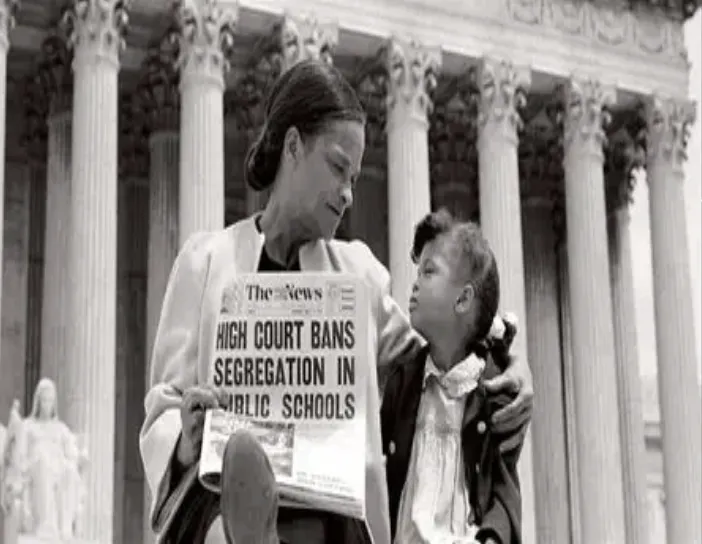
The National Association for the Advancement of Colored People (NAACP) is a civil rights activist organization in the United States that aims to eliminate discrimination, institutionalized racism, and promote civil rights for African Americans.The NAACP plays a crucial part in supporting Black communities by funding education and providing free legal services, most recognized for their work in Brown v. Board of Education– a series of cases advocating for equal and unsegregated education while combating the separate but equal doctrine [1]. They won this case by using a series of district cases with repetitive endings. District cases that involved discrimination and unequal treatment of education filed by the NAACP were repeatedly dismissed. District courts continuously offered a ruling that the school's treatment was justified under the separate but equal doctrine. This repetitive dismissal is what caused the NAACP to use a legal strategy called impact litigation. Impact litigation is when attorneys use filed cases to create national, social or legal change within the United States [2]. The NAACP was the first to popularize impact litigation as a legitimate legal strategy by filing suits in U.S. district courts, anticipating loss due to discrimination. They used the outcomes to escalate these cases to the Supreme Court level, using the series of dismissals themselves as evidence of discrimination, challenging injustice.
Brown v Board of Education consisted of five cases: Briggs v. Elliott, Bolling v. Sharpe, Brown v. Board, Davis v. County School Board, and Belton (Bulah) V. Gebhart. Briggs v. Elliott was one of many to magnify what discrimination looked like in American education. Briggs v. Elliott began in 1947 with filed complaints from African American parents who wanted equal access to resources so their students could learn properly for example, working water, transportation, libraries, etc. Clarendon County only spent $42 on educational resources per African American student, while white students received $179. Parents also requested that transportation be accommodated for African American students since white schools had more than 30 buses for their students. Parents also felt their children should not have to walk seven or more miles to obtain an education, and a petition for more buses was filed and ignored. Later, a suit was filed by the Pearson brothers, with the help of the NAACP, arguing for better transportation; but the petition was dismissed on the counts of their housing being in one district, and the suit filed in another. The NAACP got another petition and refilled after adjustments in May 1951. This suit was Briggs v. Elliott, and instead of arguing for buses, they were arguing for non-segregated institutions for learning. The NAACP argued in district court that educational segregation is a direct violation of the 14th Amendment Equal Protection Clause because of the lack of equal access to resources. While the case was dismissed because the county felt they were complying, the district did agree to give better resources to Black schools. Though the NAACP did not win, Briggs v. Elliott began to uncover legal contradictions in the Constitution. The case was later appealed later to be heard again in 1952 and is considered the first of the five cases of Brown v. Board. Although the case did not end segregation on its own, it was one of many milestones that paved the way for the Supreme Court battle with Brown v. Board that created a new equal American educational system [3].
Brown v. Board of Education became a case famously known for dismantling segregation within the American education system, marking the start of a new era for Black students. Brown v. Board of Education was filed May 1954 in Topeka, Kansas, when 13 families walked into an all-white local school asking for enrollment on the grounds of better transportation, knowing they would be denied. This allowed the NAACP to file a suit on behalf of those families; they argued Plessy v. Ferguson doctrine was not being upheld because the schools were not equal. All-white schools violated these students' 14th amendment equal protection rights, which declare “no state can deny any person within its jurisdiction equal protection of the laws.” The case was denied because, although it may have been harmful to African American students and families, it was within legal bounds. According to Plessy v. Ferguson doctrine, the school serving African Americans was within standard and had access to the same resources as white schools. The NAACP appealed this verdict to the Supreme Court in 1952 and included four other cases that also reflected discriminatory issues within the education system. They continued to argue the 14th Amendment equal protection clause within the cases, while also stating making students attend different schools based on color could cause them to feel inferior to the other group, especially when the other group has better resources. They argued that education sees no color and should be granted to all students fairly. Governor Earl Warren of California, who supported integration, stated on May 14th that “segregation was in fact detrimental to the minds of colored children.” He stated that separate but equal had no place in education and granted the students of the case the 14th amendment rights they were being deprived of. This decision desegregated 21 public schools in the South. After continuous dismissal came legal strategy, structure and systemic understanding for the NAACP that would be used to fight other battles [4].
From these court cases a pattern is seen: cases were continuously being dismissed in district courts because the schools' actions were deemed in compliance with the separate but equal doctrine. All cases up to Brown v. Board followed the same path as Briggs v. Elliot. Arguments were denied and appealed for the Supreme Court, but these repetitions allowed the NAACP to use impact litigation, taking the appealed court cases to the Supreme Court in the case Brown v. Board of Education to argue a broader and stronger argument of unequal treatment.
Brown v. Board of Education became popular because it ended school segregation. It was also popular among legal officials, however, because of the strategy used to combat racism. Ruth Bader Ginsburg, who was inspired by the NAACP’s legal strategy and usage of the 14th amendment, also used impact litigation in the 1970s when combating institutionalized sexism. Reed v. Reed, where Justice Ginsburg represented Sally Reed, became the first Supreme Court case to dismantle a law for gender discrimination under the equal protection clause of the 14th amendment. Richard Lynn Reed, minor, in Ada County, Richard Lynn died, both adopted parents Sally and Cecil Reed sought to be appointed administrator of his estate which was valued at less than $1,000. Cecil Reed was granted the estate under the Idaho Probate Code, which stated that if there are multiple individuals entitled, properties will go to the male. Sally filed for a suit arguing the 14th Amendment equal protection clause with Ruth Bader Ginsburg as her attorney [5]. The Supreme Court ruled in favor of Sally, stating the Idaho statute was indeed unconstitutional. Ruth Bader Ginsburg presented a series of cases such as Frontiero v. Richardson and Craig v. Boren to argue a broader point of ensuring the policies and laws no longer discriminate against women because of sexist ideologies [6].
Although impact litigation was used prior to Brown v. Board of Education, it became a popular tool to dismantle discriminatory action within the legal system because of Brown v. Board. Their strategy to accumulate rejected cases from district courts, appealing to these cases to argue broader points of legal change, was admirable and the blueprint for other arguments. Ruth Bader Ginsburg's admiration for the NAACP’s work and usage of impact litigation to dismantle discriminatory laws, was the blueprint in how she accumulated cases she won to argue a broad point of the unfair threat women face due to legal policies and laws. Ginsburg made change within the legal system by using past suits to argue for social change within the legal system in the 1970s, the same way the NAACP used dismissed cases to argue for educational change in the 1950s.
[1] Britannica Editors, “National Association for the Advancement of Colored People,” Britannica, April 19, 2026.
[2] Office of Public Interest Advising, “Litigation: Impact,” Harvard Law School, n.d.
[3] National Historical Park Kansas, “Briggs v. Elliot,” National Historical Park, March 5, 2026.
[4] National Historical Park Kansas, “Brown v. Board of Education,” National Historical Park, March 5, 2026.
[5] Reed v. Reed, 404 U.S. 71 (1971).
[6] Tomiko S. Nagin, “In Memoriam: Justice Ruth Bader Ginsburg, The Last Civil Rights Lawyer on the Supreme Court,” Harvard Civil Rights-Civil Liberties Law Review 56, no. 1, April 25, 2021, 15-25.
Works Cited
Britannica Editors, “National Association for the Advancement of Colored People,” Britannica, April 19, 2026. https://www.britannica.com/topic/National-Association-for-the-Advancement-of-Colored-People
National Historical Park Kansas, “Briggs v. Elliot,” National Historical Park, March 5, 2026. https://www.nps.gov/brvb/learn/historyculture/socarolina.htm
National Historical Park Kansas, “Brown v. Board of Education,” National Historical Park, March 5, 2026. https://www.nps.gov/brvb/learn/historyculture/kansas.htm
Office of Public Interest Advising, “Litigation: Impact,” Harvard Law School, n.d., https://hls.harvard.edu/bernard-koteen-office-of-public-interest-advising/about-opia/what-is-public-interest-law/public-interest-work-types/
Reed v. Reed, 404 U.S. 71 (1971).
Tomiko S. Nagin, “In Memoriam: Justice Ruth Bader Ginsburg, The Last Civil Rights Lawyer on the Supreme Court,” Harvard Civil Rights-Civil Liberties Law Review 56, no. 1, April 25, 2021, 15-25.