Operation Metro Surge as First Amendment Retaliation in a New Age of Executive “Reckoning and Retribution”
Written by: Michelle Henaku
Edited by: Chastity Blair
Abstract:
This article argues that the Trump administration’s Operation Metro Surge, a federal immigration enforcement operation that deployed over 4000 ICE agents into Minneapolis and Saint Paul, constitutes unlawful retaliation against constitutionally protected political speech of Minnesota elected officials in violation of the First Amendment. Applying the three-prong framework for First Amendment retaliation claims, this article demonstrates that Minnesota officials’ public opposition to Trump’s immigration agenda constituted protected political speech under Mills v. Alabama (1966), that Operation Metro Surge was an adverse action taken in direct response to that speech; and that the administration’s own language explicitly framing Minnesota officials’ dissent as a “Radical Left Agenda” and the catalyst for “enhanced enforcement” establishes a causal link between protected speech and retaliatory action, thus constituting a “motivating factor” for retaliation under the First Amendment. The article further applies the framework of National Rifle Association v. Vullo (2024) to former Attorney General Bondi’s demands to Governor Walz to argue that her condition, the “restoration of the rule of law” on Minnesota’s release of voter registration, constitutes an unconstitutional leverage of federal enforcement power to punish disfavored political expression. Finally, this article draws parallels to the United States v. SGO Corporation Limited (2025) in which Smartmatic alleges that the DOJ was weaponized as an instrument of political retribution, to show that these are not isolated incidents, but part of a broader pattern of the Trump administration using federal power to silence dissent in a way that threatens First Amendment freedoms.
In December 2025, the Trump administration launched a federal immigration enforcement operation, releasing over 4000 U.S Immigrant and Customs Enforcement (ICE) Agents into Saint Paul and Minneapolis, Minnesota. The Trump administration partnered with the Department of Homeland Security (DHS) to enforce and expand immigration control as a key part of President Trump’s office agenda. In State of Minnesota v. Noem, Minnesota’s Attorney General, Keith Ellison, argued that the Trump administration’s deployment of federal officers was wreaking havoc in Minnesota. Moreover, he argued their action was unconstitutional federal overreach which violated the 1st and 10th Amendments [1]. Attorney General Ellison asserted Operation Metro Surge constituted retaliatory, adverse action taken in response to protected political speech by Minnesota government officials.
The Trump administration claimed that their actions were an attempt to “protect Americans from the dangers presented by unchecked illegal immigration, including violent crime and drug trafficking” [2]. However, since President Trump’s loss in the 2020 election, he has asserted a platform of retribution, promising his supporters that he will punish political opponents, dissenters, and those who have wronged him in his second term. He threatened that, “for those who have been wronged and betrayed [him]: [he] is [their] retribution” [3]. That same year, Trump reposted a word cloud highlighting the words “revenge” and “dictatorship” as central descriptors of his second term.
Since re-election, Trump and his administration have abused executive power to punish and suppress individuals for viewpoints and actions that challenge his political agenda [4]. This has been most visible in the President’s weaponization of the Department of Justice and Department of State to prosecute specific individuals who have previously challenged his political standing. For example, in 2025, on conservative social media platform TruthSocial, President Trump publicly implored former Attorney General Pamela Bondi and the Justice Department to prosecute former FBI leader James Comey for his involvement in investigating Russian interference in the 2016 election, even though Trump had already fired him in 2017 for the same reason [5] [6]. In the same tweet, he also targeted New York Attorney General Letitia James, who successfully sued President Trump for business fraud charges, resulting in $450 million in penalties. Trump has routinely threatened to use his political power to bring indictments against officials, citizens, and institutions out of personal political animosity. Furthermore, Trump has targeted law firms that have defended political opponents and domestic students who have vocalized political dissent [7].
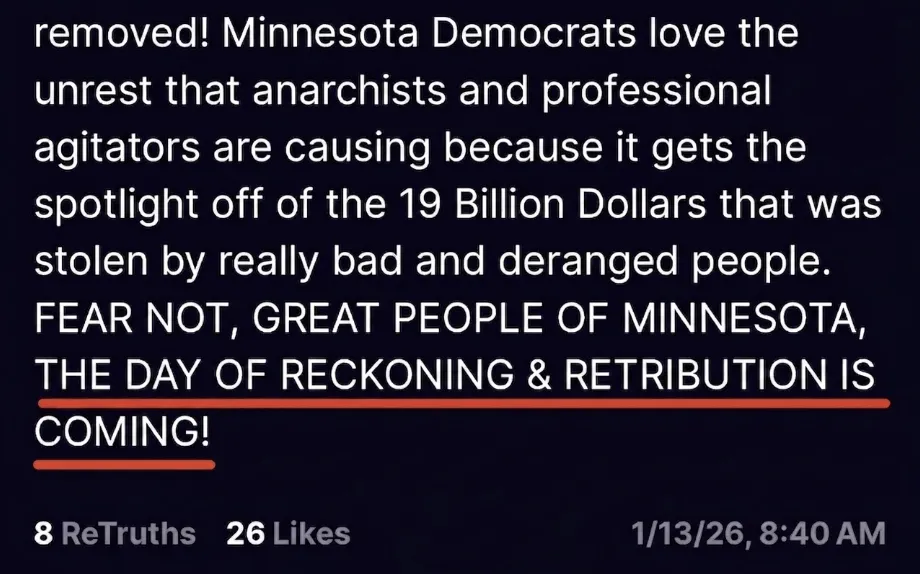
Similarly, President Trump has frequently targeted Democratic elected Minnesota officials such as Governor Tim Walz, Representative Ilhan Omar, and Mayor Jacob Frey for opposing his administration’s immigration policies. Following the initiation of Operation Metro Surge, on the platform TruthSocial, President Trump stated that these officials’ policy disagreements would result in a “DAY OF RECKONING AND RETRIBUTION” [8]. He extended this hostility towards “sanctuary cities,” jurisdictions that limit cooperation with federal immigration authorities in enforcing immigration law and handling of undocumented immigrants [9]. President Trump threatened to withhold federal funding from Democrat-led states that supported his 2024 Presidential Election opponent Kamala Harris [10]. Operation Metro Surge constitutes unlawful retaliation against the political dissent of Minnesota’s public officials on behalf of their constituency, a violation of their First Amendment Rights. This violation of the First Amendment exemplifies a broader pattern of the Trump administration weaponizing federal power against political opponents.
To make a First Amendment retaliation claim, a plaintiff must demonstrate that they (1) engaged in constitutionally protected speech, which in the case of Minnesota v. Noem would be Minnesota officials’ expression of their political viewpoint; (2) that the government took adverse action in response to the individual engaging in protected speech, in this case ICE agents’ Minnesota deployment following Minnesota officials expressing their political viewpoints and lack of intent to cooperate with the Trump administration on behalf of the state of Minnesota; and (3) that that the protected speech, or in this case Minnesota officials’ disagreement with Trump’s immigration policy, was a substantial or motivating factor behind the adverse action [11].
The White House website cited statements from several Minnesota officials expressing their opposition to Trump’s immigration agenda and their intentions not to cooperate with the current administration as justification for Operation Metro Surge [12]: Governor Tim Walz stated that his refusal to cooperate with federal immigration enforcement was rooted in his view that such enforcement fell outside the bounds of local law enforcement. Mayor Jacob Frey asserted the same position, adding that Minnesota “would continue to be a safe haven for undocumented immigrants.” Representative Ilhan Omar called the Trump administration’s actions an unconstitutional attack on sanctuary policies and affirmed Minnesota’s commitment to protecting immigrants against Trump’s immigration agenda. Under the First Amendment, these statements all qualify as “constitutionally protected speech” and in Mills v. Alabama (1966), Justice Hugo Black delivered the opinion that the “major purpose of the [First] Amendment was to protect the free discussion of governmental affairs… includ[ing] discussions of… the manner in which government is operated or should be operated, and all such matters relating to political processes” suggesting that these elected officials who are engaging in discourse on government operations have the highest protection of the First Amendment [13]. By expressing their disagreement with President Trump’s immigration enforcement, these officials were lawfully exercising their right to dissent about the way “government should be operated” on behalf of their constituency, in the way that one would expect out of officials in a representative democracy [14].
Yet, the White House publicized these statements as justification for Operation Metro Surge, stating that “the responsibility for the ‘tension and violence’ of the surge ‘lies squarely with these officials who refuse to partner with the Trump administration and instead put their Radical Left agenda over public safety and the rule of law” [15]. By characterizing Minnesota officials’ disagreement with the Trump administration as part of a “Radical Left Agenda” and explicitly citing that as the catalyst for “enhanced enforcement” under Operation Metro Surge, the administration revealed two violations of the First Amendment. First, it took an adverse reaction to protected political speech. Second, and more critically, the administration established a causal link between political speech and the adverse action. This reaction satisfied the “motivating factor” standard required to sustain a First Amendment retaliation claim.
Moreover, the phrase “Radical Left Agenda” is charged with partisan and political language that carries no legal weight or has any concern with public safety. Although the Trump administration claimed that the deployment of federal troops was intended to control immigration and restore safety and order, citing partisan disagreement as the reason for Operation Metro Surge further shows that it was a retaliatory attempt to punish and chill the dissent of political opponents rather than a neutral enforcement of immigration policy.
In National Rifle Association of America v. Vullo (2024), a New York financial regulator had pressured insurers to cease doing business with the NRA in response to the organization's political advocacy. The Supreme Court unanimously held that while government officials may freely criticize particular beliefs, they cannot “use the power of the State to punish or suppress disfavored expression” [16]. The Court emphasized that this determination rests on the “totality of circumstances,” including the official’s authority, the tone of communications, and whether the recipient could reasonably understand the conduct as threatening adverse consequences for non-compliance.
That framework applies directly to Attorney General Pamela Bondi’s January 24th 2026, letter to Governor Walz. Sent in the weeks following the fatal shootings of Renee Good and Alex Pretti by ICE agents, the letter conditioned the “restoration of the rule of law” on Minnesota’s compliance with several federal demands, most notably the surrender of voter registration data to the Department of Justice [17]. As Attorney General of the United States, Pamela Bondi held considerably more coercive power than the financial regulator in the Vullo, a power that rendered the letter’s demands not simply persuasive, but threatening. As to tone, the letter suggested Minnesota’s non-cooperation with the federal government was an ongoing threat to public safety, and that Minnesota had the responsibility for remediating the crisis. The letter’s language gave Governor Walz reasonable grounds to assume that Minnesota’s non-compliance could lead to federal escalation. Under the Vullo totality of circumstances, Bondi’s letter was not merely commentary or criticism, but coercion.
Furthermore, the demand for voter registration data, which has no connection to immigration enforcement, shows that the administration attempted to leverage the violent disruption of Operation Metro Surge to extort sensitive political information from Minnesota. This coercive demand is particularly vital because Minnesota is a state in which Trump has attacked and accused of election fraud for voting blue in the last three elections [18]. In the Vullo case, the Supreme Court described the regulator’s conduct as “leveraging power to stifle disfavored advocacy,” and it is evident that the Trump administration, through Bondi’s demands, did the same by using federal troops to punish political dissent. Thus, Minnesota officials’ political dissent falls under the First Amendment’s motivating factor standard.
This pattern of weaponizing federal power extended beyond targeting state governments and into the criminalization of private entities that have challenged the President. In United States v. SGO Corporation Limited (2025), voting technology firm Smartmatic moved to dismiss a federal indictment by arguing that the Department of Justice has been weaponized against it to further President Trump’s “campaign of retribution” among those “who undermine his mantra that the 2020 election was rigged” [19]. Smartmatic characterized the President’s conduct as “a punitive and unconstitutional use of prosecutorial power” [20]. In both Operation Metro Surge and the SGO case, the government identified a perceived political adversary, Minnesota’s elected officials in Operation Metro Surge and Smartmatic in this case. The government proceeded to wield instruments of federal power against each one, the DOJ for Smartmatic and ICE for Minnesota. What makes the criminal prosecution of SGO and Operation Metro Surge parallel is that both entities were perceived to have expressed dissent to President Trump’s political agenda, in the forms of speech and corporate conduct, respectively. Together these two cases show that Trump’s retaliation in the form of weaponizing federal power is a larger pattern of retribution and abuse of authority that threatens First Amendment freedoms.
Operation Metro Surge, alongside the Trump Administration’s broader pattern of targeting political dissenters, has set a dangerous precedent in the United States. A president weaponizing executive power against elected officials for expressing views on behalf of their constituents compromises the foundation of representative democracy. Supreme Court Justices have held again and again that the First Amendment offers its highest tier of protections to political speech and dissent, existing largely to encourage the diversity of thought and opinions that the framers recognized as essential for the health and improvement of democracy. If an administration is able to punish those who disagree with its political views, this will chill dissent and remove space for the diversity of thought and freedom that America has prided itself on since its founding.
[1] State of Minnesota v. Noem, No. 0:26-cv-00190 (D. Minn. filed Jan. 12, 2026).
[2] Pam Bondi, "Letter to Governor Tim Walz," Office of the Attorney General, January 24, 2026
[3] Peter Stone, "'I Am Your Retribution': Trump Rules Supreme at CPAC as He Relaunches Bid for White House." (The Guardian), March 5, 2023
[4] CNN, "Trump Shares a Word Cloud Including 'Revenge … Dictatorship.'" CNN, December 27, 2023
[5] Ryan J. Reilly and Adam Reiss, "Trump Accidentally Posted Message Pressuring Pam Bondi to Charge His Enemies, Source Says," NBC News, October 10, 2025
[6] Politico Staff, "Giuliani: Trump Fired Comey Because Former FBI Director Wouldn't Say He Wasn't a Target in Investigation," Politico, May 3, 2018
[7] Joe Allen, “Tracking Retaliatory Use of Arrests, Prosecutions, and Investigations by the Trump administration,” Protect Democracy, April 22, 2026
[8] Gregory Svirnovskiy, "Trump's Minnesota Reckoning: Retribution Warning," Politico, January 13, 2026
[9] Congressional Research Service, "'Sanctuary' Jurisdictions: Legal Overview," LSB11321, Congressional Research Service, September 15, 2025
[10] Cheyanne M. Daniels, "White House to End Funding to Sanctuary Cities and States." (Politico), January 13, 2026
[11] Nat'l Rifle Ass'n of Am. v. Vullo, 602 U.S. 175 (2024)
[12] The White House, "Minnesota's 'Sanctuary' Defiance Has Consequences." (The White House), January 16, 2026
[13] Mills v. Alabama, 384 U.S. 214 (1966)
[14] Mills v. Alabama, 384 U.S. 214 (1966)
[15] The White House, "Minnesota's 'Sanctuary' Defiance."
[16] Nat'l Rifle Ass'n of Am. v. Vullo, 602 U.S. 175 (2024)
[17] State of Minnesota v. Noem; Bondi, "Letter to Governor."
[18] Megan Lebowitz, "Donald Trump Falsely Claims He Won Minnesota in the 2020 Presidential Election," (NBC News), May 18, 2024
[19] United States v. SGO Corporation Limited, No. 24-cr-20343 (S.D. Fla. Mar. 10, 2026) (motion to dismiss)
[20] United States v. SGO Corp., No. 24-cr-20343
Works Cited
Allen, Joe. "Tracking Retaliatory Use of Arrests, Prosecutions, and Investigations by the Trump administration." (Protect Democracy), April 22, 2026. https://protectdemocracy.org/work/retaliatory-action-tracker/.
Bondi, Pam. Letter to Governor Tim Walz. (Office of the Attorney General), January 24, 2026. https://www.nytimes.com/interactive/2026/01/24/us/pam-bondi-walz-doc.html.
Congressional Research Service. "Government Coercion of Private Speech: National Rifle Association (NRA) v. Vullo." LSB11186. Congressional Research Service, June 28, 2024. https://www.congress.gov/crs-product/LSB11186.
Congressional Research Service. "'Sanctuary' Jurisdictions: Legal Overview." LSB11321. Congressional Research Service, September 15, 2025. https://www.congress.gov/crs-product/LSB11321.
Daniels, Cheyanne M. "White House to End Funding to Sanctuary Cities and States." (Politico), January 13, 2026. https://www.politico.com/news/2026/01/13/white-house-end-funding-sanctuary-cities-states-00726557.
Lebowitz, Megan. "Donald Trump Falsely Claims He Won Minnesota in the 2020 Presidential Election." (NBC News), May 18, 2024. https://www.nbcnews.com/politics/2020-election/donald-trump-falsely-claims-won-minnesota-2020-presidential-election-rcna152884.
Mills v. Alabama, 384 U.S. 214 (1966).
National Rifle Association of America v. Vullo, 602 U.S. 175 (2024).
Politico Staff. "Giuliani: Trump Fired Comey Because Former FBI Director Wouldn't Say He Wasn't a Target in Investigation." (Politico), May 3, 2018. https://www.politico.com/story/2018/05/03/trump-fire-comey-reason-rudy-giuliani-566043.
Reilly, Ryan J., and Adam Reiss. "Trump Accidentally Posted Message Pressuring Pam Bondi to Charge His Enemies, Source Says." (NBC News), October 10, 2025. https://www.nbcnews.com/politics/justice-department/trump-accidentally-posted-message-pressuring-pam-bondi-charge-enemies-rcna236830.
SGO Corporation Limited. Motion to Dismiss the Superseding Indictment for Vindictive and Selective Prosecution. United States v. SGO Corporation Limited, No. 24-cr-20343 (S.D. Fla. Mar. 10, 2026). https://www.democracydocket.com/wp-content/uploads/2026/03/smartmatic-filing.pdf.
State of Minnesota v. Noem, No. 0:26-cv-00190 (D. Minn. filed Jan. 12, 2026).
Stone, Peter. "'I Am Your Retribution': Trump Rules Supreme at CPAC as He Relaunches Bid for White House." (Guardian), March 5, 2023. https://www.theguardian.com/us-news/2023/mar/05/i-am-your-retribution-trump-rules-supreme-at-cpac-as-he-relaunches-bid-for-white-house.
Svirnovskiy, Gregory. "Trump's Minnesota Reckoning: Retribution Warning." (Politico), January 13, 2026. https://www.politico.com/news/2026/01/13/trump-minnesota-reckoning-retribution-warning-00724534.