Race-neutral and...Unconstitutional?: Analysis and Implications of Coalition for TJ vs. Fairfax County School Board
Written by: Jordan Pettiford
Edited by: DeVon Thompson
Abstract:
Since the Supreme Court decision in Students for Fair Admissions, Inc. v. President & Fellows of Harvard College, 600 U.S. 181 (2023) rendered most university race-based affirmative action unconstitutional, many schools have been looking to identify race-blind or race-neutral policy options to implement to preserve a diverse student body while conforming to the law. However, even race-neutral policies face legal challenges in the post-SFFA landscape, including a race-blind admissions policy implemented by Thomas Jefferson High School, a public, STEM-focused magnet school in Alexandria, VA. This article seeks to examine litigation regarding the case up to this point and to discuss the potential implications of deeming an admissions policy that considers socioeconomic factors instead of race unconstitutional.
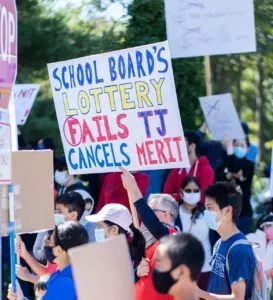
Since the decisions in Students for Fair Admissions, Inc. v. President & Fellows of Harvard College, 600 U.S. 181 (2023) and Students for Fair Admissions, Inc v. University of North Carolina, 600 U.S. 181 (2023) ruled specific race-based affirmative action policies used in higher education to be unconstitutional, an ongoing debate has arisen on the future of policies aimed at increasing diversity in schools and workplaces. Critics of affirmative action policies have claimed that, in the realm of education, replacing race-based affirmative action with policies based on class or geographical location will be as effective while being fairer to all racial and ethnic groups. However, one of these race-blind policies has itself faced recent challenges within the legal system in part due to its stated goal being to increase racial diversity.
Thomas Jefferson High School is an elite public school in Fairfax County, Virginia. Students throughout the county apply to the school for its renowned science and mathematics programs. Despite Thomas Jefferson’s, colloquially referred to as TJ, status as a public institution, Black and Latino students have been historically underrepresented in terms of enrollment when compared to the demographics of the school district. After protests for racial justice swept the country in 2020, the school’s administration changed TJ’s admissions policy, hoping to increase the number of Black and Latino students on campus. The changes included the dropping of the standardized test requirement, recommended admission for the top 1.5% of every middle school in the county, and the consideration of socioeconomic factors such as ESL status, disability status, whether a student was eligible for free lunch or attended a historically underrepresented middle school (Liptak 2022). Notably, race was not directly considered by the admissions team, who did not have access to information about an applicant’s racial identity. While the policy was effective in its stated goal of improving Black and Latino enrollment, it also caused a significant drop in admissions offers to Asian American students, from 73% to 54%.
Immediately after the details of the policy were announced, an organization called Coalition for TJ sued the school district in the Eastern District of Virginia Federal Court, alleging that the policy was enacted with discriminatory intent towards Asian Americans. Judge Claude Hilton ruled in favor of the plaintiff, issuing an injunction on the admissions policy. This decision was then reversed by the United States Court of Appeals for the Fourth Circuit, allowing the policy to remain in effect. The Coalition responded to the reversal by making an emergency appeal to the Supreme Court in 2022, which was rejected over the dissent of three justices: Neil Gorsuch, Clarence Thomas, and Samuel Alito. As of 2023, the Coalition filed a petition of Certiorari to the Supreme Court, but it has yet to be granted.
The case itself hinges on the idea of discriminatory intent; the plaintiff has to prove not just that the policy had a disparate impact for it to be subject to strict scrutiny but also that the policy was designed to discriminate against Asian Americans specifically. It is important to note that while the Eastern District of Virginia found that the challenged policy satisfied both requirements, the Fourth District Court of Appeals found that the policy did not even meet the first requirement. They explain that an incorrect standard was used to evaluate the impact of the policy.
“Searching for a racially “disproportionate” impact necessitates a relative inquiry among racial groups, not a simple appraisal of one group’s performance over time…Asian American students accounted for 48.59% of the applications to TJ’s class of 2025 but actually secured 54.36% of the 27 admission offers made for that class. By contrast, 10% of the TJ applicants in 2021 identified as Black, while only 7.9% of offers went to Black students; Hispanic students comprised 10.95% of the applicant pool and received 11.27% of offers; white students represented 23.86% of applicants and received 22.36% of offers.”Coalition for TJ v. Fairfax County School Board, 22-1280. 4th Cir. (2022)
Determining satisfaction of the discriminatory intent requirement can be nebulous. Still, it is primarily discussed with two US Supreme Court cases: Washington v. Davis, 426 US 229 (1976) and Village of Arlington Heights v. Metropolitan Housing Development Corp, 429 US 252 (1977). In Washington v. Davis, the court reasoned that for a policy to violate the equal protection clause of the Fourteenth Amendment, the plaintiff must prove the policy’s framers had intended discrimination if it did not utilize explicit racial categorization. Arlington Heights reaffirmed this the following year by setting up a test for proving discriminatory intent using a combination of factors, including disproportionate impact, historical context, a departure from standard procedures, and legislative history (Huq 2018).
This begs the question of whether the intent to increase the enrollment of one minority, which the defense claims was its aim, can be considered the same as intending to discriminate against another minority. One possible way to examine this is to consider the judicial history surrounding whether or not increasing diversity in public schools can be a compelling government interest. Justice Kennedy’s concurring opinion in the 2007 case Parents Involved in Community Schools v. Seattle School District No. 1, 551 US 701 (2007) would argue no: “School authorities concerned that their student bodies’ racial compositions interfere with offering an equal educational opportunity to all are free to devise race-conscious measures to address the problem in a general way.” However, the majority opinion in the same case is more ambiguous, stating that “racial balancing” whether or not it is framed as “racial diversity…[or] integration” cannot be considered a compelling government interest by itself. It is perhaps unsurprising then that the initial summary judgment found a desire to increase racial diversity not to be tangibly different from racial balancing.
However, the majority’s primary problem with the policies in Parents Involved was that the direct consideration of race contradicted the goal of creating an environment where students were not singled out because of their race. Of course, the admissions board at TJ had no access to information about the racial identity of prospective students, so the argument that they were being considered solely as members of that group is null. In reality, the policy was created to solve a problem the school had been facing for years: the majority of TJ’s students were recruited from schools with special gifted and talented centers in which Black, Latino, disabled, and low-income students were already underrepresented (George 2022).
The possibility of a finding that classifies the aim of uplift for one minority group as the same as discriminatory intent towards another has dire consequences for educational policy. Similarly, the conflation of a system predicated on racial classifications with one where racial diversity is simply a factor in sculpting a race-blind policy creates a dangerous precedent wherein any policy change that increases the percentage enrollment of Black and Latino students is suspect. Even more concerning is the notion expressed by Judge Hilton during his judgment that is similar to Lewis vs. Ascension Parish Sch. Bd, 996 F. Supp. 2d 450 M.D. La (2014)—which he quotes– that the “experience factors” used by TJ amount to simply “prox[ies] for race” and contribute to the overall argument for discriminatory intent. The “experience factors” were adopted to increase racial diversity and the amount of low-income students of all races at TJ. As the Fourth District Court of Appeals mentioned in their opinion: “Asian American students attending middle schools historically underrepresented at TJ saw a sixfold increase in offers, and the number of low-income Asian American admittees to TJ increased to 51 — from a mere one in 2020”, Coalition for TJ v. FCPS. Considering that Black and Latino students are disproportionately low income, an understanding of all socioeconomic markers as “proxies” for race could cast admissions policies aimed at benefiting low-income students in a suspicious light. For example, would a policy with the same effects where the legislative history included statements on benefiting “marginalized communities” as opposed to specifically Black and Latino students be considered discriminatory? The ambiguity of a standard that requires the interrogation of any policy crafted in a social justice mindset is not based on any sort of constitutional requirement; non-racial classifications such as economic class are generally permissible, especially on a state level Personnel Adm'r of Massachusetts v. Feeney, 442 U.S. 256 (1979).
Ultimately, in its attempt to prevent Black people from gaining what it views as a “racial entitlement” Gratz v. Bollinger, 539 US 244 (2003), the conservative courts have overstepped and attempted to strike down policies with decisions that threaten to forget not just the legacy that segregation and redlining have imparted on the Black community, but the reality of the inequality in school resources that students of all races face across the nation. Judge Hilton says as much, asserting that the seats set aside for the top of each middle school class “[force] Asian-American students to compete against more eligible and interested applicants” Coalition for TJ v. FCPS. He explains that the challenged policy prevents a “level playing field” by putting students from the six leading FCPS feeder schools at a disadvantage, forgetting that these schools offer classes and resources that the others do not; the playing field was never level.
Even if the Supreme Court holds oral arguments for the case and finds that the policy had a disparate impact, it must reject the notion that the defense’s legislative history and goals prove discriminatory intent.
Bibliography
George, Janel. 2022. "The Myth of Merit: The Fight of the Fairfax County School Board and the New Front of Massive Resistance." Fordham Urban Law Journal 49 (49): 1091–1120. https://ir.lawnet.fordham.edu/cgi/viewcontent.cgi?article=2889&context=ulj.
Huq, Aziz. 2018. "What Is Discriminatory Intent?" Cornell Law Review no. 103: 1211–91. https://chicagounbound.uchicago.edu/cgi/viewcontent.cgi?article=13828&context=journa l_articles.
Liptak, Adam. 2022. “Supreme Court Allows Elite High School’s New Admissions Rules.” New York Times, April 26, 2022.
https://www.nytimes.com/2022/04/25/us/politics/supreme-court-admissions-race.html. Coalition for TJ v. Fairfax County School Board, Civil Action No. 1:21cv296 E.D. VA (2022). Coalition for TJ v. Fairfax County School Board, 22-1280. 4th Cir. (2022). Lewis v. Ascension Parish Sch. Bd., 996 F. Supp. 2d 450 M.D. La (2014). Parents Involved in Community Schools v. Seattle School District No. 1, 551 U.S. 701 (2007). Personnel Adm'r of Massachusetts v. Feeney, 442 U.S. 256 (1979).
Students for Fair Admissions, Inc. v. President & Fellows of Harvard College, 600 U.S. 181 (2023).
Students for Fair Admissions, Inc v. University of North Carolina, 600 U.S. 181 (2023). Village of Arlington Heights v. Metropolitan Housing Development Corp., 429 U.S. 252 (1977). Washington v. Davis, 426 U.S. 229 (1976).