The Right to Rant: Talk Show Hosts and the Limits of Free Expression
Written by: Brianna Wilson
Edited by: Kazon Barbee & Justin James
Abstract:
The Trump Administration's first year back in office, characterized by detaining immigrants, the death of political commentators and leaders, and censorship within the media, has raised concerns surrounding its encroachment on freedom. Among the concerns are questions about the right of television and news companies to enact such restrictions and to be scrutinized for their true intent. The radical views posited by President Donald Trump and his agencies, led by his personal colleagues, provide cause to research the extent to which the government influences what information remains readily available and what gets removed from the public eye. Potentially in an effort to impede the hosts’ sharing of political information, ABC and Paramount each stopped their late-night talk shows, Jimmy Kimmel Live and The Late Show with Stephen Colbert. Further concerns come from the state-level banning of comedian and political writer Trevor Noah’s book and the indefinite stall of a CBS immigration detention center documentary, which signifies the widespread move to gradually cease opposition to the government and civil discourse about the political state of our country. The cancellation of hallmark late-night television programs, the banning of Trevor Noah’s book, and the forestalling of CBS’s documentary raise red flags for possible claims of First Amendment violations. That being said, the First Amendment protects speech and opinion only from punishment or censure by the government. Therefore, it seems that the censored parties do not have a First Amendment claim because they were censored by their companies; however, the government’s observable efforts to oversee media and entertainment companies suggest that legal action under the First Amendment is still warranted.
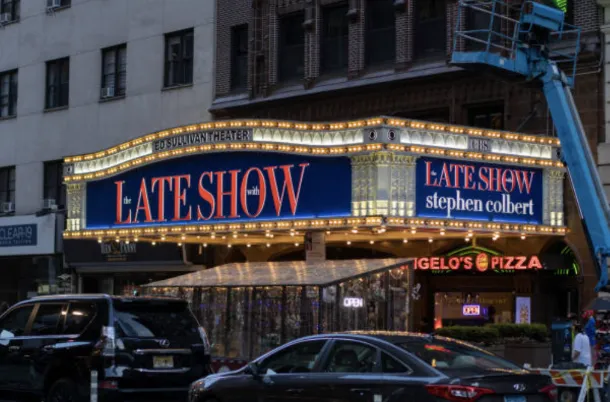
The perfect evening: relaxing on the couch after a long day at 11 PM, ready to watch late-night television before falling asleep. Tonight on the wheel of decision for what to watch are The Late Show with Stephen Colbert and Jimmy Kimmel Live. You reach for the remote to find their designated channel, only to discover that both shows are off the air. On July 17th, 2025, CBS announced the cancellation of The Late Show with Stephen Colbert, effective May 2026. Two months later, ABC briefly suspended Jimmy Kimmel for his comments following the death of Turning Point USA founder Charlie Kirk. Colbert and Kimmel broadcast criticism and jokes regarding President Donald J. Trump before the dissolution of their respective shows, calling out his influence beyond his constitutionally provided spaces and the extremist culture his administration exudes. Many, including Colbert, expressed skepticism about Kimmel’s abrupt departure from CBS after more than a decade, citing the possibility of retaliation by Trump for his outspoken disdain for the president and potential First Amendment violations. The Trump administration's relationship to current media programming appears unconstitutional to fellow journalists and media consumers. Still, its deliberate influence is sometimes difficult to prove without specific empirical evidence of direct correlations between Trump’s actions and the discontinuation or brief hiatus of a show. While the censorship enacted by media companies lacks sufficient legal merit due to privatization-driven freedoms, the Trump Administration’s overt coercion through the regulatory power of government agencies crosses a constitutional line, violating the First Amendment and increasing the country's susceptibility to litigation.
2026 marks the end of attending late-night government class with a side of political satire, from the comfort of one’s couch and pajamas. After 11 years, CBS announced the cancellation of The Late Show with Stephen Colbert[1]. The departure of the late-night television show followed Colbert's criticism of Paramount Global, CBS's parent company, which settled with the Trump Administration for $16 million after President Trump incited a lawsuit against CBS alleging the organization deceptively edited Kamala Harris’ 60 Minutes segment during the 2024 election. Colbert jokingly expressed on his show that the settlement included a statement to Trump, “you will never take our dignity; you may, however, purchase our dignity for the low, low price of $16 million”[2]. The criticism and faux statement from Paramount Global crafted by Colbert occurred during the merger plan for Paramount and Skydance Media, whose owner maintains a close relationship with President Donald Trump[3]. The merger also requires Federal Communications Commission (FCC) approval, which is controlled by a chairman designated by President Trump. CBS assured the public that the decision to part ways with Colbert remains strictly a financial one, but viewers and former Late Show guests disagree. Two months later, in September, Jimmy Kimmel faced suspension after comments regarding the shooter and the murder of Charlie Kirk. Only on September 15th, 2025, following the identity release of the man responsible for the assassination of Charlie Kirk, Kimmel shared his thoughts during his 11:35 pm screening time slot.
“We hit some new lows over the weekend with the MAGA gang desperately trying to characterize this kid who murdered Charlie Kirk as anything other than one of them, and doing everything they can to score political points from it”[4].
In response to Kimmel’s chiding of Trump and Kirk, ABC announced its decision to suspend Kimmel’s programming to ease the tense atmosphere during an “emotional moment for our country” [5]. A week later, Kimmel’s show returned to its place in the weekly rankings, but not without a statement on his first night back apologizing for his insensitive comments.
Kimmel is back on the air, but Colbert’s show awaits its impending end. Therefore, the question remains: Did removing Colbert and Kimmel from their respective channels violate the First Amendment? The First Amendment prevents Congress and the government from restricting the free exercise of speech or the press [6]. However, lawsuits and complaints wielding the First Amendment and the Bill of Rights as leverage are only viable in matters between the people and the government. After a union at a supermarket brought charges of unfair labor practices and First Amendment violation against the manager of a shopping center, following his stern request for the union picketers to cease their protesting in front of the stores, Hudgens v. NLRB decided the exercise of the First Amendment isn’t guaranteed if the expression of opinion occurs on private property [7]. This decision overturned Amalgamated Food Employees Union Local 590 v. Logan Valley Plaza, Inc. (1968), which previously prevented private groups from restricting free speech due to the First Amendment [8]. From a media perspective, most news outlets and broadcast companies are private entities. When operating as private parties, media companies and networks are allowed to control the content published and produced on their broadcast channels. Cementing this notion in a legal ruling, in Miami Herald Publishing Company v. Tornillo, Florida House of Representatives candidate Pat Tornillo sued Miami Herald Publishing Company for refusing to post his responses to two editorials posted by the company criticizing his campaign. Tornillo argued in the Dade County Circuit that under Florida Statute Section 104.38, political candidates criticized by a newspaper possess the right to request that the criticizing paper publish their rebuttal or response. The Supreme Court ruled in favor of the Miami Herald Publishing Company, holding that private media companies have full publishing and broadcasting discretion[9].
Per a correct interpretation of the First Amendment, to cite injury to one’s Amendment-given rights, the injurer would have to be the US government; therefore, in matters regarding Colbert and CBS, the First Amendment doesn’t apply. CBS is a public company, allowing citizens to purchase its shares on the stock market. However, CBS is not a public entity, as defined by the government[10]. CBS resides as a member of the private business sector, which filed with the FCC, a government agency, as a business corporation of New York[11]. Additionally, the company reported its financial and security operations with the Securities and Exchange Commission (SEC), all mandatory requirements for private sector corporations[12]. The Miami Herald Publishing Company v. Tornillo decision allowed CBS to legally decide to cancel a show, cut interviews, remove hosts, or reduce airtime on certain issues because, like Miami Herald Publishing Company, CBS's classification as a private corporation grants autonomy in what shows and segments premiere or leave the air. CBS and other private companies have no obligation to promote opposing viewpoints equally or at all. Therefore, CBS remains within its right to cancel Stephen Colbert’s Late Night Show.
Companies can face litigation if a third party, such as the government, imposes restrictions on the media. The government can attempt to influence private companies' decisions, but cannot coerce them to suppress opposing viewpoints. To cite the government as a third-party manipulator, one must determine a clear instance of the government threatening the speech of members or workers of the private company[13]. For example, the National Rifle Association(NRA) alleged that Maria. T. Vullo, head of the New York State Department of Financial Services, used her position to influence insurance companies to sever ties with the NRA following the Parkland shooting in 2018. Vullo argued that her conduct falls within her duty as a government official to criticize and persuade others, but the Supreme Court sided with the NRA because of Vullo’s powerful regulatory authority in return for prominent insurance companies. The likelihood of deliberately instructing companies to deviate from the NRA is plausible and therefore unconstitutional[14]. Trump's friendship, and therefore the government’s, ties to CBS and Paramount appear circumstantial, especially paired with CBS’s clear statement that the cancellation of Colbert’s show was financial, not political. CBS and Paramount created a joint statement that removing Colbert’s show from CBS programming was “purely a financial decision”, with the show accumulating 2.4 million viewers a night, which the company considered low, due to the uncontrollable decline in ad revenue, and most consumers shifting to streaming services[15]. With an abundance of empirical evidence to support an economic-based cancellation, it's hard to build a proper case of the government colluding with CBS and Paramount to cancel The Late Show with Stephen Colbert on political grounds.
Jimmy Kimmel, however, possesses grounds for a lawsuit. On September 17th, two days after Kimmel’s comments on the assassination of Charlie Kirk, the chairman of the FCC, Brendan Carr, participated in Benny Johnson’s podcast, issuing the following statement: “Look, we can do this the easy way or the hard way. These companies can find ways to change conduct, to take action on Kimmel or, you know, there's going to be additional work for the FCC ahead”[16]. The FCC can issue and revoke television and broadcasting documents, as provided by the Communications Act of 1934, requiring those who obtain a license to operate in consideration of the public's interests [17]. Heeding the warning and the FCC’s granted capabilities, later the same day, Nextstar, operator of numerous ABC-affiliated shows, announced its discontinuance of the Jimmy Kimmel show[18]. The evening of September 17th, ABC officially announced the indefinite suspension of the Jimmy Kimmel show. President Trump responded to the news of Kimmel’s suspension on Twitter, congratulating ABC on standing firm on their decision, calling for the termination of Jimmy Fallon and Seth Meyers next [19]. The sequence of events leading to the shelving of Kimmel's show could provide grounds for litigation. The tight timeline, public threats against ABC and Trump, his government coalition, and the absence of Jimmy Kimmel from weekend programming in September suggest that his removal from the air can be construed as direct retaliation by ABC on behalf of the government. President Trump isn’t the lone perpetrator of government coercion towards ABC. The FCC exists as a government agency. Brandon Carr’s public demand that ABC suppress Jimmy Kimmel and his views reflects deliberate government coercion and encouragement.
Colbert and Kimmel are both prominent white talk show and media personalities who have been penalized for mocking the government. Despite Kimmel and Colbert's dominating popularity, African American television hosts and journalists are abundant within this work sphere, yet their censorship goes underreported in their own line of work (the media). At the 68th Grammy Awards, hosted by CBS, Daily Show host Trevor Noah crafted jokes about President Trump amid the release of the Epstein files. Noah commented that President Trump “ needs a new [island] to hang out with Bill Clinton”, now that Epstein Island is no longer running[20]. While the crowd laughed, President Trump felt utterly disrespected, posting on Truth Social, threatening to contact his lawyers to sue Noah for “plenty of money”[21]. Although there has been no legal action on President Trump’s behalf, the public threat against a public commentator such as Trevor Noah indicates an increase in fear tactics by government figures to curtail their media appearances. Beyond his verbal speech, Trevor Noah has remained a victim of censorship, beginning with his book It’s Trevor Noah: Born a Crime: Stories from a South African Childhood. Noah’s book is an autobiography about his childhood in the post apartheid era of South Africa, an era marked by racial segregation, inequality, and poverty for Black Americans. Noah’s book currently faces a ban or challenge, due to the book's apparent anti-Catholic views[22]. Many critics see Noah’s book as pure indoctrination and his entire existence as a critique of South African laws, which prohibited interracial marriage and conceiving[23]. The attack on White and Black media anchors alike implies that this isn’t a racial issue, but rather a fundamental issue involving the protection of civil liberties or lack thereof by the Constitution.
Kimmel and Colbert play a primary role as comedians who relay important news in a satirical manner. Censorship doesn’t have a lane, attacking more than just the humorous attacks on our government and President, extending its breadth to explicitly restricting political conversations framed in a serious light. A 60-minute segment dedicated to El Salvador‘s CECOT prisons, used for immigrant deportation, was struck down by CBS News Editor-in-Chief Barry Weiss. CBS correspondent Sharon Alfonsi conducted interviews with deportees, which, when included in the documentary, already gained approval from CBS lawyers and the 60 Minutes division[24]. Weiss pulled the show following the Trump Administration’s reluctance to participate in interviews regarding their deportation tactics; the segment lacked information on the administration’s vision for the future of immigration. Alfsoni commented that canceling the broadcast “after every rigorous internal check has been met is not an editorial decision, it is a political one”, granting the Trump Administration a “kill switch” to spike any reporting on their actions[25]. The open admittance of stalling the 60-minute premiere due to the Trump Administration signals clear government influence to suppress information and a negative viewpoint. Weiss’ deliberate dismissal of the 60 Minutes documentary could set a precedent for future media censorship by the Trump Administration.
Visual media, such as news broadcasts and social media, are the main source of news for 54% of consumers[26]. Censorship alters public perception by portraying a polarized version of events while curtailing individuals’ access to information. Deliberate media censorship by the federal government violates the First Amendment, limiting the viability of public forums and platforms for free expression and speech. Regulating speech regarding today’s most prevalent topics appears strategic to curtail any thinking that competes with the actions of the government; the craftiness to disguise the monitoring with alternate reasons, such as budget cuts, displayed forethought in the censorship to ensure it cannot be traced back to First Amendment violations and, consequently, litigation. Without grounds for wrongdoing, you sit on the couch disappointed that Kimmel and Colbert are canceled, and turn to a new show, but now with the long-standing fear that your new show may be next.
Endnotes
[1] Mandalit del Barco, “CBS Will End ‘The Late Show with Stephen Colbert’ Next Year,” National Public Radio, July 18, 2025.
[2] Democracy Now! “Big Fat Bribe: Stephen Colbert’s Show Canceled After He Slams Trump & Paramount/Skydance Merger,” YouTube, 2025.
[3] Benjamin Mullin, Michael M. Grynbaum, Lauren Hirsch, and David Enrich. “Paramount to Pay Trump $16 Million to Settle ‘60 Minutes’ Lawsuit,” The New York Times, July 2, 2025.
[4] Kailyn Rhone, “What to Know About the Suspension, and the Return, of Jimmy Kimmel’s Show,” The New York Times, September 25, 2025.
[5] Rhone, “What to Know About the Suspension, and the Return, of Jimmy Kimmel’s Show.”
[6] “U.S. Constitution–First Amendment,” Constitution Annotated, Library of Congress.
[7] Hudgens v. NLRB, 424 U.S. 507 (1976).
[8] Food Employees v. Logan Valley Plaza, Inc., 391 U.S. 308 (1968).
[9] Miami Herald Publishing Co v. Tornillo, 418 U.S. 241 (1974).
[10] “Definition: Public Entity from 42 USC § 12131(1),” Legal Information Institute, Cornell Law School.
[11] Paramount Global, "Annual Report on Form 10-K," U.S. Securities and Exchange Commission, 2011.
[12] "Paramount Global, "Annual Report on Form 10-K."
[13] “Coercive Government Speech,” Constitution Annotated, Library of Congress.
[14] National Rifle Association of America v. Vullo, 602 U.S. 175 (2024).
[15] Stephanie Sy and Jackson Hudgins, “CBS Says Colbert Cancellation Was Financial Decision, but Timing Raises Questions” PBS NewsHour, Jul 18, 2025.
[16] David Folkenflik, “FCC Chair Brendan Carr Leads Trump’s Charge Against the Media,” National Public Radio, September 19, 2025.
[17] Brian A. Rankin,“Freedom, Broadcasting, and the Public Interest,” Competitive Enterprise Institute, November 5, 2026.
[18] “Nexstar ABC Affiliates To Preempt ‘Jimmy Kimmel Live!’ Indefinitely Beginning Tonight,” Nexstar Media Group, Inc., September 17, 2025.
[19] “Donald Trump: Social Media Archive” Roll Call, September 17, 2025.
[20] Logan Schiciano and Isabelle D’Antonio, “Trevor Noah Draws Trump’s Ire after Grammys Epstein Joke,” CNN Politics, February 2, 2026.
[21] Logan Schiciano and Isabelle D’Antonio, “Trevor Noah Draws Trump’s Ire after Grammys Epstein Joke,” CNN Politics, February 2, 2026.
[22] “Banned Book List,” Colorado Department of Higher Education.
[23] Chase Ollis, “Born A Crime,” Unite Against Book Bans, April 5, 2024.
[24] David Bauder, “60 Minutes’ Pulls Story about Trump Deportations from Its Lineup,” Associated Press, December 22, 2025.
[25] Michael Savage, “Social Media Overtakes TV as Main Source of News in US, Analysis Finds”, The Guardian, June 17, 2025.
Works Cited
"60 Minutes' Pulls Story about Trump Deportations from Its Lineup." Associated Press, December 22, 2025. https://apnews.com/article/60-minutes-trump-weiss-cecot-56c68d45c3d6bc7183f23aa285a70719.
"Banned Book List." Colorado Department of Higher Education. https://cdhe.colorado.gov/banned-book-list.
"Coercive Government Speech." Constitution Annotated. Library of Congress. https://constitution.congress.gov/browse/essay/amdt1-7-8-3/ALDE_00000094/.
del Barco, Mandalit. "CBS Will End 'The Late Show with Stephen Colbert' Next Year." National Public Radio, July 18, 2025. https://www.npr.org/2025/07/17/nx-s1-5471581/cbs-stephen-colbert-late-show.
Democracy Now! "'Big Fat Bribe': Stephen Colbert's Show Canceled After He Slams Trump & Paramount/Skydance Merger." YouTube, July 23, 2025. https://www.youtube.com/watch?v=RfRF7Rak2cw.
"Definition: Public Entity from 42 USC § 12131(1)." Legal Information Institute. Cornell Law School. https://www.law.cornell.edu/definitions/uscode.php.
Roll Call. "Donald Trump: Social Media Archive" Roll Call. https://rollcall.com/factbase-twitter/.
Food Employees v. Logan Valley Plaza, Inc., 391 U.S. 308 (1968).
Folkenflik, David. "FCC Chair Brendan Carr Leads Trump's Charge Against the Media." National Public Radio, September 19, 2025. https://www.npr.org/2025/09/19/nx-s1-5546764/fcc-brendan-carr-kimmel-trump-free-speech.
Hudgens v. NLRB, 424 U.S. 507 (1976).
Miami Herald Publishing Co. v. Tornillo, 418 U.S. 241 (1974).
Mullin, Benjamin, Michael M. Grynbaum, Lauren Hirsch, and David Enrich. "Paramount to Pay Trump $16 Million to Settle '60 Minutes' Lawsuit." The New York Times, July 2, 2025. https://www.nytimes.com/2025/07/02/business/media/paramount-trump-60-minutes-lawsuit.html
National Rifle Association of America v. Vullo, 602 U.S. 175 (2024).
Nexstar Media Group. "Nexstar ABC Affiliates to Preempt 'Jimmy Kimmel Live!' Indefinitely Beginning Tonight." September 17, 2025. https://www.nexstar.tv/nexstar-abc-affiliates-to-preempt-jimmy-kimmel-live-indefinitely-beginning-tonight/.
Ollis, Chase. "Born a Crime." Unite Against Book Bans, April 5, 2024. https://bookresumes.uniteagainstbookbans.org/born-a-crime/.
Paramount Global. "Annual Report on Form 10-K." U.S. Securities and Exchange Commission, 2011. https://ir.paramount.com/node/68701/html.
Rankin, Brian A."Freedom, Broadcasting, and the Public Interest." Competitive Enterprise Institute. November 5, 2026. https://cei.org/studies/freedom-broadcasting-and-the-public-interest/.
Rhone, Kailyn. "What to Know About the Suspension, and the Return, of Jimmy Kimmel’s Show." The New York Times, September 20, 2025. https://www.nytimes.com/2025/09/20/business/jimmy-kimmel-show-abc-kirk-fcc.html.
Savage, Michael. "Social Media Overtakes TV as Main Source of News in US, Analysis Finds." The Guardian, June 17, 2025. https://www.theguardian.com/media/2025/jun/17/social-media-overtakes-tv-as-main-source-of-news-in-us-analysis-finds.
Schiciano, Logan, and Isabelle D'Antonio. "Trevor Noah Draws Trump's Ire after Grammys Epstein Joke." CNN Politics, February 2, 2026. https://www.cnn.com/2026/02/02/politics/trevor-noah-trump-grammys-epstein.
"Securities and Exchange Commission–Viacom." U.S. Securities and Exchange Commission. https://www.sec.gov/Archives/edgar/data/813828/000104746911001419/a2202111z10-k.htm.
Sy, Stephanie, and Jackson Hudgins. "CBS Says Colbert Cancellation Was Financial Decision, but Timing Raises Questions." PBS NewsHour, July 18, 2025. https://www.pbs.org/newshour/show/cbs-says-colbert-cancelation-was-financial-decision-but-timing-raises-questions.
"U.S. Constitution–First Amendment." Constitution Annotated. Congress.gov, Library of Congress. https://constitution.congress.gov/constitution/amendment-1/.