The Trump Administration’s Attempt to Create Uniformity of Thought
Written by: Arianna Anderson
Edited by: Michelle Henaku and Jessica Nwosu
Abstract:
This piece explores the effects of the Trump administration's use of federal school funding to control the public agenda by discouraging free speech and protests. Here, there is an argument for the necessity of discourse and tension within the United States to create change. From the pressure the Trump Administration has put on academic institutions to control student protest, free speech, and academic freedom to the policy he has enacted to protect uniformity of thought, the administration’s impact has roles and implications stretching much farther than the umbrella of American academia. Its outreach contaminates the roots of democracy that this country has spent so many years cultivating.
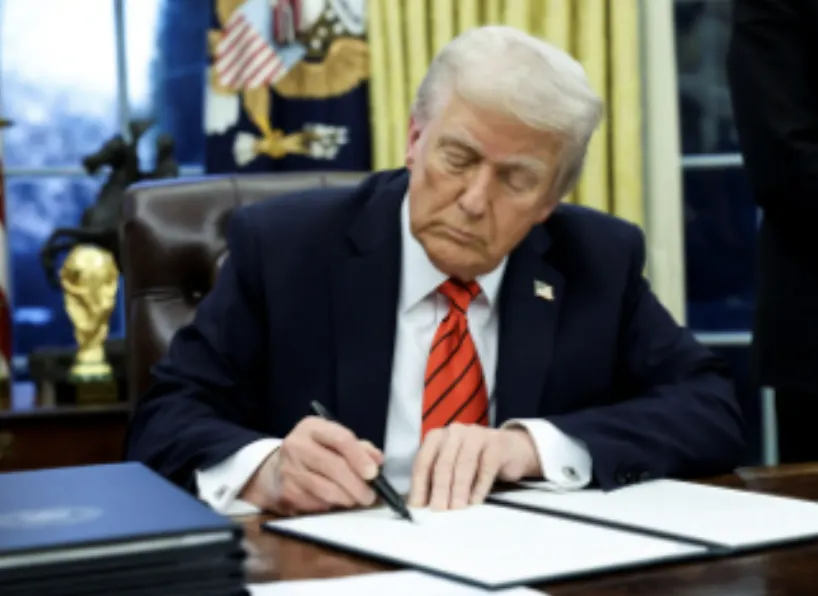
Protests serve as a mechanism through which the people can hold the government accountable. This, along with free speech, calls attention to dissenting opinions and widens the lens through which voters and politicians assess policy. Through the cultivation of free speech and protest in American society, the government seeks to preserve one of the most significant catalysts of American freedom and democracy.
However, the current Trump Administration has attempted to suppress dissenting opinions by revoking federal funds from several universities through misuse of the Title VI Civil Rights Act. On March 7th, 2025, the Trump Administration ordered the cancellation of $400 million worth of federal grants and contracts for Columbia University. [1] Since then, the administration has taken similar steps for a slew of other prestigious universities, including Harvard University, the University of Pennsylvania, and Duke University. Many students, after closely following the war between Palestine and Israel, held protests for the people of Palestine and against the US’s support of Israel. The administration argues that these universities created a hostile environment for Jewish students, therefore violating the requirements under Title VI Civil Rights Act to receive federal funding. The Title VI Civil Rights Act prohibits discrimination based on race, color, and national origin in programs that receive federal funding. However, safeguards are in place to prevent the potential weaponization of this Act. Title VI mandates that before cutting federal funding, a federal agency must conduct a thorough investigation, draw conclusions, and offer conditions for the institution to comply with. It also specifies that funding cuts must be tailored to the programs that do not comply. [2] The Trump administration did not follow this process. They enforced cuts to Columbia University grants before the inquiry process began, cut funding to unrelated research efforts, and neglected to use a standard of objectivity and subjectivity that is often cited as proof of discrimination when conducting their investigation. [3]
Students protested through marches, fliers, and encampments throughout the country. The vast majority of these protests were strictly peaceful and did not result in injury until police intervention. [4] Protests that are simply uncomfortable and do not cause harm cannot be the reason for a federal agency to punish freedom of speech. There must be a case of blatant discrimination. For example, in the case of Snyder v. Phelps, a Baptist church picketed outside of a military funeral carrying offensive signs. They were then sued on the premise that these signs caused the plaintiff emotional distress. On March 7th, 2011, the majority sided with the defendant. Chief Justice Roberts writes that, “On the facts before us, we cannot react to that pain by punishing the speaker. As a Nation, we have chosen a different course—to protect even hurtful speech on public issues to ensure that we do not stifle public debate.” [5] Public debate remains a large cornerstone of American democracy. It enables citizens to engage in agenda-setting and broaden the forum to encompass diverse opinions and perspectives. Diversity is sometimes discomforting, but it is also enlightening. For diversity to enrich communities, decision-makers must allow diversity to flourish through discourse and a healthy appreciation for a marketplace of ideas.
Cutting this funding increased the Trump Administration’s authority to impose policies discouraging discourse, suppressing academic freedom, and forcing forms of surveillance within academic institutions. For example, one policy that Columbia University’s administration has enacted is that the University will create “training materials to socialize all students to campus norms and values more broadly.” [6] This policy aims to create uniformity in a space whose purpose is to celebrate and unify diverse opinions, cultures, and norms. Colleges should serve as a smaller forum of discourse and debate within a larger democracy. “Numerous studies support a connection between civil discourse and the development of civic knowledge, skills, and dispositions, all fundamental components of a democratic society.” [7]
Healthy discourse is essential to foster an effective educational environment, and the Constitution also protects it. A fear of disturbance to the “social norms and values” of a university is not enough to diminish discourse. In the West Virginia State Board of Education v. Barnette case, a public school in Virginia expelled students who refused to salute the American flag during the Pledge of Allegiance. On June 19th, 1943, Judge Robert Houghwout Jackson states in the majority opinion that, “If there is any fixed star in our constitutional constellation, it is that no official, high or petty, can prescribe what shall be orthodox in politics, nationalism, religion, or other matters of opinion.” [8] Though the collegiate institutions attacked are not public schools, the same precedent still stands: no single authority of government can force uniformity of opinion.
The Trump Administration’s attempt to suppress dissent by enforcing uniformity has not been limited to institutions of higher education. In his “Plan to Save American Education,” he states that he will “cut federal funding for any school or program pushing Critical Race Theory, gender ideology, or other inappropriate racial, sexual, or political content on our children.” [9] Effectively, this program can erase or suppress the past and present injustices throughout American history, essentially erasing the agency and dissent that led to positive progression in American education and overall quality of life. The Plan to Save American Education is another clear display of the administration leveraging funds to promote a “gold standard” of thought centered around traditional patriotic ideas. The government dishonors courageous actors over the last 500 years who have fought for freedom and the recognition of their respective groups. Barring institutions from teaching about the contested and rich histories within the United States discredits these brave people.
In the case of Tinker v. Des Moines (1969), students were suspended for wearing black armbands protesting the Vietnam War. In the concurring opinion, Chief Justice Fortas stated that, “Any word spoken, in class, in the lunchroom, or on the campus, that deviates from the views of another person may start an argument or cause a disturbance. But our Constitution says we must take this risk.”[10] Such a risk protects civil liberties and the democratic values that the United States claims to have at its bedrock. Non-business-as-usual resistance in American school systems strengthens democratic values and builds tolerance for opposing opinions. Young minds start to develop their own ideas, influenced not only by their parents’ views but also by their peers, education, and the interactions that come with open encouragement of ideas, both popular and unpopular. This allows them to grow into adults who challenge the status quo and present ideas outside of the conventions of societal norms.
“Public opinion sets bounds to every government, and is the real sovereign in every free one.” - James Madison, also known as the Father of the Constitution. [11]
The Trump Administration’s actions described throughout the article are attempts to “set bounds” to the crux of public opinion and discourse, which starts in the classroom. Justice Douglas wrote, “Accordingly, a function of free speech under our system of government is to invite dispute. It may indeed best serve its high purpose when it induces a condition of unrest, creates dissatisfaction with conditions as they are, or even stirs people to anger.” [12] Free speech that creates good trouble and unrest, solidifies the public’s dissatisfaction with conditions as they are’ allows people to change the status quo in the government. This same dissatisfaction shows itself in the form of protests that amplify the voices of those who are unhappy with the governmental action. By these means, the people control the bounds of government and play a role in agenda setting. This is why it is vital to recognize that seemingly isolated policy and executive action can have deep-seated intentions and effects. If people do not commit to retaliating against means of control then the inevitable future of constant democratic backsliding becomes authoritarianism.
Works Cited
[1] U.S. Department of Education. “DOJ, HHS, ED, and GSA Announce Initial Cancelation of Grants and Contracts to Columbia University Worth $400 Million,” March 7, 2025. https://www.ed.gov/about/news/press-release/doj-hhs-ed-and-gsa-announce-initial-cancelation-of-grants-and-contracts-columbia-university-worth-400-million
[2] U.S. Department of Justice. 2025. “Title vi of the Civil Rights Act of 1964.” Justice.gov. March 24, 2025. https://www.justice.gov/crt/fcs/TitleVI.
[3] Alex Kane, “Trump’s Illegal Cuts to University Funding, Explained,” Jewish Currents, 2025, https://jewishcurrents.org/trump-cuts-university-funding-harvard-antisemitism-explainer.
[4] Lois Beckett, “Nearly All Gaza Campus Protests in the US Have Been Peaceful, Study Finds,” The Guardian, May 10, 2024, sec. US news, https://www.theguardian.com/us-news/article/2024/may/10/peaceful-pro palestinian-campus-protests.
[5] “Snyder v. Phelps, 562 U.S. 443 (2011),” Justia Law, 2011, https://supreme.justia.com/cases/federal/us/562/443/.
[6] Pickering, Emily. 2025. “‘There’s a Lot of Fear’: Faculty React to Columbia’s $200 Million Settlement with Trump Administration.” Columbia Daily Spectator. The Spectator. July 26, 2025. https://www.columbiaspectator.com/news/2025/07/26/theres-a-lot-of-fear-faculty-react-to-columbias-200-million-settlement-with-trump-administration/.
[7] Sara Whipple, Valentina Dimitrova-Grajz;, and Kim Connolly, “‘All the World Is a (Debate) Stage’: College Debates as a Form of Civic Engagement,” EJournal of Public Affairs, October 28, 2025, https://doi.org/10.21768/ejopa.20251028.01.
[8] Justia. “West Virginia State Bd. Of Educ. V. Barnette, 319 U.S. 624 (1943).” Justia Law, 2019. https://supreme.justia.com/cases/federal/us/319/624/.
[9] Carpenter, Amanda, Erica Newland, Genevieve Nadeau, Aisha Woodward, Deana El-Mallawany, and Justin Florence. “The Authoritarian Playbook for 2025.” The Authoritarian Playbook for 2025, 2025. https://www.authoritarianplaybook2025.org/what-we-can-expect-1#directing-investigations.
[10] Justia. “Tinker v. Des Moines Independent Community School District, 393 U.S. 503 (1969).” Justia Law, 2019. https://supreme.justia.com/cases/federal/us/393/503/.
[11] Madison, James . “Founders Online: For the National Gazette, [Ca. 19 December] 1791.” founders.archives.gov, n.d. https://founders.archives.gov/documents/Madison/01-14-02-0145.
[12] Justia Law. “Terminiello v. Chicago, 337 U.S. 1 (1949),” n.d. https://supreme.justia.com/cases/federal/us/337/1/.