The Use of the Supreme Court’s Shadow Docket to Quietly Reshape America’s Immigration Seizures and Due-Process Procedures
Written by: Natasha Kalombo
Edited by: Brett Fisher and Emma Farley
Abstract:
This article explores how the Supreme Court’s use of the shadow docket in Noem v. Vasquez Perdomo allowed for the unjustified decision to allow immigration officers in the United States to search and seize an individual, based solely on i) presence at particular location such as bus stops, car washes, day laborer pickup sites, agricultural sites, etc; ii) the type of work one does; iii) speaking Spanish or English with an accent; and/or iv) apparent race or ethnicity. This piece seeks to show how the explanations given in the concurring opinion by Justice Brett Kavanaugh are not based on practical legal foundations, but rather on racist and xenophobic ideology that affirms immigration officers’ use of racial profiling when searching or seizing an individual. This ruling highlights the ways in which the shadow docket permits a lack of proper explanation and accountability within the Supreme Court. This article also explains the effect that the Noem v. Vasquez Perdomo ruling and its infringement on Fourth and Fifth Amendment rights have had and will have on individuals in immigration cases moving forward.
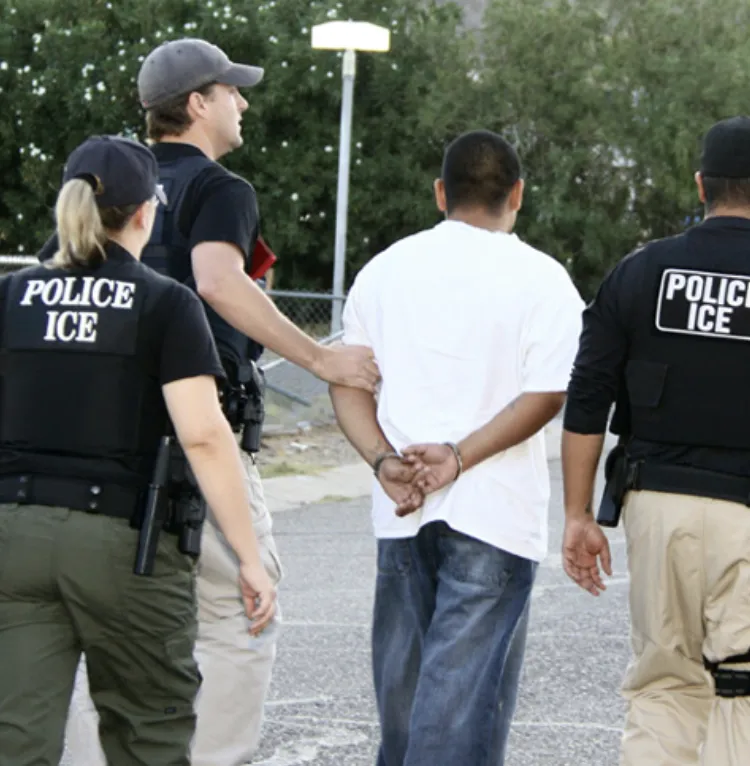
In early June of 2025, the United States Government launched an immigration control mission called “Operation at Large.” It was a concentrated effort in Los Angeles, California, in accordance with President Donald Trump’s plan to conduct “the largest deportation operation in the history of our country” [1]. Unmasked and armed immigration agents fled the streets, local businesses, and community areas of Los Angeles, including car washes, Home Depots, tow yards, bus stops, recycling centers, churches, and parks. During this mission, there were over 2,800 immigration-related arrests and thousands detained [2]. As a result, a group of plaintiffs targeted by immigration officers filed a lawsuit in the 9th Circuit Court - the largest federal Court of Appeals, which hears cases from all over the western United States and whose decisions can be appealed to the United States Supreme Court. [3] They claimed that the immigration officer’s stops were unlawful and that they were based solely on four factors: “i) presence at particular location such as bus stops, car washes, day laborer pickup sites, agricultural sites, and the like, ii) the type of work one does, iii) speaking Spanish or speaking English with an accent, and/or iv) apparent race or ethnicity” [2]. The plaintiffs argued that the seizures under these four conditions alone violated their rights under the Fourth and Fifth Amendments. These amendments guarantee protection against unreasonable searches and seizures as well as a guarantee of due process. The 9th Circuit Court ruled in favor of the plaintiffs and ordered the injunction (a judicial order that restrains a person from continuing an action that threatens the legal right of another) of these seizures, on the basis that they “relied on generalizations” and did indeed violate their rights under these Amendments [2]. The Government then refuted this, and it was brought to the Supreme Court, where it was placed on the shadow docket, an emergency docket of the Court where decisions are made with limited or no explanation required.
In its final decision, the Supreme Court ruled in favor of the Government. It held that it was neither unconstitutional nor a violation of these amendments for officers to stop individuals based solely on these four factors. Because the decision was made on the shadow docket, it is unknown whether five or six justices supported it. Still, it is known that Justice Elena Kagan and Justice Ketanji Brown Jackson joined Justice Sonia Sotomayor in dissent [5]. The concurring opinion, written by Justice Brett Kavanaugh, claimed that because there is a high level of “illegal aliens” in Los Angeles, about 10%, the searches and seizures were justified because there is a high probability that the individuals stopped would be illegally residing in the U.S. [2]. The concurrence also claimed that there was justification for the agents to target specific locations during their searches (reason i), because oftentimes in workplaces like construction, landscaping, agriculture, or car washes, employers don’t require citizenship verification paperwork and usually don’t speak English [2]. Justice Kavanaugh stated that seizures have been an “important component of U.S. immigration enforcement for decades” and that an injunction would “halt or chill lawful immigration efforts” [2]. Another justification for this majority ruling was that the plaintiffs’ case lacked appropriate Article III standing, meaning the courts found they were “absent a sufficient likelihood.” This makes the case dismissible because the majority does not believe there is sufficient evidence to suggest that such extreme searches and seizures will occur again. Justice Kavanaugh expounds on this by saying that the plaintiffs don’t have “good basis to believe that law enforcement will unlawfully stop them in the future based on the prohibited factors - and certainly no good basis for believing that any stop of the plaintiffs if imminent.” [2] Finally, the concurring opinion ends by stating that all of these factors, “when taken together,” are probable cause for a search or seizure. It claims that the stops conducted by these officers are usually brief and that, once papers are shown, the individual in question can go free without an issue. The opinion claims that any use of force is not to be taken into consideration because “the Fourth Amendment’s reasonableness standard continues to govern the officers’ use of force and to prohibit excessive force.” [2]
The legal and moral logic within the concurring opinion that was used to justify this ruling is inherently flawed and openly affirms overt racial profiling within immigration seizures and searches. It lacks factual legal backing because, according to multiple records from plaintiffs and other individuals living in the Los Angeles community, there is a very rational fear of this type of extreme seizure occurring again (granting them Article III standing). The implications of allowing for searches and seizures to occur on the sole basis of the four conditions (previously mentioned) encourage the unlawful subjection of individuals, documented or not, without due process. In her dissenting opinion, Justice Sotomayor states that “The Government submitted no evidence suggesting that its seizures to date were based on anything other than those four factors” [2]. The problem with this is that if seizures are conducted on these four factors alone, it would essentially mean that if someone is Brown or Black, has an accent, happens to be at a bus stop where there is a large population of immigrants, and/or works a particular job, like the ones mentioned above by Justice Kavanaugh, that they are subjected to be searched or seized by immigration officers with no reasonable evidence.
In Justice Kavanaugh’s opinion, he states that the procedures aren’t violent and that if one is carrying their papers on their person, identifying themselves as documented, they are released without an issue. He even goes so far as to claim insufficient Article III standing against the plaintiffs, stating that there isn’t reasonable evidence that it will even happen again. But from multiple accounts from the plaintiffs, individuals who have had firsthand experience with officers on the ground, we know this isn’t true. This isn’t true for plaintiff Jason Gavidia, a man at a tow yard approached by agents with hand guns and rifles, asked multiple times if he was American and which hospital he was born at, to be then pinned against a gate because the agents didn’t like his delayed response. They then only let him go once he showed his REAL ID, which he never received back, subjecting him to further arrests in the future on the basis that he has no documentation [2]. This isn’t true for plaintiff Jorge Viarmontes, a car wash owner in Whitter, whose shop was raided more than four times within nine days, and who, after being questioned and not believed about his citizenship status and California driver's license, was taken off to a “warehouse area” and forced to make phone calls to verify his identity [2]. This also isn’t true for Pedro Vasquez Perdomo, Carlos Alexander Osorto, and Isaac Antonio Villegas Molina, who were sitting having coffee before work when they were raided by dozens of unannounced and masked immigration agents at Home Depot in Glendale [2].
The plaintiffs submitted 21 declarations describing dozens of seizures and even statements from government officials. Even Deputy Chief of Staff, Stephen Miller, was among them, saying, “just go out there and arrest illegal aliens” [2]. The plaintiff’s stories and the language used are proof that these interactions are not civil or peaceful, where the accused individual simply shows their valid papers, is believed, and then is allowed to go on their way. The reality is much more sinister: that the continued justification of these unreasonable and unconstitutional seizures and due process violations is perpetuating the cycle of violence and stereotyping against immigrants in the United States. It is precedent that officers may stop an individual “only if they are aware of the specific articulable facts, together with rational inferences from those facts, that reasonably warrant suspicion” that the individual “may be illegally in the country” [2]. This precedent for officers would assume that a reasonable seizure would need to be based on more than a stereotype, but the Noem v. Vasquez Perdomo majority ruling inherently contradicts that.
Another significant precedent that this ruling fundamentally contradicts is that of United States v. Brignoni-Ponce (1975). In this case, a man named Felix Humberto Brignoni-Ponce was stopped by border patrol agents while driving his car. During his questioning, it was concluded that there were two undocumented immigrants in the vehicle, and Brignoni-Ponce was charged with two counts of knowingly transporting illegal immigrants [5]. In this case, it was argued by the Government that they were allowed to “stop drivers of alleged Mexican ancestry in border areas because most undocumented immigrants in those areas are Mexican and most ‘leave the border area in private vehicles’” [2]. In a unanimous opinion, the Supreme Court ruled that because there was no probable cause for this search, Brignoni-Ponce should not have been charged. The Court used the basis that if the charge were allowed, “it would cover a large volume of legitimate traffic as well” [2]. The Court rightfully recognized that this would mean subjecting a vast number of innocent people to unreasonable searches without probable cause, which is inherently unconstitutional. This basis should have been the precedent used to guide the ruling in Noem v. Vasquez Perdomo, a case similarly dealing with a question of unreasonable search and improbable cause. The logic is identical: allowing for an incredibly vast cause for reasonable suspicion (such as an individual’s type of car, their skin color, or their occupation) inherently subjugates numerous rightfully innocent people to a harsh and punitive system with a history of violence. It sets a perilous precedent and allows agents to act on an individual solely based on preconceived perceptions and biases, with no requirement to use facts or evidence.
The ripple effects of this ruling have already been felt in cities across the United States. On October 14, 2025, the County of Los Angeles voted to declare a state of emergency for the city in lieu of the incredible upsurge in violence and unjust procedures from immigration officers [6]. This was also seen in Woodburn City, OR [7]; Washington County, OR [8]; Shelby County, TN [9]; and numerous other counties and cities across the nation, which all declared states of emergency in response to the unlawful federal immigration practices and arrests. The Supreme Court’s outward affirmation of these practices encourages this behavior to continue. It jeopardizes the safety and well-being of immigrants, not only in Los Angeles but all over the country.
One very key thing to note in this case is its use of the shadow docket. The case is extremely high-profile because it fundamentally shifts the immigration seizure dynamics across the entire country by validating the absence of factual probable cause —the legal standard that law enforcement must meet before conducting a search or making an arrest. While it is a pertinent case, it was put on the emergency case shadow docket, which doesn’t require a full explanation or justification for the ruling. The shadow docket has a history of being used in very controversial cases, such as this, to allow sweeping decisions to be made without accountability. It has been used to allow for racial gerrymandering when a lower court found it in violation, to approve state-level abortion bans, and even in death penalty cases. These decisions often have an intense and immediate impact on individuals (i.e., one injunction causing thousands of federal employees to be fired or individuals to be deported), and they frequently lack transparency within their rulings.
In this Noem v. Vasquez Perdomo, a concurring and dissenting opinion was written. Still, the concurring opinion undoubtedly contained multiple fallacies and did not use appropriate legal backing to reach its conclusion - something the shadow docket permits. A case of this magnitude being placed on a shadow docket also sets an uncanny precedent for future cases of this manner. It allows cases such as this to be swept under the rug and for decisions to be made without full accountability and transparency to the public. The shadow docket inherently contains an accountability issue because, in its cases, it doesn’t require a record of which justices voted in which way. As civil servants, Supreme Court Justices have a duty to inform the public about their decisions and the logic behind them. Cases such as this should require that a record be taken of which justices voted yea and nay, to hold them accountable. As of now, we have no record of whether five or six justices voted in favor of this ruling.
To mitigate the negative effects of this decision, it is imperative that changes be made to the system and that the ruling be re-evaluated. The risk of due process violations occurring under this ruling is extremely high; therefore, it is recommended that a policy be enacted to check this overreach of immigration officers’ authority. A third party within immigration courts to check the constitutionality of the search and seizure of a particular individual entering the immigration court could help ensure that the rights of these individuals were/are not violated as they go through the process. On a more fundamental level, action must be taken to address the evasion of accountability by Justices within the shadow docket. This could be done through requiring that every vote of the Justices is publicly recorded and that both concurring and dissenting opinions are written (even if they are shorter than a typical opinion). This would ensure that the Justices are held responsible for their decisions and that a full explanation of the legal reasoning behind the ruling is provided. When pertaining to federal and highly impactful legal rulings, a strong legal foundation must be required of the Justices.
The effects of Noem v. Vasquez Perdomo, as they have already demonstrated, will leave lasting marks on this country's immigration system for a very long time. The Supreme Court has COLUMBIA BLACK PRE-LAW JOURNAL set an incredibly dangerous precedent by stating that immigration officers can now seize someone based on where they are located, the job they work, their language or accent, and even the color of their skin. These notions, while contradicting basic morality and human dignity, fundamentally contradict the constitution and previous precedents of the Supreme Court - both of which are the Court’s duty to uphold. It remains to be seen what the true magnitude of this ruling will be for immigrants, documented or not. Even still, it is vital that in future decisions on cases of unreasonable searches, due process, and probable cause, the Court return to the foundations of the United States v. Brignoni-Ponce ruling: that once you allow the subjugation of one group to harm in this way, you allow it for a multitude of others who are innocent.
[1] Inskeep, Steve, and Christopher Thomas. “Trump promised the 'largest deportation' in US history. Here's how he might start.” 2024.
[2] Vasquez Perdomo, et al. v. Noem, et al., no. 25-4312 (9th Cir. 2025)
[3] “9th Circuit Court of Appeals” 2025.
[4] Chacón, Jennifer. “Whose Common Sense? Some Reflections on Noem v. Vazquez Perdomo | Stanford Law School.” 2025.
[5] United States v. Brignoni-Ponce, 422 U.S. 873 (1975)
[6] Wolfe, Jonathan. “L.A. County Declares State of Emergency Over Immigration Raids.” 2025.
[7] Lugo, Dianne. “Woodburn declares state of emergency in wake of ICE enforcement.” 2025.
[8] “Washington County Declares State of Emergency in Response to Federal Actions.” 2025.
[9] Wadhwani, Anita, and Cassandra Stephenson. “Shelby County Mayor declares state of emergency in response to Memphis Safe Task Force arrests • Tennessee Lookout.” 2025.
Works Cited
Chacón, Jennifer. 2025. “Whose Common Sense? Some Reflections on Noem v. Vazquez Perdomo | Stanford Law School.” Stanford Law School. https://law.stanford.edu/2025/09/24/whose-common-sense-some reflections-on-noem-v-vazquez-perdomo/.
Inskeep, Steve, and Christopher Thomas. 2024. “Trump promised the 'largest deportation' in US history. Here's how he might start.” OPB. https://www.opb.org/article/2024/11/15/trump-mass-deportation-immigration-border/.
Lugo, Dianne. 2025. “Woodburn declares state of emergency in wake of ICE enforcement.” Statesman Journal.
https://www.statesmanjournal.com/story/news/local/2025/11/21/woodburn-oregon-state-of-emergency-immigration-enforcement/87402923007/.
“9th Circuit Court of Appeals – FederalCourt.Press.” n.d. FederalCourt.Press – Federal Court Legal Printer. Accessed November 24, 2025. https://federalcourt.press/federal-circuits/9th-circuit.
Wadhwani, Anita, and Cassandra Stephenson. 2025. “Shelby County Mayor declares state of emergency in response to Memphis Safe Task Force arrests • Tennessee Lookout.” Tennessee Lookout. https://tennesseelookout.com/2025/10/16/shelby-county-mayor-declares-state-of-emergency-in-response-to-memphis-safe-task-force-arrests/.
“Washington County Declares State of Emergency in Response to Federal Actions.” 2025. Washington County, OR.https://www.washingtoncountyor.gov/bcc/news/2025/11/04/washington-county-declares-state-emergency-response-federal-actions.
Wolfe, Jonathan. 2025. “L.A. County Declares State of Emergency Over Immigration Raids.” The New York Times.https://www.nytimes.com/2025/10/15/world/americas/los-angeles-emergency-immigration-raids.html.